« 美国战后社会:冷战与富裕社会 » : différence entre les versions
Aucun résumé des modifications |
(→杜鲁门主义) |
||
| Ligne 52 : | Ligne 52 : | ||
== 杜鲁门主义 == | == 杜鲁门主义 == | ||
哈里-杜鲁门总统于 1947 年 3 月 12 日宣布的杜鲁门主义标志着美国外交政策的一个重要转折点。该理论规定,美国将向所有受到共产主义或极权主义威胁的国家提供政治、军事和经济支持。其目的有两个:遏制共产主义的蔓延,促进民主和资本主义。杜鲁门主义是针对苏联的崛起而制定的,苏联已将其影响力扩展到东欧,并被视为对西方民主和资本主义理想的直接威胁。因此,杜鲁门主义代表了对苏联扩张的坚定回应,发出了美国准备在全球范围内积极捍卫和促进其利益和价值观的明确信号。这一理论标志着美国与以往孤立主义外交政策的重大决裂。它为美国卷入冷战奠定了基础,表明美国准备进行干预,包括军事干预,以遏制苏联的影响,维护其在世界舞台上的主导地位。杜鲁门主义因此成为美国几十年来外交政策中遏制战略的核心要素。 | |||
杜鲁门主义和乔治-肯南的遏制政策在冷战背景下紧密相连,相辅相成。作为外交官和苏联事务专家,乔治-凯南在制定遏制政策方面发挥了至关重要的作用。在其著名的 "长篇电报 "以及后来以笔名 "X "发表的文章中,肯南认为苏联本质上是扩张主义国家,必须遏制其扩张。他认为,美国必须采取长期战略来防止共产主义的蔓延,无论苏联的影响扩散到哪里,美国都要予以反对。杜鲁门主义是这一遏制战略的一部分。杜鲁门主义是为应对希腊和土耳其危机而宣布的,它承诺美国将支持受到共产主义或极权主义威胁的国家,不仅在口头上,而且还采取具体行动,包括军事和经济支持。因此,肯南的遏制政策提供了理论和战略框架,而杜鲁门主义则将这一框架转化为积极和实际的政策。它们共同构成了冷战时期美国战略的支柱,指导美国努力维护其霸权、对抗苏联的影响并保护其在全世界的利益。 | |||
对比冷战时期的遏制政策和门罗主义,可以发现两者既有相似之处,也有显著区别。两者的首要目标都是保护美国的国家利益。门罗主义制定于1823年,旨在防止欧洲列强干涉西半球事务,实质上是宣布拉丁美洲和北美洲是美国具有特权影响力的地区,禁止欧洲进一步殖民。与此相反,冷战期间实施的遏制政策旨在通过防止共产主义在世界范围内的传播来保护美国的利益。这两项政策也都是对感知到的威胁的回应。门罗主义应对的是欧洲殖民扩张的威胁,而遏制政策应对的是苏联扩张主义和共产主义传播的威胁。然而,两者之间存在根本性的差异。首先,地理范围大不相同。门罗主义侧重于西半球,而遏制政策则是全球性的。其次,威胁的性质不同。门罗主义主要反对殖民企图或欧洲政治干涉,而遏制政策则反对特定的意识形态--共产主义和苏联的影响。最后,制定这些理论的历史和政治背景也截然不同。门罗主义是在欧洲殖民主义蓬勃发展、美国还很年轻的时候提出的。而遏制政策则是在第二次世界大战后,美苏意识形态对立的背景下制定的。 | |||
遏制政策与之前的门罗主义一样,体现了美国例外主义的信念,反映了美国在全球范围内保持其主导地位和保护其利益的愿望。然而,遏制政策适应了冷战时期的具体现实,冷战时期的特点是与苏联的激烈竞争。门罗主义旨在将欧洲列强拒之于西半球之外,而遏制政策则不同,它的范围远远超出了美国的边界。其主要目的是限制苏联影响力的扩张,遏制共产主义的传播。这一政策适用于世界各地,尤其是欧洲,美国试图在欧洲加强和保护其盟国,以应对苏联的威胁。因此,遏制政策在冷战期间确定美国外交政策方面发挥了至关重要的作用。它决定了美国与苏联的互动,并对世界政治的演变产生了相当大的影响,几十年来一直影响着美国的决策和战略。简而言之,这一政策是对当时独特挑战的回应,同时延续了捍卫美国国际利益的传统。[[File:US-MarshallPlanAid-Logo.png|thumb|150px|马歇尔计划一揽子援助所使用的标签。]] | |||
马歇尔计划的正式名称是 "欧洲复兴计划",它仍然是战后经济外交和国际援助最具代表性的范例之一。该计划由美国国务卿乔治-C-马歇尔于 1948 年发起,具有多重战略目标。首先,马歇尔计划旨在支持受第二次世界大战破坏的欧洲经济的重建。通过提供大量财政援助,美国希望加快经济复苏,稳定欧洲各国的局势。其次,马歇尔计划还包含了打击共产主义影响的重要因素。当时,共产主义在欧洲,特别是在经济实力较弱的国家日益壮大,美国的援助旨在提供一种替代方案,防止共产主义意识形态的传播。通过加强经济和支持民主政府,美国试图在欧洲建立一道抵御共产主义的屏障。第三,该计划对美国经济本身也有积极影响。通过帮助重建欧洲,美国为其出口产品开辟了新的市场,并加强了跨大西洋的经济联系。这在战后尤为重要,因为刺激国际需求对于维持美国经济增长至关重要。最终,马歇尔计划取得了巨大成功。它不仅为欧洲的经济复苏做出了重大贡献,还为至今仍在继续的跨大西洋密切合作奠定了基础。它还加强了美国在欧洲的影响力,是战后欧洲大陆经济繁荣的关键因素。此外,作为一种外交政策工具,它表明美国有能力将经济援助作为促进其全球战略利益的有效手段。 | |||
== | == 国家安全法 == | ||
1947 年《国家安全法》标志着美国历史上的一个决定性时刻,特别是在塑造美国应对冷战带来的威胁和挑战方面。该法案对美国国防和情报部门的结构和组织进行了重大改革,以应对与苏联不断升级的紧张局势。这项立法带来的最显著变化之一就是成立了国家安全委员会(NSC)。根据设想,国家安全委员会是就国家安全和外交政策问题向总统提供建议的重要机构。它的成立使国家安全的各个层面,包括军事、外交和情报方面得到了更好的协调和整合。该法案还见证了中央情报局(CIA)的成立。中央情报局的成立是美国收集、分析和处理外国情报能力的转折点。作为一个中央情报机构,中情局在收集苏联活动情报和开展秘密行动以对抗苏联在世界各地的影响方面发挥了至关重要的作用。此外,该法案还促使陆军部和海军部重组为单一的国防部。这一合并旨在提高美国武装部队的协调性和有效性。空军作为一个独立的军种与陆军、海军和海军陆战队并列,凸显了空中力量在现代军事战略中日益重要的地位。 | |||
20 世纪 50 年代及以后,中央情报局积极参与各种秘密行动,这表明冷战期间美国试图影响世界政治并遏制共产主义蔓延的方式。这些行动往往饱受争议,但却对相关国家和美国的国际声誉产生了持久影响。最臭名昭著的行动之一是 1953 年的伊朗政变,被称为 "阿贾克斯行动"。该行动由美国中央情报局和英国特工部门联合实施,旨在推翻将伊朗石油工业国有化的伊朗总理穆罕默德-摩萨台。虽然政变成功地恢复了穆罕默德-礼萨-巴列维国王的权力,但也在伊朗国内引起了对美国的强烈不满,为未来的冲突埋下了种子。1961 年,由中央情报局支持的古巴流亡者领导的猪湾入侵古巴,试图推翻菲德尔-卡斯特罗的政府。这次行动的失败是美国的一大耻辱。这次行动不仅巩固了卡斯特罗在古巴的地位,还使古巴更加接近苏联。另一个突出的例子是 1973 年智利推翻萨尔瓦多-阿连德的民选政府。中央情报局在这场政变中扮演了角色,因为阿连德被视为马克思主义者,是对美国在该地区利益的威胁。推翻阿连德后,奥古斯托-皮诺切特将军建立了以公然侵犯人权为特点的独裁政权。这些秘密行动表明了美国在冷战期间根据自身利益塑造世界秩序的决心,以及与它所认为的苏联影响力扩张的斗争。它们还凸显了美国所面临的复杂性和道德困境,因为美国的外交政策有时与其所倡导的民主和人权原则相悖。<gallery mode="packed" widths="200" heights="200"> | |||
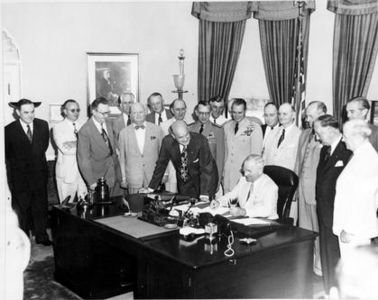
Fichier:Truman signing National Security Act Amendment of 1949.jpg| | Fichier:Truman signing National Security Act Amendment of 1949.jpg|杜鲁门总统在椭圆形办公室签署《1949 年国家安全法修正案》。 | ||
Fichier:NSC logo.jpg| | Fichier:NSC logo.jpg|国家安全委员会的徽标。 | ||
Fichier:2430 E Street.png| | Fichier:2430 E Street.png|华盛顿第一座中央情报局大楼上的徽章。 | ||
</gallery> | </gallery> | ||
== | == 麦卡锡主义的发展:1947-1962 年 == | ||
美国的反共情绪根深蒂固,可以追溯到 19 世纪末。政治、经济和意识形态等多种因素,包括对社会主义和共产主义运动出现的日益担忧,都助长了这种情绪。对共产主义的不信任还因担心美国的商业利益可能受到威胁以及强烈反布尔什维克的意识形态而加剧。随着冷战的爆发,这些担忧愈演愈烈。苏联获得原子武器、共产主义在东欧和亚洲蔓延等事件加剧了人们的恐惧。此外,由于怀疑美国政府内部存在间谍和颠覆活动,众议院非美活动委员会(HUAC)于 1938 年成立。该委员会的任务是调查可疑的共产主义活动,在营造恐惧和怀疑气氛方面发挥了关键作用。20 世纪 50 年代,这种 "红色恐慌 "达到顶峰,部分原因是参议员约瑟夫-麦卡锡(Joseph McCarthy)发表了耸人听闻的演讲。b 美国政治领导人巧妙地利用对共产主义颠覆的恐惧,为在国内和国际上维持反共政策辩护。这种不信任和恐惧的气氛对美国社会产生了深远的影响,数十年来影响着美国的政治、文化和国际关系。 | |||
麦卡锡主义是 20 世纪 50 年代美国主要由参议员约瑟夫-麦卡锡领导的强烈怀疑和反共镇压时期。在这一时期,经常有人被指控从事政治颠覆和间谍活动,而且往往没有确凿证据。这些指控导致许多行业的个人被列入黑名单,包括娱乐业。麦卡锡主义 "成为政治迫害的代名词,其特点是毫无根据的指控和不公正的镇压。[[File:McCarthy Cohn.jpg|left|thumb|150px|麦卡锡在军队-麦卡锡听证会上与罗伊-科恩(右)交谈。]] | |||
麦卡锡主义 "一词经常被用来描述以参议员约瑟夫-麦卡锡的行为为标志的美国强烈反共歇斯底里的时期。麦卡锡是这场反共运动的先锋,他提出的指控往往缺乏证据,毁掉了许多无辜者的事业和名誉。这一时期,人们对共产主义可能渗透美国社会的恐惧根深蒂固,同时也感受到了来自苏联的威胁。这些恐惧助长了普遍怀疑和迫害的气氛,给当时的美国社会和政治打上了深深的烙印。 | |||
战后时期是美国和整个世界发生深刻变革的时期。第二次世界大战结束后,苏联成为全球超级大国,杜鲁门总统及其政府对此深感忧虑。在美国,经济的不稳定、频繁的罢工以及美国共产党党员人数的不断增加加剧了这些担忧。在这种社会动荡和不确定的背景下,对共产主义在美国本土蔓延的恐惧无处不在。杜鲁门及其政府认为共产主义不仅是意识形态上的威胁,也是对国家和全球安全的现实威胁。出于这种担忧,杜鲁门推出了旨在抵制共产主义影响和扩张的政策和措施。1947 年提出的杜鲁门主义就是一个突出的例子。这一外交政策旨在通过向受到共产主义运动威胁的国家提供经济和军事支持来遏制共产主义的蔓延。它象征着美国反对苏联扩张、促进世界民主的承诺。杜鲁门总统创建的国家安全委员会(NSC)在巩固美国反共努力方面也发挥了至关重要的作用。国家安全委员会成为协调国家安全政策和国防战略的重要工具,反映出冷战背景下安全问题日益受到重视。在杜鲁门的领导下,美国采取果断行动保护自身利益,打击共产主义的蔓延。这些行动对美国外交政策的形成产生了相当大的影响,并在冷战态势的形成中发挥了决定性作用。因此,以这些事态发展为标志的战后时期塑造了世界历史的进程,并为冷战时期数十年的竞争和对抗奠定了基础。 | |||
杜鲁门对联邦政府雇员忠诚度的担忧受到了共产主义在国内和国际日益增长的影响力的强烈影响。毛泽东领导的共产党在中国取得胜利等重大事件加剧了杜鲁门的担忧。这些事态发展强化了人们对迫在眉睫的共产主义威胁的看法,并促使杜鲁门采取行动确保美国政府机构的安全。为了应对这些恐惧,杜鲁门对政府雇员实施了忠诚计划和广泛的审查程序。这些措施旨在识别和消除政府内部任何潜在的共产主义影响或同情。这种普遍怀疑的气氛也助长了麦卡锡主义的兴起,麦卡锡主义的特点是经常毫无根据地指控共产主义,并对据称不忠诚的个人进行抹黑。红色恐慌"--一个强烈的反共歇斯底里时期--也在这一背景下扎根,对美国政治和社会产生了深远影响。这一时期,包括艺术家、学者和政府官员在内的许多人被诬告同情共产主义,但往往证据不足或根本没有证据,这限制了言论自由,并在美国社会中埋下了不信任的种子。杜鲁门应对共产主义威胁的方法以及他为确保联邦雇员的忠诚所做的努力产生了持久的影响,不仅塑造了当时的政治,也塑造了冷战时期美国的文化和社会历史。 | |||
麦卡锡主义时代在很大程度上是由参议员约瑟夫-麦卡锡(Joseph McCarthy)发起的,它在美国引发了一段极度恐惧和怀疑的时期。麦卡锡的指控往往毫无根据或证据可疑,引发了一场名副其实的 "猎巫 "行动,主要针对共产主义嫌疑分子或同情共产主义的人。在此期间,许多人被列入黑名单、解雇,有些人甚至被监禁。这些行动不仅限于政府,私人组织也参与了这些侵入性调查,审查个人的政治信仰和交往。这种对私人生活的干涉严重损害了许多人的职业生涯,并扰乱了当事人的个人生活。麦卡锡主义对公民自由的影响是深远的。言论自由和结社自由这些美国民主的基本原则受到严重损害。这一时期还灌输了一种普遍的偏执感,因为人们害怕被诬告或与被视为颠覆性的活动联系在一起。麦卡锡主义给美国社会留下了永久的伤痕,成为恐惧和猜疑如何破坏正义和自由原则的典型例子。尽管这一时期已经结束,但麦卡锡主义的教训仍在影响着美国围绕公民自由和国家安全的辩论和政策。 | |||
冷战期间,美国国内对共产主义的恐惧和不信任气氛导致政府采取了一系列措施,旨在发现和应对被视为国内威胁的共产主义。其中一项措施是 1950 年通过的《颠覆活动控制法》,更常见的名称是《麦卡伦法》。该法要求共产主义组织向联邦政府登记,被视为限制和监督共产主义活动的一种手段。与此同时,众议院非美活动委员会(HUAC)在调查共产主义渗透各部门(包括联邦政府)的指控方面发挥了重要作用。众议院非美活动委员会因其公开听证会而声名狼藉,在听证会上,一些人被问及他们的政治派别和信仰,并经常被迫说出其他被怀疑从事共产主义活动的人的名字。这些措施影响深远,往往具有破坏性。许多人受到广泛的审查,被剥夺了工作,公民自由受到严重限制。对被贴上 "共产主义者 "或 "共产主义同情者 "标签的恐惧无处不在,指控可能会毁掉事业和生活,有时仅凭非常有限甚至根本不存在的证据。美国历史上的这一时期深刻地提醒我们,对内部敌人的恐惧如何导致基本权利的滥用和普遍的猜疑气氛。以国家安全为借口采取的行动对个人自由和美国的民主结构造成了持久影响。 | |||
美国麦卡锡主义时期的特点是对那些被怀疑是共产主义者或与共产主义有联系的人的强烈怀疑和严厉措施。这些人发现自己受到了严格的审查,而这种指控的后果往往很严重。这些人可能会丢掉工作、被剥夺职业机会、护照被扣押,在某些极端情况下还会被驱逐出境。国土安全法》(Homeland Security Act)又称《麦卡伦法》(McCarran Act),通过将帮助建立极权独裁统治的行为定为非法,强化了这种猎巫行为。该法还要求共产主义组织成员向联邦政府登记。这一要求的目的是监督和控制共产主义组织的活动,但也被视为对公民自由的侵犯和一种意识形态歧视。这些措施对相关人员的影响是深远的。许多人仅仅因为自己的政治信仰或被认为与共产主义有关联,生活和事业就发生了翻天覆地的变化。这一时期产生的恐惧和不信任在美国社会留下了不可磨灭的印记,凸显了国家安全与保护个人自由之间的紧张关系。 | |||
朝鲜战争是冷战历史上的一个转折点,其特点是美国支持的军队与共产主义大国支持的军队之间的直接对抗。冲突始于 1950 年,当时北朝鲜在中国和苏联的支持下入侵南朝鲜。作为回应,美国在哈里-杜鲁门总统的领导下,做出了军事干预以支持南朝鲜的关键决定,这标志着美国在冷战期间首次直接参与对抗共产主义势力的冲突。美国之所以能够进行干预,部分原因是苏联没有参加联合国安理会。苏联抵制安理会,以抗议安理会拒绝给予共产党中国常任理事国席位,这为美国获得联合国授权干涉朝鲜留下了道路。朝鲜冲突十分激烈,破坏性极大。1953 年,双方最终签署了停火协议,但没有达成真正的和平条约。该协议导致在南北朝鲜之间建立了非军事区(DMZ),而非军事区至今仍是世界上军事化程度最高的边界之一。朝鲜战争不仅对朝鲜半岛,而且对冷战的动态都产生了深远的影响,它强化了美国的遏制政策,并表明美国愿意进行军事干预以遏制共产主义的蔓延。[[Image:Julius and Ethel Rosenberg NYWTS.jpg|thumb|100px|埃塞尔和朱利叶斯-罗森伯格]] | |||
罗森伯格案是美国法律史上最具争议和两极分化的案件之一,尤其是在麦卡锡主义时期。朱利叶斯-罗森伯格和埃塞尔-罗森伯格于 1950 年被捕,被控密谋从事间谍活动,包括涉嫌在第二次世界大战期间向苏联传递有关原子弹的情报。1951 年,他们被认定有罪并被判处死刑,即使在反共歇斯底里的时代,这也是一个异常严厉的判决。尽管国际社会提出抗议并呼吁宽大处理,声称对他们不利的证据不足,而且主要基于间接证词,但罗森伯格夫妇还是于 1953 年 6 月被电椅处死。此案引发了激烈的争论,至今仍是一个有争议的话题。一些人认为这是一个因反共恐惧而歪曲司法的悲惨例子,而另一些人则认为,虽然证据可能不足以判处死刑,但却表明他们参与了间谍活动。随着时间的推移,解密文件和与此案有关的个人随后的供词提供了新的见解,但对于罗森伯格夫妇是否有罪仍然众说纷纭。 | |||
1953 年德怀特-D-艾森豪威尔当选总统时,正值美国政坛坚定反共的时期,部分原因是麦卡锡主义的影响和兴起。艾森豪威尔虽然在态度上比同时代的一些人更为温和,但仍坚持冷战时期的主导理论,将反共斗争作为美国外交和国内政策的核心。理查德-尼克松作为艾森豪威尔的副总统,在推动反共立场方面发挥了重要作用。甚至在担任副总统之前,尼克松就因作为国会议员起诉间谍案,特别是阿尔杰-希斯事件而声名鹊起。在他的政治生涯中,他始终坚持反对共产主义的坚定立场。在艾森豪威尔政府时期,不仅在美国,而且在全世界范围内都在齐心协力遏制共产主义的影响。这表现在支持反共政权、参与海外冷战冲突以及将共产主义视为对自由和民主的全球性威胁的政治言论上。值得注意的是,尽管艾森豪威尔并没有直接支持麦卡锡的方法和过激行为,但在其任期的大部分时间里,他也没有公开反对麦卡锡。与麦卡锡主义的某些方面相比,艾森豪威尔的总统任期虽然没有那么明显,但他所处的时代正是对共产主义的恐惧和不信任深深渗透美国政治和社会的时代。 | |||
1954年在美国宣誓时加入 "上帝保佑 "一词,就是反共主义如何深入美国文化的一个例子。这一改动旨在加强国家认同,反对苏联推行的无神论共产主义。它是在冷战和麦卡锡主义最激烈的时候通过的,反映了将美国意识形态和价值观与共产主义意识形态和价值观明确区分开来的愿望。至于反共立法,国会的投票与 1950 年《国土安全法》(又称《麦卡伦法》)相对应。该法要求共产主义组织成员向政府登记,并授权在国家紧急状态下为嫌疑人建立拘留营。尽管杜鲁门总统以违反宪法自由为由否决了这项立法,但他的否决被国会推翻。1954 年,《共产主义活动控制法》(又称《国际社会法》)获得通过,进一步加强了反共立法。该法规定,在美国建立或支持建立极权独裁统治是非法的,并要求共产主义组织成员向政府登记。该法将共产党员定为刑事犯罪,并被用来作为监视和镇压涉嫌同情共产党的个人和组织的理由。这些措施是在恐惧和不信任的气氛中采取的,对美国社会产生了深远影响,限制了公民自由,助长了偏执和镇压的气氛。麦卡锡主义强调忠诚,往往没有辩护或上诉的可能,这对许多被指控为共产党员或仅仅被怀疑为共产党员的人造成了毁灭性的后果。 | |||
在麦卡锡主义和 "红色恐慌 "时期,被告的法律保护和权利往往被搁置或被忽视。在许多人看来,对共产主义颠覆的恐惧无处不在,因此有理由采取极端措施来保护国家。不公正的审判司空见惯,许多被指控为共产党员或共产党同情者的人面临着基于间接证据或可疑证词的判决。在法庭之外,仅仅指控或怀疑就可能导致黑名单,尤其是在电影、广播和电视等行业,往往在没有具体证据或没有机会为自己辩护的情况下,黑名单就会毁掉他们的职业生涯。正当程序原则对法律制度中的公平待遇至关重要,但却经常被忽视。被告在被证明无罪之前往往被认定有罪,推翻了无罪推定原则。当时的社会和政治压力迫使法官、政客和雇主对那些被怀疑与共产党有联系的人采取行动。如果不对 "共产主义嫌疑分子 "采取行动,就会被解释为同情共产主义。政府机构,特别是埃德加-胡佛(J. Edgar Hoover)领导下的联邦调查局(FBI),对共产主义嫌疑团体的监视和渗透不断加强,但往往没有适当的逮捕令,或法律依据令人怀疑。最后,由于害怕被指控为共产主义分子,许多人对自己进行审查,或避免与被认为可疑的事业或人物发生任何联系,从而形成了一种压迫和墨守成规的氛围。麦卡锡主义时期仍然是美国历史上黑暗的一章,它说明了当恐惧和猜疑笼罩在正义和公民权利的基本原则之上时可能产生的灾难性后果。 | |||
美军事件标志着约瑟夫-麦卡锡反共运动的一个关键转折点。1954 年,麦卡锡因经常毫无根据地指控共产主义而声名狼藉,他将矛头指向美国陆军,声称共产主义分子渗透了美国陆军。许多人,包括那些以前支持或容忍麦卡锡行为的人,都认为麦卡锡的做法太过分了。随后举行的电视听证会被称为 "军队和麦卡锡听证会",让广大观众亲眼目睹了麦卡锡的手段。观众看到了他咄咄逼人的手段、毫无根据的指控和恐吓策略。媒体的曝光对改变公众对麦卡锡的看法起到了至关重要的作用。这些听证会中最令人难忘的时刻之一,是军方律师约瑟夫-韦尔奇(Joseph N. Welch)面对麦卡锡提出了他的著名问题: "先生,你就没有一点体面吗?" 这一质问引起了美国公众的共鸣,象征着越来越多的人反对麦卡锡的恐惧和无端指责运动。最终,军队和麦卡锡听证会大大削弱了政治和公众对麦卡锡的支持。1954 年 12 月,美国参议院投票谴责麦卡锡,这一行动标志着麦卡锡的政治下台和影响力的衰落。尽管麦卡锡主义作为一种运动在麦卡锡之后仍持续了一段时间,但这一时期标志着麦卡锡主义开始结束对美国政治和社会的控制。 | |||
20 世纪 50 年代中期是美国和苏联之间竞争和紧张局势加剧的时期,反映了冷战的复杂动态。1955 年,已被视为不断扩张的超级大国的苏联向前迈出了一大步,成功试验了第一颗氢弹。这一成功凸显了苏联日益增长的核能力,加剧了美国和其他西方国家的恐惧和担忧。同年,苏联成立了华沙条约组织,以应对美国及其盟国于 1949 年成立的北大西洋公约组织(NATO)。华沙条约组织是由苏联和几个东欧国家组成的军事同盟,它的成立加强了欧洲东西方集团的政治和军事分工。1957 年,苏联发射了人造地球卫星,标志着冷战的另一个关键时刻。这一技术上的成功不仅展示了苏联在科学上的进步,也引起了美国对两个超级大国之间可能存在 "导弹鸿沟 "的担忧。人造地球卫星的发射产生了重大的心理影响,促使美国加快了自己的太空和防御计划。在这种竞争和威胁加剧的背景下,苏联的行动加强了杜鲁门政府在美国评估忠诚度并采取反共行动的政策的正当性。对苏联影响和共产主义传播的恐惧助长了不信任和怀疑的气氛,在冷战的这一紧张时期影响了美国的内政和外交政策。 | |||
= | = 美国的富裕社会 = | ||
The post-war period in the United States, particularly in the 1950s and 1960s, presents a fascinating contrast between fear and prosperity. On the one hand, the Cold War and the perceived threat of Soviet aggression created a climate of mistrust and anxiety. The arms race and the fear of nuclear attack were omnipresent, and the US government responded with increased surveillance and control over the population, particularly in the fight against communism. At the same time, this period witnessed an unprecedented economic boom. After the deprivations of the Second World War, the United States experienced massive economic growth, fuelled in part by pent-up demand for consumer goods. This economic prosperity led to a significant increase in the standard of living for many Americans, characterised by the growth of suburbs and the availability of cars, household appliances and other consumer goods. Socially and culturally, the post-war years were also marked by significant change. The civil rights movement gained momentum, fighting segregation and racial discrimination, and seeking equal rights for African Americans. Emblematic figures such as Martin Luther King Jr. emerged, symbolising the fight for justice and equality. The rise of the suburbs has also reshaped the American landscape. Increased land ownership and massive home construction have contributed to a new form of American life, centred around family, community and a more comfortable, accessible lifestyle. | The post-war period in the United States, particularly in the 1950s and 1960s, presents a fascinating contrast between fear and prosperity. On the one hand, the Cold War and the perceived threat of Soviet aggression created a climate of mistrust and anxiety. The arms race and the fear of nuclear attack were omnipresent, and the US government responded with increased surveillance and control over the population, particularly in the fight against communism. At the same time, this period witnessed an unprecedented economic boom. After the deprivations of the Second World War, the United States experienced massive economic growth, fuelled in part by pent-up demand for consumer goods. This economic prosperity led to a significant increase in the standard of living for many Americans, characterised by the growth of suburbs and the availability of cars, household appliances and other consumer goods. Socially and culturally, the post-war years were also marked by significant change. The civil rights movement gained momentum, fighting segregation and racial discrimination, and seeking equal rights for African Americans. Emblematic figures such as Martin Luther King Jr. emerged, symbolising the fight for justice and equality. The rise of the suburbs has also reshaped the American landscape. Increased land ownership and massive home construction have contributed to a new form of American life, centred around family, community and a more comfortable, accessible lifestyle. | ||
Version du 15 novembre 2023 à 11:45
根据 Aline Helg 的演讲改编[1][2][3][4][5][6][7]
美洲独立前夕 ● 美国的独立 ● 美国宪法和 19 世纪早期社会 ● 海地革命及其对美洲的影响 ● 拉丁美洲国家的独立 ● 1850年前后的拉丁美洲:社会、经济、政策 ● 1850年前后的美国南北部:移民与奴隶制 ● 美国内战和重建:1861-1877 年 ● 美国(重建):1877 - 1900年 ● 拉丁美洲的秩序与进步:1875 - 1910年 ● 墨西哥革命:1910 - 1940年 ● 20世纪20年代的美国社会 ● 大萧条与新政:1929 - 1940年 ● 从大棒政策到睦邻政策 ● 政变与拉丁美洲的民粹主义 ● 美国与第二次世界大战 ● 第二次世界大战期间的拉丁美洲 ● 美国战后社会:冷战与富裕社会 ● 拉丁美洲冷战与古巴革命 ● 美国的民权运动
1954 年,在冷战最激烈的时候,美国国会做出了一项战略性决定,将 "上帝保佑 "这一短语写入效忠誓词。这一改动绝非无足轻重,而是为了与当时被视为无神论堡垒的苏联划清界限。通过这一象征性的改变,美国试图突出其宗教和爱国价值观,与共产主义意识形态直接对立。
这一立法变革是在民族主义日益高涨的背景下发生的。直到 2003 年,得克萨斯州和其他州的学校还在诵读《效忠誓词》,现在誓词中包含了 "在上帝之下 "的字样,这反映了这些价值观在美国教育中的持续存在。
在这段国际紧张局势期间,美国和其他西方国家开展了民防演习,目的是让包括儿童在内的民众做好准备,应对苏联可能发动的核攻击。这些演习旨在教授针对放射性尘降物的防护措施,是为潜在核战争做准备的整体战略的一部分。
第二次世界大战后,美国作为一个经济超级大国蓬勃发展,这个时代有时被称为 "富裕社会"。这一时期的特点是,在高产劳动力、有利的政府政策和蓬勃发展的消费市场的推动下,经济异常繁荣。凭借其世界工业领导者的地位及其政治和军事影响力,美国得以在整个冷战期间保持并增进其繁荣,塑造了我们今天生活的现代世界。
美国与冷战
1945 年 8 月,美国在广岛和长崎使用原子弹,这不仅标志着第二次世界大战悲剧性和争议性的结束,而且也是冷战黎明的前奏。这一时期的特点是激烈的政治、军事和意识形态竞争,美国与苏联这两个当时正在崛起的超级大国针锋相对。美国拥有核武器,并在日本以毁灭性的方式进行了展示,这在战后谈判中最初似乎给美国人带来了战略优势。然而,它也催化了美国和苏联之间史无前例的军备竞赛,使世界陷入了不确定和对可能发生的核启示录的恐惧之中。冷战在多条战线上展开。美国采取遏制政策,旨在通过军事干预、经济措施和外交战略等多种手段限制共产主义的传播。与此同时,苏联也做出了巨大努力,将其影响力扩展到境外,并建立了自己的意识形态模式。这种两极对抗极大地影响了美国和全球社会。国际关系、全球经济和许多国家的国内政策都受到冷战动态的深刻影响,甚至是决定性的影响。这场旷日持久的冲突虽然从未演变成两个超级大国之间的公开战争,但却引发了各种代理冲突,刺激了疯狂的军备竞赛,并造成了持续数十年的不信任和猜疑气氛。
第二次世界大战结束时,与世界其他大国相比,美国处于异常有利的地位。美国的领土基本上没有受到战争的破坏,经济不但没有衰退,反而蓬勃发展。然而,这种优势地位遇到了一个重大障碍:他们无法将自由主义理想强加给苏联。美国将共产主义的传播视为对其生活方式和他们希望建立的世界秩序的直接威胁,因此采取了多层面的政策来遏制共产主义的影响。这一战略包括政治、经济和军事措施,所有这些措施都旨在阻止共产主义扩张并维护其霸权。然而,事实证明,约瑟夫-斯大林及其继任者领导下的苏联无法抵挡这些影响企图。相反,苏联采取了以封闭市场和国家严格控制经济发展为基础的经济政策。这种做法与美国倡导的资本主义模式和自由贸易形成了鲜明对比。这一根本分歧为美国经济利益的扩张制造了巨大障碍,限制了美国主导世界市场的能力。此外,苏联的外交政策侧重于扩大其影响力和意识形态模式,导致其在世界各地与美国发生直接或间接的对抗。因此,战后美苏之间出现了一个激烈竞争的时代,确定了冷战的轮廓。这种竞争不仅表现在经济上和政治上,还表现在军备竞赛、代理人冲突以及在全球范围内争夺文化和意识形态影响力。

1945 年 2 月在克里米亚海滨度假胜地举行的雅尔塔会议是世界历史上具有决定性意义的时刻。会议聚集了当时最具影响力的三位领导人: 他们是美国总统富兰克林-罗斯福、英国首相温斯顿-丘吉尔和苏联总理约瑟夫-斯大林。这次历史性会议的主要目的是确定第二次世界大战后时代的轮廓,并规划通往世界新秩序的道路。雅尔塔会议的主要成果之一是成立了联合国(UN),旨在成为一个促进和平、安全和国家间合作的国际论坛。联合国的成立是朝着建立国际治理全球架构迈出的重要一步,旨在避免一战后导致国际联盟失败的陷阱。然而,尽管取得了这一成就,雅尔塔会议也凸显了盟国之间根深蒂固的分歧。美国和英国是自由贸易和开放市场的坚定捍卫者,这种经济理念植根于资本主义原则。相比之下,苏联在斯大林的领导下,力图保持对其经济的严格控制,并限制西方的影响,特别是在其控制或影响的东欧领土上。这些在经济理念、外交政策和意识形态上的根本分歧不仅未能在雅尔塔会议上得到解决,而且还为冷战奠定了基础。美国和苏联这两个超级大国之间的互不信任和相互冲突的野心,塑造了未来几十年的国际关系格局,创造了一个东西方势力范围分裂的世界,并开创了一个紧张和对抗的时代,这将决定 20 世纪下半叶的命运。
为了确立其在战后世界秩序中的主导地位,美国主动创建了世界银行、国际复兴开发银行(IBRD)和国际货币基金组织(IMF)等国际金融机构。这些机构是在 1944 年布雷顿森林会议上构思和建立的,旨在战后促进经济增长和全球稳定方面发挥重要作用。它们为国际经济合作提供了一个结构化框架,力图防止战时经济危机的重演。然而,苏联对这些机构的看法却截然不同。在苏联看来,世界银行、国际货币基金组织和其他类似机构不仅是美国金融和商业霸权的工具,也是美国试图扩大其影响力和巩固其对世界经济统治的机制。此外,苏联担心参与这些机构会导致失去对本国经济的控制,并使其计划经济体制受到外部影响。因此,苏联选择不加入这些机构,这一拒绝不仅扩大了美苏之间的经济和意识形态差距,还加剧了冷战中固有的紧张局势。苏联拒绝加入这些国际金融机构,不仅被视为反对美国的金融和商业霸权,也是两个超级大国之间深刻的政治和经济分歧的明确体现。这种反对标志着全球经济秩序的明显分界线,强化了共产主义东方与资本主义西方之间的分裂,并帮助塑造了 20 世纪下半叶复杂的地缘政治动态。
第二次世界大战后,美国建立了世界银行、国际复兴开发银行(IBRD)和国际货币基金组织(IMF)等国际金融机构,这是美国在全球范围内建立金融和商业霸权的战略举措。通过提出国际经济合作框架,并为重建和发展提供必要的资源,美国试图推动建立以自由贸易和市场一体化为基础的自由经济体系。然而,这一愿景遭到了苏联的拒绝,苏联拒绝加入这些机构。对苏联来说,这些机构不仅是美国影响力的延伸,也是对其计划经济模式和自主权的潜在威胁。通过不参加这些机构,苏联表明其拒绝美国的金融和商业霸权,并坚持其自主经济发展政策。这种拒绝加剧了两个超级大国之间在意识形态和经济方面的紧张关系,助长了以美国为首的资本主义集团和以苏联为首的共产主义集团之间的两极分化。这种分化是冷战的象征,反映了东西方在经济理念和世界观上的深刻差异。
加剧冷战的恐惧
美苏之间长达数十年的对峙--冷战--确实是由政治、经济和意识形态性质的根本分歧所引发的。美国自由资本主义与苏联共产主义之间的对立不仅仅是意见分歧,而是两种截然不同的世界观的斗争。一方面,美国提倡民主、个人自由、自由贸易和市场资本主义。另一方面,苏联则捍卫专制治理模式、国家计划经济和基于马克思列宁主义原则的社会。意识形态上的分歧因双方对扩张和影响力的担忧而加剧。每个超级大国都担心对方会将其影响力扩展到全世界,从而导致在各条战线上的激烈竞争。在政治上,美国和苏联进行代理冲突,支持第三国的盟国政权或游击队运动。在经济上,它们寻求扩展各自的经济模式,并通过财政援助和贸易赢得盟友。在军事上,他们进行军备竞赛,尤其是核军备竞赛,这引发了对全球冲突的恐惧。这段以恐惧、不信任和竞争为特征的时期深刻地影响了国际关系,塑造了几代人的政策、联盟和冲突。冷战不仅是一场争夺世界霸权的斗争,也是一场定义世界秩序的斗争,每个超级大国都在寻求将自己对人类未来的愿景强加于人。
对资本主义列强包围的恐惧在冷战期间的苏联外交政策中发挥了至关重要的作用。这种恐惧可追溯到第一次世界大战和俄国革命,当时苏联(当时的沙皇俄国,后来的苏联)感到受到西方列强的威胁。俄罗斯内战期间的外国干预加剧了这种感觉。第二次世界大战后,苏联试图在自己与西欧之间建立一个缓冲区。被红军从纳粹占领下解放出来的中欧和东欧国家成为苏联的卫星国。共产主义政权在那里建立,通常是通过武力或操纵选举过程。这些缓冲国旨在为苏联提供一定程度的安全保障,保护其免受西方可能的新入侵。与此同时,1949 年北大西洋公约组织(NATO)的成立加深了苏联领导人对被包围的恐惧。他们认为北约是一个旨在遏制和威胁苏联的侵略性军事联盟。作为回应,苏联于 1955 年成立了华沙条约组织,巩固了对卫星国的控制,并建立了一个与北约对立的军事集团。这种包围感和在邻国建立盟国政权的愿望导致了与西方的重大政治和意识形态冲突。它加剧了相互之间的不信任,在冷战的态势中发挥了核心作用,导致超级大国在世界各地的间接对抗。
美国对苏联构成全球威胁的恐惧决定了其在冷战期间的外交政策。第二次世界大战后,世界处于转型和脆弱时期。许多国家,尤其是欧洲和亚洲国家,经济凋敝,政局动荡。这种局势为美国和苏联之间的意识形态竞争和影响力争夺创造了肥沃的土壤。在希腊和中国的内战中,美国和苏联支持对立的派别,这是冷战上演方式的先兆。同样,非殖民化运动和对英法帝国的压力也开辟了意识形态和战略竞争的新战线。在此背景下,1947 年杜鲁门主义正式确立了美国的遏制战略。这一理论旨在支持那些反抗少数民族武装征服或外部压力的国家,这些国家通常被解释为苏联支持的共产主义运动。马歇尔计划是对遏制政策的补充,该计划是一项旨在帮助重建欧洲的大规模经济援助计划。该计划的目的不仅在于重建欧洲,还在于稳定欧洲,使其不易受到共产党的影响。美国担心共产主义的蔓延,认为苏联是对其利益和世界稳定的重大威胁,因此采取了全球策略。无论苏联的影响出现在欧洲、亚洲、非洲还是拉丁美洲,美国都试图予以打击。这导致美国直接或间接地卷入了世界各地的各种冲突,如朝鲜战争和越南战争,同时也增加了美国在全球范围内的军事和经济存在。因此,对苏联扩张的恐惧以及将苏联视为全球威胁是冷战期间美国外交政策的主要驱动力,影响了数十年的国际关系和冲突。
美国的内部因素
第二次世界大战结束时,美国国内的一些因素加剧了冷战期间对苏联威胁的担忧。其中一个关键因素是富兰克林-D-罗斯福于 1945 年 4 月去世后领导层的更迭。他的继任者哈里-杜鲁门虽然是副总统,但被认为外交政策经验不足。这一转变可能使人们担心美国政府是否有能力有效应对苏联的威胁。此外,第二次世界大战促进了美国的工业和军事生产。战后,国防部门的许多参与者看到了通过继续生产武器来保持繁荣的机会。这种愿望影响了美国的外交政策,使其倾向于对苏联采取更具侵略性的立场。对社会主义和共产主义的不信任在美国有着深厚的历史渊源,可以追溯到 19 世纪 80 年代,并在 1917 年俄国革命后愈演愈烈。冷战期间,这种不信任发展成为对苏联和国际共产主义的公开恐惧和敌意。反共宣传是塑造美国公众舆论的关键因素,媒体、电影和政治演讲经常将共产主义描绘成对民主和美国生活方式的直接全球性威胁。最后,美国担心共产主义政党在欧洲,特别是法国和意大利的崛起。人们担心,如果这些国家受到共产主义的影响,就会产生多米诺骨牌效应,威胁到美国的战略和经济利益。这些因素加上战后的国际背景,为美国和苏联之间的不信任和对抗创造了有利环境,为冷战的动态发展推波助澜。
冷战时期美国外交政策的总体思想与经济增长和国家繁荣的理念有着内在联系。美国认为其经济福祉与其进入新的出口市场和确保基本原材料供应的能力密切相关。这一观点在很大程度上影响了他们在此期间处理国际关系的方式。对其全球扩张计划的限制或制约被视为对美国利益的直接威胁。因此,保持强大的经济和军事实力成为美国的首要任务,促使其加强在全球范围内的主导地位。这一战略的目的是保护美国在全球的经济和战略利益。在此背景下,共产主义的崛起,尤其是苏联日益增长的影响力,被视为对美国霸权的直接挑战。共产主义的蔓延不仅代表着意识形态上的威胁,也是经济扩张以及市场和资源准入的潜在障碍。为了应对这一威胁,美国采取了遏制政策,旨在限制共产主义的传播,维护其在全球范围内的影响力和主导地位。这一方针在很大程度上决定了美国对苏联的反应,并界定了美国在冷战期间国际秩序中的角色。它导致了一系列政治、经济和军事决定,其中一些决定对国际关系结构和全球地缘政治格局产生了深远而持久的影响。
杜鲁门主义
哈里-杜鲁门总统于 1947 年 3 月 12 日宣布的杜鲁门主义标志着美国外交政策的一个重要转折点。该理论规定,美国将向所有受到共产主义或极权主义威胁的国家提供政治、军事和经济支持。其目的有两个:遏制共产主义的蔓延,促进民主和资本主义。杜鲁门主义是针对苏联的崛起而制定的,苏联已将其影响力扩展到东欧,并被视为对西方民主和资本主义理想的直接威胁。因此,杜鲁门主义代表了对苏联扩张的坚定回应,发出了美国准备在全球范围内积极捍卫和促进其利益和价值观的明确信号。这一理论标志着美国与以往孤立主义外交政策的重大决裂。它为美国卷入冷战奠定了基础,表明美国准备进行干预,包括军事干预,以遏制苏联的影响,维护其在世界舞台上的主导地位。杜鲁门主义因此成为美国几十年来外交政策中遏制战略的核心要素。
杜鲁门主义和乔治-肯南的遏制政策在冷战背景下紧密相连,相辅相成。作为外交官和苏联事务专家,乔治-凯南在制定遏制政策方面发挥了至关重要的作用。在其著名的 "长篇电报 "以及后来以笔名 "X "发表的文章中,肯南认为苏联本质上是扩张主义国家,必须遏制其扩张。他认为,美国必须采取长期战略来防止共产主义的蔓延,无论苏联的影响扩散到哪里,美国都要予以反对。杜鲁门主义是这一遏制战略的一部分。杜鲁门主义是为应对希腊和土耳其危机而宣布的,它承诺美国将支持受到共产主义或极权主义威胁的国家,不仅在口头上,而且还采取具体行动,包括军事和经济支持。因此,肯南的遏制政策提供了理论和战略框架,而杜鲁门主义则将这一框架转化为积极和实际的政策。它们共同构成了冷战时期美国战略的支柱,指导美国努力维护其霸权、对抗苏联的影响并保护其在全世界的利益。
对比冷战时期的遏制政策和门罗主义,可以发现两者既有相似之处,也有显著区别。两者的首要目标都是保护美国的国家利益。门罗主义制定于1823年,旨在防止欧洲列强干涉西半球事务,实质上是宣布拉丁美洲和北美洲是美国具有特权影响力的地区,禁止欧洲进一步殖民。与此相反,冷战期间实施的遏制政策旨在通过防止共产主义在世界范围内的传播来保护美国的利益。这两项政策也都是对感知到的威胁的回应。门罗主义应对的是欧洲殖民扩张的威胁,而遏制政策应对的是苏联扩张主义和共产主义传播的威胁。然而,两者之间存在根本性的差异。首先,地理范围大不相同。门罗主义侧重于西半球,而遏制政策则是全球性的。其次,威胁的性质不同。门罗主义主要反对殖民企图或欧洲政治干涉,而遏制政策则反对特定的意识形态--共产主义和苏联的影响。最后,制定这些理论的历史和政治背景也截然不同。门罗主义是在欧洲殖民主义蓬勃发展、美国还很年轻的时候提出的。而遏制政策则是在第二次世界大战后,美苏意识形态对立的背景下制定的。
遏制政策与之前的门罗主义一样,体现了美国例外主义的信念,反映了美国在全球范围内保持其主导地位和保护其利益的愿望。然而,遏制政策适应了冷战时期的具体现实,冷战时期的特点是与苏联的激烈竞争。门罗主义旨在将欧洲列强拒之于西半球之外,而遏制政策则不同,它的范围远远超出了美国的边界。其主要目的是限制苏联影响力的扩张,遏制共产主义的传播。这一政策适用于世界各地,尤其是欧洲,美国试图在欧洲加强和保护其盟国,以应对苏联的威胁。因此,遏制政策在冷战期间确定美国外交政策方面发挥了至关重要的作用。它决定了美国与苏联的互动,并对世界政治的演变产生了相当大的影响,几十年来一直影响着美国的决策和战略。简而言之,这一政策是对当时独特挑战的回应,同时延续了捍卫美国国际利益的传统。

马歇尔计划的正式名称是 "欧洲复兴计划",它仍然是战后经济外交和国际援助最具代表性的范例之一。该计划由美国国务卿乔治-C-马歇尔于 1948 年发起,具有多重战略目标。首先,马歇尔计划旨在支持受第二次世界大战破坏的欧洲经济的重建。通过提供大量财政援助,美国希望加快经济复苏,稳定欧洲各国的局势。其次,马歇尔计划还包含了打击共产主义影响的重要因素。当时,共产主义在欧洲,特别是在经济实力较弱的国家日益壮大,美国的援助旨在提供一种替代方案,防止共产主义意识形态的传播。通过加强经济和支持民主政府,美国试图在欧洲建立一道抵御共产主义的屏障。第三,该计划对美国经济本身也有积极影响。通过帮助重建欧洲,美国为其出口产品开辟了新的市场,并加强了跨大西洋的经济联系。这在战后尤为重要,因为刺激国际需求对于维持美国经济增长至关重要。最终,马歇尔计划取得了巨大成功。它不仅为欧洲的经济复苏做出了重大贡献,还为至今仍在继续的跨大西洋密切合作奠定了基础。它还加强了美国在欧洲的影响力,是战后欧洲大陆经济繁荣的关键因素。此外,作为一种外交政策工具,它表明美国有能力将经济援助作为促进其全球战略利益的有效手段。
国家安全法
1947 年《国家安全法》标志着美国历史上的一个决定性时刻,特别是在塑造美国应对冷战带来的威胁和挑战方面。该法案对美国国防和情报部门的结构和组织进行了重大改革,以应对与苏联不断升级的紧张局势。这项立法带来的最显著变化之一就是成立了国家安全委员会(NSC)。根据设想,国家安全委员会是就国家安全和外交政策问题向总统提供建议的重要机构。它的成立使国家安全的各个层面,包括军事、外交和情报方面得到了更好的协调和整合。该法案还见证了中央情报局(CIA)的成立。中央情报局的成立是美国收集、分析和处理外国情报能力的转折点。作为一个中央情报机构,中情局在收集苏联活动情报和开展秘密行动以对抗苏联在世界各地的影响方面发挥了至关重要的作用。此外,该法案还促使陆军部和海军部重组为单一的国防部。这一合并旨在提高美国武装部队的协调性和有效性。空军作为一个独立的军种与陆军、海军和海军陆战队并列,凸显了空中力量在现代军事战略中日益重要的地位。
20 世纪 50 年代及以后,中央情报局积极参与各种秘密行动,这表明冷战期间美国试图影响世界政治并遏制共产主义蔓延的方式。这些行动往往饱受争议,但却对相关国家和美国的国际声誉产生了持久影响。最臭名昭著的行动之一是 1953 年的伊朗政变,被称为 "阿贾克斯行动"。该行动由美国中央情报局和英国特工部门联合实施,旨在推翻将伊朗石油工业国有化的伊朗总理穆罕默德-摩萨台。虽然政变成功地恢复了穆罕默德-礼萨-巴列维国王的权力,但也在伊朗国内引起了对美国的强烈不满,为未来的冲突埋下了种子。1961 年,由中央情报局支持的古巴流亡者领导的猪湾入侵古巴,试图推翻菲德尔-卡斯特罗的政府。这次行动的失败是美国的一大耻辱。这次行动不仅巩固了卡斯特罗在古巴的地位,还使古巴更加接近苏联。另一个突出的例子是 1973 年智利推翻萨尔瓦多-阿连德的民选政府。中央情报局在这场政变中扮演了角色,因为阿连德被视为马克思主义者,是对美国在该地区利益的威胁。推翻阿连德后,奥古斯托-皮诺切特将军建立了以公然侵犯人权为特点的独裁政权。这些秘密行动表明了美国在冷战期间根据自身利益塑造世界秩序的决心,以及与它所认为的苏联影响力扩张的斗争。它们还凸显了美国所面临的复杂性和道德困境,因为美国的外交政策有时与其所倡导的民主和人权原则相悖。
杜鲁门总统在椭圆形办公室签署《1949 年国家安全法修正案》。

国家安全委员会的徽标。

华盛顿第一座中央情报局大楼上的徽章。


麦卡锡主义的发展:1947-1962 年
美国的反共情绪根深蒂固,可以追溯到 19 世纪末。政治、经济和意识形态等多种因素,包括对社会主义和共产主义运动出现的日益担忧,都助长了这种情绪。对共产主义的不信任还因担心美国的商业利益可能受到威胁以及强烈反布尔什维克的意识形态而加剧。随着冷战的爆发,这些担忧愈演愈烈。苏联获得原子武器、共产主义在东欧和亚洲蔓延等事件加剧了人们的恐惧。此外,由于怀疑美国政府内部存在间谍和颠覆活动,众议院非美活动委员会(HUAC)于 1938 年成立。该委员会的任务是调查可疑的共产主义活动,在营造恐惧和怀疑气氛方面发挥了关键作用。20 世纪 50 年代,这种 "红色恐慌 "达到顶峰,部分原因是参议员约瑟夫-麦卡锡(Joseph McCarthy)发表了耸人听闻的演讲。b 美国政治领导人巧妙地利用对共产主义颠覆的恐惧,为在国内和国际上维持反共政策辩护。这种不信任和恐惧的气氛对美国社会产生了深远的影响,数十年来影响着美国的政治、文化和国际关系。
麦卡锡主义是 20 世纪 50 年代美国主要由参议员约瑟夫-麦卡锡领导的强烈怀疑和反共镇压时期。在这一时期,经常有人被指控从事政治颠覆和间谍活动,而且往往没有确凿证据。这些指控导致许多行业的个人被列入黑名单,包括娱乐业。麦卡锡主义 "成为政治迫害的代名词,其特点是毫无根据的指控和不公正的镇压。

麦卡锡主义 "一词经常被用来描述以参议员约瑟夫-麦卡锡的行为为标志的美国强烈反共歇斯底里的时期。麦卡锡是这场反共运动的先锋,他提出的指控往往缺乏证据,毁掉了许多无辜者的事业和名誉。这一时期,人们对共产主义可能渗透美国社会的恐惧根深蒂固,同时也感受到了来自苏联的威胁。这些恐惧助长了普遍怀疑和迫害的气氛,给当时的美国社会和政治打上了深深的烙印。
战后时期是美国和整个世界发生深刻变革的时期。第二次世界大战结束后,苏联成为全球超级大国,杜鲁门总统及其政府对此深感忧虑。在美国,经济的不稳定、频繁的罢工以及美国共产党党员人数的不断增加加剧了这些担忧。在这种社会动荡和不确定的背景下,对共产主义在美国本土蔓延的恐惧无处不在。杜鲁门及其政府认为共产主义不仅是意识形态上的威胁,也是对国家和全球安全的现实威胁。出于这种担忧,杜鲁门推出了旨在抵制共产主义影响和扩张的政策和措施。1947 年提出的杜鲁门主义就是一个突出的例子。这一外交政策旨在通过向受到共产主义运动威胁的国家提供经济和军事支持来遏制共产主义的蔓延。它象征着美国反对苏联扩张、促进世界民主的承诺。杜鲁门总统创建的国家安全委员会(NSC)在巩固美国反共努力方面也发挥了至关重要的作用。国家安全委员会成为协调国家安全政策和国防战略的重要工具,反映出冷战背景下安全问题日益受到重视。在杜鲁门的领导下,美国采取果断行动保护自身利益,打击共产主义的蔓延。这些行动对美国外交政策的形成产生了相当大的影响,并在冷战态势的形成中发挥了决定性作用。因此,以这些事态发展为标志的战后时期塑造了世界历史的进程,并为冷战时期数十年的竞争和对抗奠定了基础。
杜鲁门对联邦政府雇员忠诚度的担忧受到了共产主义在国内和国际日益增长的影响力的强烈影响。毛泽东领导的共产党在中国取得胜利等重大事件加剧了杜鲁门的担忧。这些事态发展强化了人们对迫在眉睫的共产主义威胁的看法,并促使杜鲁门采取行动确保美国政府机构的安全。为了应对这些恐惧,杜鲁门对政府雇员实施了忠诚计划和广泛的审查程序。这些措施旨在识别和消除政府内部任何潜在的共产主义影响或同情。这种普遍怀疑的气氛也助长了麦卡锡主义的兴起,麦卡锡主义的特点是经常毫无根据地指控共产主义,并对据称不忠诚的个人进行抹黑。红色恐慌"--一个强烈的反共歇斯底里时期--也在这一背景下扎根,对美国政治和社会产生了深远影响。这一时期,包括艺术家、学者和政府官员在内的许多人被诬告同情共产主义,但往往证据不足或根本没有证据,这限制了言论自由,并在美国社会中埋下了不信任的种子。杜鲁门应对共产主义威胁的方法以及他为确保联邦雇员的忠诚所做的努力产生了持久的影响,不仅塑造了当时的政治,也塑造了冷战时期美国的文化和社会历史。
麦卡锡主义时代在很大程度上是由参议员约瑟夫-麦卡锡(Joseph McCarthy)发起的,它在美国引发了一段极度恐惧和怀疑的时期。麦卡锡的指控往往毫无根据或证据可疑,引发了一场名副其实的 "猎巫 "行动,主要针对共产主义嫌疑分子或同情共产主义的人。在此期间,许多人被列入黑名单、解雇,有些人甚至被监禁。这些行动不仅限于政府,私人组织也参与了这些侵入性调查,审查个人的政治信仰和交往。这种对私人生活的干涉严重损害了许多人的职业生涯,并扰乱了当事人的个人生活。麦卡锡主义对公民自由的影响是深远的。言论自由和结社自由这些美国民主的基本原则受到严重损害。这一时期还灌输了一种普遍的偏执感,因为人们害怕被诬告或与被视为颠覆性的活动联系在一起。麦卡锡主义给美国社会留下了永久的伤痕,成为恐惧和猜疑如何破坏正义和自由原则的典型例子。尽管这一时期已经结束,但麦卡锡主义的教训仍在影响着美国围绕公民自由和国家安全的辩论和政策。
冷战期间,美国国内对共产主义的恐惧和不信任气氛导致政府采取了一系列措施,旨在发现和应对被视为国内威胁的共产主义。其中一项措施是 1950 年通过的《颠覆活动控制法》,更常见的名称是《麦卡伦法》。该法要求共产主义组织向联邦政府登记,被视为限制和监督共产主义活动的一种手段。与此同时,众议院非美活动委员会(HUAC)在调查共产主义渗透各部门(包括联邦政府)的指控方面发挥了重要作用。众议院非美活动委员会因其公开听证会而声名狼藉,在听证会上,一些人被问及他们的政治派别和信仰,并经常被迫说出其他被怀疑从事共产主义活动的人的名字。这些措施影响深远,往往具有破坏性。许多人受到广泛的审查,被剥夺了工作,公民自由受到严重限制。对被贴上 "共产主义者 "或 "共产主义同情者 "标签的恐惧无处不在,指控可能会毁掉事业和生活,有时仅凭非常有限甚至根本不存在的证据。美国历史上的这一时期深刻地提醒我们,对内部敌人的恐惧如何导致基本权利的滥用和普遍的猜疑气氛。以国家安全为借口采取的行动对个人自由和美国的民主结构造成了持久影响。
美国麦卡锡主义时期的特点是对那些被怀疑是共产主义者或与共产主义有联系的人的强烈怀疑和严厉措施。这些人发现自己受到了严格的审查,而这种指控的后果往往很严重。这些人可能会丢掉工作、被剥夺职业机会、护照被扣押,在某些极端情况下还会被驱逐出境。国土安全法》(Homeland Security Act)又称《麦卡伦法》(McCarran Act),通过将帮助建立极权独裁统治的行为定为非法,强化了这种猎巫行为。该法还要求共产主义组织成员向联邦政府登记。这一要求的目的是监督和控制共产主义组织的活动,但也被视为对公民自由的侵犯和一种意识形态歧视。这些措施对相关人员的影响是深远的。许多人仅仅因为自己的政治信仰或被认为与共产主义有关联,生活和事业就发生了翻天覆地的变化。这一时期产生的恐惧和不信任在美国社会留下了不可磨灭的印记,凸显了国家安全与保护个人自由之间的紧张关系。
朝鲜战争是冷战历史上的一个转折点,其特点是美国支持的军队与共产主义大国支持的军队之间的直接对抗。冲突始于 1950 年,当时北朝鲜在中国和苏联的支持下入侵南朝鲜。作为回应,美国在哈里-杜鲁门总统的领导下,做出了军事干预以支持南朝鲜的关键决定,这标志着美国在冷战期间首次直接参与对抗共产主义势力的冲突。美国之所以能够进行干预,部分原因是苏联没有参加联合国安理会。苏联抵制安理会,以抗议安理会拒绝给予共产党中国常任理事国席位,这为美国获得联合国授权干涉朝鲜留下了道路。朝鲜冲突十分激烈,破坏性极大。1953 年,双方最终签署了停火协议,但没有达成真正的和平条约。该协议导致在南北朝鲜之间建立了非军事区(DMZ),而非军事区至今仍是世界上军事化程度最高的边界之一。朝鲜战争不仅对朝鲜半岛,而且对冷战的动态都产生了深远的影响,它强化了美国的遏制政策,并表明美国愿意进行军事干预以遏制共产主义的蔓延。

罗森伯格案是美国法律史上最具争议和两极分化的案件之一,尤其是在麦卡锡主义时期。朱利叶斯-罗森伯格和埃塞尔-罗森伯格于 1950 年被捕,被控密谋从事间谍活动,包括涉嫌在第二次世界大战期间向苏联传递有关原子弹的情报。1951 年,他们被认定有罪并被判处死刑,即使在反共歇斯底里的时代,这也是一个异常严厉的判决。尽管国际社会提出抗议并呼吁宽大处理,声称对他们不利的证据不足,而且主要基于间接证词,但罗森伯格夫妇还是于 1953 年 6 月被电椅处死。此案引发了激烈的争论,至今仍是一个有争议的话题。一些人认为这是一个因反共恐惧而歪曲司法的悲惨例子,而另一些人则认为,虽然证据可能不足以判处死刑,但却表明他们参与了间谍活动。随着时间的推移,解密文件和与此案有关的个人随后的供词提供了新的见解,但对于罗森伯格夫妇是否有罪仍然众说纷纭。
1953 年德怀特-D-艾森豪威尔当选总统时,正值美国政坛坚定反共的时期,部分原因是麦卡锡主义的影响和兴起。艾森豪威尔虽然在态度上比同时代的一些人更为温和,但仍坚持冷战时期的主导理论,将反共斗争作为美国外交和国内政策的核心。理查德-尼克松作为艾森豪威尔的副总统,在推动反共立场方面发挥了重要作用。甚至在担任副总统之前,尼克松就因作为国会议员起诉间谍案,特别是阿尔杰-希斯事件而声名鹊起。在他的政治生涯中,他始终坚持反对共产主义的坚定立场。在艾森豪威尔政府时期,不仅在美国,而且在全世界范围内都在齐心协力遏制共产主义的影响。这表现在支持反共政权、参与海外冷战冲突以及将共产主义视为对自由和民主的全球性威胁的政治言论上。值得注意的是,尽管艾森豪威尔并没有直接支持麦卡锡的方法和过激行为,但在其任期的大部分时间里,他也没有公开反对麦卡锡。与麦卡锡主义的某些方面相比,艾森豪威尔的总统任期虽然没有那么明显,但他所处的时代正是对共产主义的恐惧和不信任深深渗透美国政治和社会的时代。
1954年在美国宣誓时加入 "上帝保佑 "一词,就是反共主义如何深入美国文化的一个例子。这一改动旨在加强国家认同,反对苏联推行的无神论共产主义。它是在冷战和麦卡锡主义最激烈的时候通过的,反映了将美国意识形态和价值观与共产主义意识形态和价值观明确区分开来的愿望。至于反共立法,国会的投票与 1950 年《国土安全法》(又称《麦卡伦法》)相对应。该法要求共产主义组织成员向政府登记,并授权在国家紧急状态下为嫌疑人建立拘留营。尽管杜鲁门总统以违反宪法自由为由否决了这项立法,但他的否决被国会推翻。1954 年,《共产主义活动控制法》(又称《国际社会法》)获得通过,进一步加强了反共立法。该法规定,在美国建立或支持建立极权独裁统治是非法的,并要求共产主义组织成员向政府登记。该法将共产党员定为刑事犯罪,并被用来作为监视和镇压涉嫌同情共产党的个人和组织的理由。这些措施是在恐惧和不信任的气氛中采取的,对美国社会产生了深远影响,限制了公民自由,助长了偏执和镇压的气氛。麦卡锡主义强调忠诚,往往没有辩护或上诉的可能,这对许多被指控为共产党员或仅仅被怀疑为共产党员的人造成了毁灭性的后果。
在麦卡锡主义和 "红色恐慌 "时期,被告的法律保护和权利往往被搁置或被忽视。在许多人看来,对共产主义颠覆的恐惧无处不在,因此有理由采取极端措施来保护国家。不公正的审判司空见惯,许多被指控为共产党员或共产党同情者的人面临着基于间接证据或可疑证词的判决。在法庭之外,仅仅指控或怀疑就可能导致黑名单,尤其是在电影、广播和电视等行业,往往在没有具体证据或没有机会为自己辩护的情况下,黑名单就会毁掉他们的职业生涯。正当程序原则对法律制度中的公平待遇至关重要,但却经常被忽视。被告在被证明无罪之前往往被认定有罪,推翻了无罪推定原则。当时的社会和政治压力迫使法官、政客和雇主对那些被怀疑与共产党有联系的人采取行动。如果不对 "共产主义嫌疑分子 "采取行动,就会被解释为同情共产主义。政府机构,特别是埃德加-胡佛(J. Edgar Hoover)领导下的联邦调查局(FBI),对共产主义嫌疑团体的监视和渗透不断加强,但往往没有适当的逮捕令,或法律依据令人怀疑。最后,由于害怕被指控为共产主义分子,许多人对自己进行审查,或避免与被认为可疑的事业或人物发生任何联系,从而形成了一种压迫和墨守成规的氛围。麦卡锡主义时期仍然是美国历史上黑暗的一章,它说明了当恐惧和猜疑笼罩在正义和公民权利的基本原则之上时可能产生的灾难性后果。
美军事件标志着约瑟夫-麦卡锡反共运动的一个关键转折点。1954 年,麦卡锡因经常毫无根据地指控共产主义而声名狼藉,他将矛头指向美国陆军,声称共产主义分子渗透了美国陆军。许多人,包括那些以前支持或容忍麦卡锡行为的人,都认为麦卡锡的做法太过分了。随后举行的电视听证会被称为 "军队和麦卡锡听证会",让广大观众亲眼目睹了麦卡锡的手段。观众看到了他咄咄逼人的手段、毫无根据的指控和恐吓策略。媒体的曝光对改变公众对麦卡锡的看法起到了至关重要的作用。这些听证会中最令人难忘的时刻之一,是军方律师约瑟夫-韦尔奇(Joseph N. Welch)面对麦卡锡提出了他的著名问题: "先生,你就没有一点体面吗?" 这一质问引起了美国公众的共鸣,象征着越来越多的人反对麦卡锡的恐惧和无端指责运动。最终,军队和麦卡锡听证会大大削弱了政治和公众对麦卡锡的支持。1954 年 12 月,美国参议院投票谴责麦卡锡,这一行动标志着麦卡锡的政治下台和影响力的衰落。尽管麦卡锡主义作为一种运动在麦卡锡之后仍持续了一段时间,但这一时期标志着麦卡锡主义开始结束对美国政治和社会的控制。
20 世纪 50 年代中期是美国和苏联之间竞争和紧张局势加剧的时期,反映了冷战的复杂动态。1955 年,已被视为不断扩张的超级大国的苏联向前迈出了一大步,成功试验了第一颗氢弹。这一成功凸显了苏联日益增长的核能力,加剧了美国和其他西方国家的恐惧和担忧。同年,苏联成立了华沙条约组织,以应对美国及其盟国于 1949 年成立的北大西洋公约组织(NATO)。华沙条约组织是由苏联和几个东欧国家组成的军事同盟,它的成立加强了欧洲东西方集团的政治和军事分工。1957 年,苏联发射了人造地球卫星,标志着冷战的另一个关键时刻。这一技术上的成功不仅展示了苏联在科学上的进步,也引起了美国对两个超级大国之间可能存在 "导弹鸿沟 "的担忧。人造地球卫星的发射产生了重大的心理影响,促使美国加快了自己的太空和防御计划。在这种竞争和威胁加剧的背景下,苏联的行动加强了杜鲁门政府在美国评估忠诚度并采取反共行动的政策的正当性。对苏联影响和共产主义传播的恐惧助长了不信任和怀疑的气氛,在冷战的这一紧张时期影响了美国的内政和外交政策。
美国的富裕社会
The post-war period in the United States, particularly in the 1950s and 1960s, presents a fascinating contrast between fear and prosperity. On the one hand, the Cold War and the perceived threat of Soviet aggression created a climate of mistrust and anxiety. The arms race and the fear of nuclear attack were omnipresent, and the US government responded with increased surveillance and control over the population, particularly in the fight against communism. At the same time, this period witnessed an unprecedented economic boom. After the deprivations of the Second World War, the United States experienced massive economic growth, fuelled in part by pent-up demand for consumer goods. This economic prosperity led to a significant increase in the standard of living for many Americans, characterised by the growth of suburbs and the availability of cars, household appliances and other consumer goods. Socially and culturally, the post-war years were also marked by significant change. The civil rights movement gained momentum, fighting segregation and racial discrimination, and seeking equal rights for African Americans. Emblematic figures such as Martin Luther King Jr. emerged, symbolising the fight for justice and equality. The rise of the suburbs has also reshaped the American landscape. Increased land ownership and massive home construction have contributed to a new form of American life, centred around family, community and a more comfortable, accessible lifestyle.
This phenomenon is a recurring motif throughout history. When economic, social or political crises occur, governments and societies often tend to look for scapegoats to channel people's frustration and anger. This approach generally involves naming an internal or external enemy, often a minority or ideological group, which is blamed for the difficulties encountered. This tactic can serve several purposes. Firstly, it can divert attention from the real systemic problems or failures of government by focusing public attention on a designated enemy. Secondly, it can reinforce the government's authority, especially if it presents itself as the protector against the identified threat. Finally, the presence of a common enemy can serve to unite different factions within a society, creating a sense of unity against a perceived threat. However, the use of scapegoats often has negative consequences. Firstly, scapegoating can lead to human rights abuses, discrimination and persecution of innocent groups. Secondly, rather than solving problems, this approach can create or exacerbate social and political divisions. Finally, by focusing on a manufactured enemy, the real structural and systemic problems often remain unresolved. History offers many examples where this dynamic has manifested itself, from the persecution of religious and ethnic minorities to campaigns against "enemies of the state" in various authoritarian regimes. Recognising and understanding this trend is crucial if we are to avoid repeating the mistakes of the past and work towards building fairer, more inclusive societies.
Causes and characteristics
The Golden Age of Capitalism, which followed the Second World War, marked a period of exceptional prosperity for the United States. It was a time of rapid economic growth, driven by technological innovation, rising productivity and strong demand for consumer goods. The labour market was robust, with remarkably low unemployment rates, enabling most people of working age to find a job with little difficulty. Alongside this economic growth, Americans' standard of living improved considerably. Rising incomes led to increased consumption of goods such as houses, cars and household appliances. This period also saw a significant expansion of the middle class, with many families achieving a comfortable standard of living. In addition, the development of infrastructure, including motorways and suburbs, stimulated economic growth and facilitated a car-centric lifestyle. The government has played a key role in stabilising the economy through sound fiscal and monetary policies, as well as social programmes. Internationally, the United States' position as a world economic leader was strengthened by foreign aid, such as the Marshall Plan, and by participation in international institutions that promoted trade. Although this period was one of remarkable prosperity, it was not without its faults. Communities, particularly racial minorities, did not benefit equally from this prosperity, revealing persistent economic and social disparities. Despite these problems, the Gilded Age of Capitalism remains an iconic period of economic growth and prosperity unprecedented in the history of the United States.
In the period following the Second World War, despite the economic prosperity and the consumer boom, some Americans remained cautious, even sceptical. Many feared the onset of a recession, reminiscent of the difficulties of the Great Depression. This caution was anchored in the collective memory, influencing economic behaviour and attitudes towards financial stability. At the same time, anti-communism became a central pillar of American society, shaping domestic and foreign policy. This fear of communism has served as a unifying force for the nation, justifying US military interventions abroad and supporting the country's foreign policy objectives. Anti-Communist sentiment also played a role in maintaining social stability, providing American society with a common enemy and channelling domestic anxieties towards an external goal. However, this period was not without controversy. The United States' military involvement in international conflicts, particularly the Vietnam War, began to arouse significant public opposition. As the reality of war became more apparent, particularly through media reports and shock images, anti-war sentiment gained momentum. More and more Americans questioned the human and financial costs of these interventions, as well as the motives behind US involvement in these distant conflicts. This led to a national debate about US foreign policy and responsibility on the world stage, a debate that significantly shaped American history and politics during this period.
The post-World War II economic boom in the United States, sometimes referred to as the "golden age of capitalism", was a time of unprecedented growth and prosperity. This boom was underpinned by several key industries that expanded rapidly during this period.
The construction and automotive industries played a major role. The demand for new homes, particularly in the rapidly expanding suburbs, led to a boom in the construction sector. This boom was fuelled by a combination of factors, including easier access to credit and a growing desire for a comfortable and stable family life after the war years. The car industry also experienced spectacular growth. The American car culture, with the rise of suburbanisation and improved road networks, led to a significant increase in demand for cars. This stimulated not only the car industry itself, but also related industries such as oil production and vehicle maintenance. The arms industry was also a major driver of the economy. The Cold War and the containment policy towards the Soviet Union led to a significant increase in military spending. This expansion of the arms industry not only stimulated industrial production, but also created many jobs. The government played a crucial role in this economic growth. It stimulated the economy through significant public spending and investment in infrastructure projects, such as motorways, which supported economic growth and created jobs. These investments not only directly stimulated the economy, but also facilitated business growth and improved the quality of life for Americans.
The period of economic prosperity that followed the Second World War benefited many Americans, particularly those in the middle class. Rising wages and overall economic growth gave many people access to a higher standard of living and greater economic security. It was a time when the American dream seemed within reach for many, characterised by the purchase of houses in the suburbs, increased accessibility to cars and improved living conditions. However, despite this apparent prosperity, there were deep and persistent inequalities. Minority groups, particularly African Americans and other communities of colour, faced significant systemic barriers. Discriminatory practices, such as racial segregation and redlining (discrimination in banking and insurance services), limited these groups' access to economic opportunities, quality education and decent housing. In addition, wage disparities and limited access to well-paid jobs kept many families of colour in a state of poverty or economic insecurity. Similarly, although economic conditions had improved for many, poverty remained a significant problem in the United States. Rural and some urban areas were particularly hard hit, with high rates of poverty and poor living conditions. This period therefore highlights a paradox: while it was marked by unprecedented growth and affluence for many, it also highlighted deep structural inequalities and persistent challenges related to poverty and discrimination. This laid the foundations for social movements and political reforms in the decades that followed, as the country sought to respond to these challenges and create a more equitable and inclusive society.

The post-war baby boom is one of the most significant demographic periods in American history. It took place against a backdrop of veterans returning from the front to rebuild their lives and start families. The sense of optimism and economic prosperity that prevailed at the time played a crucial role in this significant increase in the birth rate. Between 1945 and 1961, the United States experienced a demographic explosion with the birth of 63.5 million children, transforming the structure of the American population. By 1960, the US population had reached almost 189 million, reflecting not only the effects of the baby boom, but also immigration and other demographic factors. This population increase had profound implications for American society. It has led to an increased demand for housing, the growth of suburbs, and an expansion of education and other public services to meet the needs of this growing generation. The baby boom also shaped the cultural, economic and political trends of the following decades, as this large cohort of individuals gradually influenced all aspects of American society.
The period immediately following the Second World War in the United States saw the emergence of the baby boom, a phenomenon that profoundly affected American society. The baby boom refers to the dramatic increase in the birth rate between 1945 and 1961, a period when veterans were returning home and starting families. This demographic surge led to a rapid increase in the population, with lasting and varied repercussions. This large cohort of young people grew up and reached adulthood during a period of major upheaval, marked by important social movements such as civil rights, feminism and protests against the Vietnam War. Baby boomers played a key role in these movements, contributing to significant changes in social and cultural norms. They not only shaped the social agenda, but also influenced popular culture, becoming a driving force behind music, art and fashion trends. In economic terms, the baby boom created a massive and stable consumer market, which had a positive impact on economic prosperity. Businesses have responded by adapting their products and marketing strategies to meet the needs of this dynamic generation. However, the baby boom also put pressure on infrastructure. The population explosion required an expansion of schools, housing and other services, leading to rapid urbanisation and suburban growth. Today, as the baby boomers age, they continue to influence society. Their transition to retirement has major implications for the health, pension and social support systems, given the growing number of older people relative to the working population. So the baby boom, beyond its immediate post-war impact, continues to shape American society in many ways.
The post-war baby boom was not unique to the United States. Many countries experienced significant increases in birth rates after the end of the Second World War. In the United States, however, the duration of the baby boom was remarkable, stretching into the 1960s. This prolonged period of increased birth rates left an indelible mark on various aspects of American society, particularly in the construction sector. The high demand for new homes, schools and infrastructure led to a massive expansion of suburban areas, suburbs characterised by detached houses that became emblematic of the American dream. This era saw the emergence of vast residential estates, offering families an environment deemed more ideal and conducive to family development. In addition, this demographic growth stimulated the construction of new factories, the creation of supermarkets and the development of airports to meet the needs of an ever-growing population. These large-scale projects have not only created numerous employment opportunities, but have also acted as catalysts for the US economy. The trend towards suburbanisation intensified during this period, marking an exodus from city centres to the suburbs. This migration has brought about significant changes in the American landscape, transforming not only the physical environment but also the social and cultural fabric of the country. The suburbs have become the symbol of a lifestyle aspiring to greater tranquillity, security and comfort, reflecting the values and aspirations of post-war American society.
The growth of suburbs and the post-war baby boom in the United States led to a dramatic increase in car ownership. With the expansion of suburban communities, often designed around the use of the car, people found themselves in need of a reliable means of transport to navigate these new sprawling residential areas. Urban sprawl and the suburban lifestyle have made the car not only a practical means of transport, but also a symbol of independence and social status. The car has become essential for getting to work, running errands, and transporting families through the various activities of daily life. In response to this growing demand, the car industry enjoyed a period of prosperity and development. Car manufacturers began to produce an ever-increasing variety of models, meeting the tastes and needs of a diverse customer base. Mass production also made cars more affordable for the American middle class. This boom in the car industry had a major economic impact, creating jobs and stimulating other related sectors, such as oil production, road building and the tyre industry. In short, the increase in car ownership associated with the suburban boom played a key role in shaping the social and economic landscape of the United States during this period.
The automobile was of paramount importance to the post-war American way of life, becoming a powerful symbol of freedom, prosperity and mobility. The car was not only a practical means of transport, but also an object of pride and individual expression. It allowed people to travel freely, explore new regions and expand their horizons, which was particularly relevant in the context of the economic prosperity and optimism that prevailed at the time. At the same time, the growing popularity of the motor car meant that appropriate infrastructure had to be developed. Motorways and interstate highways were built on a massive scale to make it easier to travel around the country by car. These infrastructure projects have not only connected cities and suburbs, but have also opened up new areas for development and commerce. Similarly, as the number of cars has increased, structures such as car parks, service stations and car maintenance centres have proliferated, becoming common features of the urban and suburban landscape. These developments have had a considerable impact on the planning, culture and economy of the United States, permanently shaping American society and its built environment.
The drive-in cinema became a cultural phenomenon emblematic of the post-war car society in the United States. These establishments offered a unique experience, allowing spectators to watch films from the comfort and privacy of their own cars. They quickly became popular leisure destinations, especially for families and young couples. The location of drive-in cinemas on the outskirts of towns reflected the growth of the suburbs and the increasing importance of the motor car in everyday American life. Access by car was essential, underlining the extent to which the car had become a central feature of American society. As well as providing entertainment, drive-in cinemas were also social gathering places. They represented a space where people could interact in a relaxed setting, strengthening community ties. In addition, the design and ambience of drive-in cinemas, often accompanied by snack bars and additional entertainment, contributed to a unique leisure experience that was highly prized at the time.
The Cold War period saw a dramatic increase in US military spending, an escalation driven by intense rivalry with the Soviet Union and the desire to maintain military superiority. Between 1949 and 1954, US military spending almost quadrupled, reflecting the emphasis on strengthening military power. This substantial increase in spending was the result of a combination of factors. The arms race with the Soviet Union, centred on the development of advanced weaponry including nuclear weapons, required enormous investment. The United States' containment strategy, aimed at preventing the spread of communism, led to military engagements in various parts of the world, including the Korean War. In addition, as a founding member of NATO, the United States made a significant contribution to the collective defence effort against the Soviet threat in Europe. The era was also marked by rapid advances in military technology, requiring significant investment. In addition, maintaining and improving the US nuclear arsenal, as part of the strategy of deterrence, also required significant financial resources. This increased military spending has become a substantial part of the US federal budget, reflecting the priority given to national security and the country's geopolitical position against a backdrop of international tensions. This has had repercussions not only for US foreign policy, but also for the country's economy, society and culture.
The substantial proportion of the US military budget devoted to research and development has been a major driver of innovation in the post-war era. Constantly seeking to create more sophisticated weapons systems to maintain a military advantage, the United States invested heavily in science and technology. This focus generated a multitude of innovations and technological advances. These investments have not been limited to the military. They have had a knock-on effect on other industries, stimulating innovation in sectors such as aeronautics, electronics, telecommunications and even medicine. For example, the space race, fuelled by rivalry with the Soviet Union, led to the development of technologies that have found civilian applications, such as communications satellites. In addition, advances in materials, electronics and computing, initially intended for military applications, have found uses in the commercial sector, giving rise to new industries and creating jobs. These developments not only contributed to America's military superiority, but also played a key role in the general economic prosperity of the time. They helped make the United States a world leader in a number of technological fields, strengthening its economic and geopolitical position on the world stage.
The arms race between the United States and the Soviet Union during the Cold War was undeniably one of the main drivers of the escalation in military spending. This intense rivalry saw the two superpowers engage in fierce competition to develop ever newer and more powerful weapons systems. Each side sought to gain a strategic advantage, which led to a series of innovations and developments in the military field. In particular, the concept of nuclear deterrence took on paramount importance, with both countries amassing huge nuclear arsenals in the hope of deterring the other from direct aggression. This led to the doctrine of mutually assured destruction, whereby neither side could survive an all-out nuclear war, making direct nuclear conflict unlikely. In addition to nuclear weapons, the United States and the Soviet Union invested in the development of advanced fighter aircraft, missiles, submarines and other military technologies. Competition also extended to space with the Space Race, in which each side sought to prove its technological superiority and secure strategic advantages. This competition had a considerable impact on world affairs, influencing not only relations between the two superpowers, but also their relations with other countries. It led to numerous proxy conflicts in different parts of the world, where the United States and the Soviet Union supported opposing factions in their struggle for geopolitical influence.
The US defence industry plays a complex and often controversial role in the country's politics and economy. Primarily made up of private companies dependent on federal government contracts, it is intrinsically linked to military spending. So high levels of military spending can translate directly into higher profits for these companies. This dynamic creates a strong financial incentive for the defence industry to promote policies that perpetuate or increase military spending. Sometimes this can involve promoting a heightened perception of insecurity or threats, thereby justifying the need to maintain or increase investment in military capabilities. This phenomenon is sometimes described as part of the concept of the "military-industrial complex", an expression popularised by President Dwight D. Eisenhower in his farewell address in 1961, when he warned of the potential and excessive influence of this complex on American policy. The application of the Monroe Doctrine, which was established in the 19th century to deter European powers from becoming involved in the affairs of the Western Hemisphere, has also been invoked in a modern context to justify American intervention in other countries. Although the Monroe Doctrine was originally designed to protect the independence of the nations of the Americas, its interpretation and application over the centuries has often been extended to support interventions designed to maintain or extend American influence abroad.

The invention of the transistor in 1947 was a major event in the history of technology. Created by physicists John Bardeen, Walter Brattain and William Shockley of Bell Laboratories, the transistor revolutionised the world of electronics. Before the advent of the transistor, electronic devices relied mainly on vacuum tubes, which were bulky, consumed a lot of energy and generated a lot of heat. The transistor, on the other hand, was small, energy-efficient and more reliable. Its ability to amplify and switch electronic signals made it possible to miniaturise electronic components, paving the way for a host of technological innovations. This advance played a key role in the development of the first generation of commercial computers, which were much smaller and more affordable than their vacuum tube predecessors. As well as computers, the transistor also enabled the creation of compact, portable radios, changing the way people listened to music and got information. This portability had a significant cultural impact, making music and news accessible almost anywhere. Over the years, the continuing evolution of transistors has led to ever smaller and more powerful devices, laying the foundations for the semiconductor era and modern electronics. From smartphones and laptops to satellite navigation systems and medical devices, transistors continue to play a crucial role in almost every aspect of modern technology.
The electronics revolution, sparked by innovations such as the transistor, has had a huge impact on the world of work and the economy in general. The automation of industries is one of the direct consequences of this revolution. With the advent of smarter, more efficient machines, capable of carrying out tasks previously performed by humans, the need for labour in many industries has diminished. This has been most noticeable in sectors such as manufacturing and assembly, where robots and automated machines have replaced workers in many functions. This has led to a decline in industrial employment, with a significant impact on workers, particularly those who lacked the skills to adapt to these changes. Alongside automation, a wave of mergers and acquisitions swept through many industries. Large companies, seeking to consolidate their power and maximise their profits, often sought to merge with or acquire smaller companies, particularly those holding key or innovative technologies. This consolidation has enabled these larger companies to control a larger share of the market, achieve economies of scale, and often gain access to cutting-edge technologies. These mergers and acquisitions have also changed the economic landscape, sometimes leading to the creation of monopolies or oligopolies in certain sectors. They have also raised concerns about competition and the impact on consumers, particularly in terms of price, quality and choice.
The period following the Second World War saw the emergence of large conglomerates, which played a major role in the global economy. These conglomerates, often with impressive financial and technological strength, were formed through the merger and acquisition of various companies in multiple industries. Bringing these different industries together under one roof allowed these conglomerates to diversify their operations and reduce the risks associated with dependence on a single sector. They could manufacture a wide range of products, from everyday consumer goods to cutting-edge technologies, and often control the entire value chain, from manufacturing to distribution. These conglomerates acquired companies in fields as varied as electronics, automobiles, aerospace, chemicals, and even media and financial services. This diversification has often led to economies of scale and synergies, increasing their competitiveness and capacity to innovate. However, the concentration of economic power in the hands of a few large conglomerates has also raised concerns. Issues of competition, market control, influence on policy and impact on consumers have become major concerns. Governments and regulators have had to find ways of balancing the benefits of these vast enterprises with the need to preserve a fair and competitive market.
The concentration of production in the hands of a few large companies has profoundly influenced the US economy and society. These conglomerates and multinationals, through their size and power, have shaped the economic and political landscape in a variety of ways. These companies have often acquired a dominant position in their sectors, controlling a significant share of the market. This dominance has enabled them to dictate prices and industry standards, and often to impose their terms on suppliers and distributors. At the same time, their political influence has been strengthened by their considerable resources, enabling them to exert pressure on decision-makers and influence public policy in their favour. The concentration of production has also had an impact on employment and the workforce. In some cases, this has led to downsizing, automation, and downward pressure on wages and benefits. Whole communities have sometimes been economically disrupted, particularly when these large companies have relocated production. Although these companies have often had the means to invest in research and development, their dominance has sometimes stifled competition and innovation, preventing smaller companies from competing or entering the market. This has sometimes limited consumer choice and led to unfavourable commercial practices, such as higher prices or lower quality products. Finally, these large, often multinational, companies have played a key role in globalisation, influencing not only the US economy, but also world markets. They have exported the American business model internationally and have had a significant impact on business practices, labour standards and even cultures in other countries. The concentration of production has stimulated efficiency and innovation on the one hand, but has posed challenges in terms of competition, equity and governance on the other.
The economic history of the United States is marked by several waves of concentration of production and growth of large companies, each with distinct characteristics and impacts on the economy and society. The end of the 19th century saw the emergence of the first wave of concentration, associated with the rise of the "Robber Barons", tycoons such as John D. Rockefeller, Andrew Carnegie and J.P. Morgan. These figures built up immense fortunes and vast businesses in sectors such as oil, steel and railways, forming trusts and monopolies that raised concerns about their power and influence over the economy. The 1920s, often referred to as the Roaring Twenties, was a period of rapid economic growth and prosperity, marked by a second wave of concentration. Companies of this era sought to expand through mergers and acquisitions, increasing their size and reach. This period also saw the emergence of new industries, such as automotive and broadcasting. The third wave of concentration took place in the 1960s and 1970s, a period characterised by the rise of conglomerates. In their quest to diversify, companies acquired companies in completely different sectors, forming large multi-sector entities. However, this strategy sometimes proved detrimental to efficiency and management. Finally, the end of the twentieth century and the beginning of the twenty-first were marked by a fourth wave stimulated by globalisation and technological progress. Multinational companies extended their influence on a global scale, while the technology sector experienced explosive growth, leading to the emergence of giants such as Google, Apple and Amazon. Each wave of concentration has helped to reshape not only the economic landscape but also regulation, government policy and social dynamics. They have raised persistent questions about the power of big business, the balance between efficiency and competition, and the impact on workers, consumers and the economy as a whole.
The first wave of concentration at the end of the 19th century was a defining period in the economic history of the United States. During this period, several large companies emerged, dominating key sectors of the economy. Magnates such as John D. Rockefeller in oil and Andrew Carnegie in steel formed monopolies or trusts, centralising control and exerting considerable influence over their respective industries. This concentration of economic power raised concerns about its impact on competition and the economy in general. The second wave of concentration occurred in the 1920s, a period of economic prosperity and innovation. The rise of the automobile and consumer goods industries stimulated economic growth, and with it a new wave of mergers and acquisitions. Companies such as Ford and General Motors became dominant players in the automotive sector, while other industries also saw the formation of large companies. This period was marked by economic dynamism, but also by growing concern about the concentration of economic power and its implications for American society.
The third wave of concentration occurred during the New Deal period of the 1930s, a time of profound economic and political change in the United States. This period was marked by the Great Depression, which caused massive economic and social upheaval. In response, the federal government, under President Franklin D. Roosevelt, implemented a series of policies and programmes known as the New Deal, aimed at promoting economic recovery and reforming the financial system. Despite the government's efforts to regulate the economy and promote competition, this period also saw a new wave of consolidation in many industries. Large companies, seeking to survive and prosper in a difficult economic climate, have often sought to take control of new markets and new technologies. They have carried out mergers and acquisitions, consolidating their hold on key sectors of the economy. This trend towards concentration, even during a period of increased government regulation, has underlined the ability of large companies to adapt and maintain their influence in the US economy.
The fourth wave of economic concentration took place in the post-war period, marked by profound technological and economic change. This era was defined by the electronic revolution and the growth of the military-industrial complex, both of which played a crucial role in restructuring the US economy. The electronic revolution, catalysed by advances such as the invention of the transistor, paved the way for the emergence of new technologies and industries. It facilitated the development and production of innovative electronic goods, from computers to communications systems, transforming working methods and lifestyles. At the same time, the military-industrial complex, fuelled by competition with the Soviet Union during the Cold War, led to a massive expansion in military spending and investment in research and development of defence technologies. This focus on armaments and military technology had a profound impact on industry and scientific research. This period was characterised by an unprecedented concentration of industrial capital. A small number of large companies, often involved in emerging technologies or weapons production, dominated the US economy. These companies exerted considerable influence not only on the market, but also on government policy. Mergers and acquisitions were commonplace, as companies sought to extend their influence, consolidate their power and control greater shares of the market. This concentration of economic power in the hands of a few large companies profoundly shaped the structure of the American economy and continues to influence economic and political dynamics to this day.
The concentration of production and the rise of big business in the post-war period had a significant impact on the trade union movement in the United States. Faced with the consolidation of industries and increasing automation, workers felt a greater need for solidarity and collective representation. In response to these changes, the American Federation of Labor (AFL) and the Congress of Industrial Organizations (CIO) merged in 1955 to form the AFL-CIO. This merger created the largest trade union federation in the United States, uniting unions representing various sectors and professions. This consolidation in the labour movement was in part a response to consolidation in the business world. Unions recognised that in order to negotiate effectively with large and powerful corporations, they too needed to be strong and united. The AFL-CIO merger was designed to increase their influence and bargaining power, enabling them to better defend workers' rights and interests. The Cold War context also played a role in the formation of the AFL-CIO. During this period, there was strong pressure for organisations in the United States to take a firm stance against communism. The AFL-CIO, on forming, adopted an anti-communist stance, distancing itself from influences or affiliations perceived as radical or communist. This stance was in part a strategy to maintain the legitimacy and acceptance of the union in the largely anti-communist American society of the time. The AFL-CIO played a crucial role in the history of the labour movement in the United States, seeking to unite workers and strengthen their voice in negotiations with employers, while navigating the complex political climate of the Cold War.
The consolidation of the trade union movement in the United States with the creation of the AFL-CIO in 1955 did not lead to a significant increase in union membership in the post-war period. Several factors contributed to this stagnation, or even a relative decline, in union membership. Firstly, the post-war boom saw the creation of many jobs in the 'white collar' sector, including administrative, clerical and professional positions. These sectors traditionally had lower rates of unionisation than industrial and manufacturing jobs. White-collar workers, often perceived as middle-class employees, did not have the same history or affinity with trade unions as working-class workers. In addition, the growth of the suburbs played an important role. Many companies moved their operations to suburbs or regions where there was less of a union tradition. This decentralisation weakened the influence of the unions, which were stronger in urban and industrial areas. Employers, particularly in new industries and fast-growing businesses, often resisted unionisation. They used a variety of strategies, from improving working conditions to reduce the appeal of unions, to more aggressive tactics such as anti-union campaigns and lobbying for more restrictive labour relations legislation. Legislation such as the 1947 Taft-Hartley Act imposed further restrictions on the activities and powers of trade unions. These laws made unionisation more difficult and limited the effectiveness of unions in some cases. Finally, during the Cold War period, unions also had to navigate a political climate where any association with radical or socialist ideas was strongly criticised. This sometimes hampered their ability to mobilise and win new members.
The changing composition of the US workforce in the post-war period, and the decline in union membership and influence, played a major role in the weakening of the trade union movement. The transition to a more service-based economy and the rise of white-collar employment have created considerable challenges for unions that were traditionally rooted in the industrial sector. Despite these obstacles, the AFL-CIO has continued to exert a significant influence on the political and social landscape of the United States. As a coalition of unions, it has fought to defend workers' rights, striving to promote fair working conditions, equitable wages, and job security. It has also played an active role in supporting pro-worker legislation and has been involved in wider political and economic issues. Although the influence of unions may have diminished from their heyday in earlier years, the AFL-CIO and other labour organisations continued to represent an important voice for American workers, seeking to balance power between employers and employees and to promote a fairer, more inclusive economy.
The post-war period marked an era of profound transformation in the American agricultural sector. The spectacular increase in agricultural productivity was mainly fuelled by a series of technological advances and innovations. Mechanisation, which replaced manual and animal labour with machines, greatly increased the efficiency and speed of farming operations. The use of pesticides and chemical fertilisers has made it possible to control pests and improve soil fertility, leading to a significant increase in yields. In addition, improved farming techniques, including crop and livestock management methods, have played a crucial role in increasing production. These advances have not only improved the quantity of agricultural production, but have also contributed to the quality and diversity of the products available. However, this rise in agricultural productivity has also led to a concentration of production in the hands of a small number of large agri-food companies. Consolidation in the agricultural sector was driven by economies of scale: large companies could produce more efficiently and at lower cost. This trend had a significant impact on small family farms, many of which found it difficult to compete with the large companies and some of which were even forced to close or sell their land. As a result, the agricultural landscape of the United States changed radically in the post-war period, characterised by industrialised and centralised agricultural production, dominated by large players in the agri-food industry. This transformation has had lasting effects on the rural economy, farming lifestyles and the global environment of the agricultural industry.
The increasing concentration of agricultural production in the United States has had a profound and lasting impact on the farming sector and rural communities. As large agribusinesses and corporations have grown in influence, many small and medium-sized farms have found themselves unable to compete. This unequal competition, often exacerbated by significant differences in resources, technology and access to markets, has forced many small farmers out of business or to sell their land. The gradual disappearance of these traditional family farms has not only had an economic impact, but has also led to social and cultural changes. Rural communities, once vibrant and centred on family farming, have often suffered decline, faced with job losses, falling populations and the deterioration of local infrastructure. In addition, the concentration of agricultural production in the hands of a few large entities has raised questions about crop diversity, the sustainability of farming practices and food security. Dependence on a limited number of large companies for food production has highlighted the risks of monoculture, soil depletion and environmental degradation. In response to these challenges, movements in favour of sustainable agriculture, agroecology and support for small farms have emerged, seeking to promote more balanced farming practices and strengthen rural communities. Despite these efforts, the consequences of the concentration of agricultural production and the decline of small farms remain important issues in today's agricultural landscape.
The post-war period has seen considerable progress in the agricultural sector in the United States and other developed countries. The introduction of new technologies and the adoption of improved farming techniques led to significant increases in productivity and yields. Innovations such as increased mechanisation, the use of chemical fertilisers and pesticides, and improved crop and livestock management practices have helped transform agriculture into a more efficient, large-scale industry. However, this agricultural revolution has come at a significant social cost. As noted, many family farms have been unable to compete with the large agri-businesses that have begun to dominate the sector. These small farms, often deprived of the same resources, capital and access to advanced technologies, found it increasingly difficult to maintain their competitiveness in the marketplace. The decline of family farming has had profound implications, not only for individual farmers and their families, but also for rural communities as a whole. These communities have often seen a decline in their population, an erosion of their economic base and a loss of their social fabric. In addition, this shift towards large-scale farming has raised environmental issues and concerns about the long-term sustainability of farming practices. Although increased productivity has made it possible to meet growing food demand and reduce the cost of agricultural products, the social, economic and environmental consequences of this transformation have continued to be a subject of debate and concern. Striking a balance between efficiency, sustainability and support for farming communities remains a central challenge in today's agricultural sector.
Rural-urban migration, driven by the search for new employment opportunities, has profoundly transformed many rural communities in the wake of the post-war agricultural revolution. As farmers left the land, these communities often faced major challenges: population decline, erosion of local services, weakened infrastructure and widespread economic hardship. These persistent problems have left an indelible mark on the rural landscape, sometimes transforming once prosperous communities into areas facing economic hardship and demographic decline. But the story of rural communities is not just one of decline. Despite these considerable challenges, many have shown remarkable resilience. They have found ways to adapt and reinvent themselves by exploring new economic avenues, building on local assets and strengthening the community fabric. Some have seen the development of rural tourism or the emergence of small businesses focused on niche markets or local products. Others have benefited from the growth of organic farming or small-scale production, offering an alternative to large-scale industrial operations. Beyond their economic contributions, rural communities continue to play a crucial role in the social and cultural fabric of the country. They preserve traditions, lifestyles and knowledge that are an essential part of the national identity. Their resilience and ability to adapt are testament not only to the strength of these communities, but also to their continuing importance in modern society.
The Great Migration, which took place mainly from the beginning of the 20th century until the 1970s, represented a massive migration of African-Americans from the southern states to the cities of the north and California. This migration led to significant demographic changes in the United States, redefining the social, economic and political landscape of many regions. For many African-Americans, the Great Migration symbolised hope and the aspiration for a better life. Fleeing segregation, discrimination and the harsh economic conditions of the rural South, they sought employment opportunities, education for their children and emancipation from the shackles of institutionalised racism. Industrial jobs in the cities of the North offered higher wages and a degree of freedom from the oppressive restrictions of the South. However, the reality in Northern cities was not without its challenges. Many African-Americans found themselves confronted with new forms of discrimination and segregation. They were often relegated to low-paid jobs and lived in overcrowded, underdeveloped neighbourhoods. Poverty, racial tensions and marginalisation were persistent problems. Despite these difficulties, the Great Migration led to the formation of vibrant African-American communities in northern cities. These communities played a crucial role in the development of African-American culture, particularly in the fields of music, literature and the arts. In addition, this migration has had a significant impact on American politics, with African-Americans becoming an important electoral force in many northern cities.
Birth of the symbols of the American affluent society
The post-war period in the United States was an era of profound transformation, marked by robust economic growth and unprecedented prosperity. This era gave rise to what is often referred to as the 'affluent society', characterised by a number of key elements that illustrate the significant cultural shift that America underwent. Firstly, there was a dramatic rise in consumerism. The increased availability of a variety of products, from household appliances to cars, stimulated a consumer culture that became central to American life. Advertising and marketing played a crucial role in encouraging this consumerism, presenting the possession of goods as a symbol of status and success. At the same time, the post-war period witnessed a massive expansion of suburbs. American families, seduced by the idea of single-family homes and quiet neighbourhoods, moved to the suburbs in large numbers. This trend was reinforced by government policies favouring home ownership and the development of motorways, facilitating transport between the suburbs and the cities. Technological innovation was also a mainstay of this period. The introduction of new products such as televisions, fridges and washing machines transformed daily life, offering comfort and efficiency. These technologies also changed consumer habits and leisure activities, with television in particular becoming a central part of American popular culture. Finally, the emphasis on individualism and the American Dream was reinforced during this period. The American Dream ideal of success through hard work and the pursuit of material wealth was widely celebrated. This vision encouraged personal ambition and was a powerful driver of entrepreneurial effort.
The 1950s was a pivotal period in the cultural and social history of the United States, marked by the advent of a consumer culture and the emergence of new symbols of prosperity. During this decade, television became a central feature of the American home, offering a new means of entertainment and information. Brands like McDonald's began to shape the fast-food landscape, while toys like Barbie became iconic parts of American culture. At the same time, the likes of Marilyn Monroe and Elvis Presley became major figures in popular culture. Monroe, with her charm and sex appeal, became a symbol of Hollywood glamour, while Elvis Presley revolutionised the music scene. Elvis's style, combining influences from rhythm and blues and rock 'n' roll, and his provocative dance moves, triggered a cultural upheaval, particularly within the WASP (White Anglo-Saxon Protestant) community, which represented the dominant cultural and social establishment at the time. For many in the WASP community, Elvis' style and music were seen as a threat to traditional values. His music, heavily influenced by African-American culture, represented a break with the musical and cultural norms of the time. He introduced rhythms and styles that had previously been confined to African-American communities into the mainstream, paving the way for a greater integration of African-American music into American popular culture.
The 1950s represented an era of profound transformation for American society, fuelled by an unprecedented economic boom. This period was marked by growing prosperity and greater access to mass consumption. With rising disposable incomes, Americans were able to invest in an ever wider range of consumer goods, fuelling a significant expansion of the economy.
Suburbanisation was a central phenomenon of this decade. Attracted by the promise of the American dream - owning a home with a garden, a car and a comfortable middle-class life - many families settled in rapidly expanding suburbs. These suburban communities symbolised a new form of American life, offering space, security and a certain idealisation of family life. This period also saw the start of the baby boom. Birth rates soared after the Second World War, resulting in a rapidly growing population and increased demand for housing, education and services. The youth of this baby-boom generation would later play a key role in the social and cultural changes of the following decades. In terms of technology, the 1950s saw remarkable progress. Commercial air travel became more accessible, revolutionising the way people travelled and interacted. Air conditioning became more affordable and widespread, improving comfort in homes and offices, particularly in hot climates. At the same time, the widespread use of credit cards introduced a new form of financial flexibility and further fuelled consumer culture. Overall, the 1950s laid the foundations for the modern consumer economy and shaped many aspects of American life that continue to this day. The combination of economic prosperity, technological advances and social change created a dynamic period that greatly influenced the course of American history.

Marilyn Monroe, in the 1950s.

The first Barbie doll was introduced in both blonde and brunette in March 1959.

The oldest McDonald's restaurant still in operation, in Downey, California, on the corner of Lakewood Bvd and Florence Ave. It is the third restaurant built by the chain and the second with the golden arches. Its appearance has hardly changed since it opened in 1953.

Elvis Presley in 1957.


¾ of Americans benefiting from the affluent society
The post-war period in the United States, particularly during the 1950s, was marked by a significant demographic and economic movement, often referred to as the "Sunbelt miracle". This region, which includes the southern and western states of the United States, experienced spectacular growth in terms of population, industry and economic prosperity. Migration to the Sunbelt was driven by a number of factors. Firstly, the milder climate attracted many Americans. Secondly, the abundant economic opportunities played a crucial role. Booming industries such as armaments, aerospace, oil extraction and food processing created jobs and stimulated the local economy. This industrial growth was underpinned by significant investment, both private and public, particularly with government spending on defence during the Cold War. The growth of these industries led to increased prosperity in the Sunbelt region, which significantly benefited the white middle class. Around three quarters of Americans enjoyed some form of prosperity during this period, with increased access to consumer goods, property and education. However, it is important to note that this period of prosperity was not evenly distributed. Ethnic minorities, and African Americans in particular, were often excluded from this growing prosperity due to systemic discrimination and socio-economic inequalities. These inequalities helped shape America's social and economic landscape and continued to be issues of concern and civil rights struggles in the decades that followed.
During the 1950s, American society witnessed major changes in the role and place of women, particularly in the workplace. Having played a crucial role in the workforce during the Second World War, many women continued to work or sought to enter the labour market in the years that followed. However, this period was characterised by tensions between traditional ideals and the growing aspirations of women. On the one hand, the dominant ideology promoted the model of the housewife, dedicated to bringing up children and doing household chores. This image was reinforced by popular culture, advertising and even certain government policies that favoured the traditional family. On the other hand, the increasing integration of women into the workforce began to challenge these traditional norms. Many middle-class women began to seek personal and professional fulfilment beyond the home. Paid work offered not only a source of income, but also a sense of independence, identity and contribution to society. This conflict between traditionalist values and the desire for professional independence created tensions within society. Working women often faced discrimination, unequal pay and limited opportunities for career progression. What's more, they had to juggle work and family responsibilities, a challenge that continues to this day. The entry of women into the workforce in the 1950s was therefore an important turning point. It paved the way for progressive changes in gender roles and contributed to the emergence of subsequent movements for gender equality. This period laid the foundations for future struggles for women's rights and highlighted the complexity of women's identities and roles in American society.
During the 1950s, the white middle class in the United States played a central role in post-war economic growth and prosperity. This demographic group benefited greatly from the economic expansion and government policies of the time, which had a significant impact on the American social and economic landscape. The white middle class had access to well-paid jobs in booming sectors such as manufacturing, construction and the service sector. This availability of stable, well-paid jobs has enabled many middle-class Americans to achieve a comfortable standard of living. In addition, federal programs such as the GI Bill (formally known as the Servicemen's Readjustment Act of 1944) provided substantial benefits to veterans, including low-interest mortgages and scholarships, which helped many buy homes in rapidly growing suburbs and obtain higher education. These programmes played a key role in the growth of the middle class and the expansion of the suburbs. However, it is important to note that these benefits and opportunities were not evenly distributed across American society. Ethnic minorities, particularly African-Americans, as well as other marginalised groups, were often excluded from these opportunities due to discriminatory practices such as segregation and redlining.
The Federal Housing Administration (FHA), established in 1934, has played a crucial role in shaping the residential landscape of the United States, in particular by facilitating home ownership for millions of Americans. However, its policies and practices also contributed to racial and ethnic discrimination and segregation in housing. The FHA favoured mortgages for white middle-class citizens, often to the detriment of people of colour, the poor, Jews and other minority communities. This discrimination was institutionalised through practices such as 'redlining', where maps of neighbourhoods were coloured red to indicate areas where loans were considered risky, often because of the presence of black residents or other minorities. As a result, residents in these areas were frequently refused mortgages, preventing them from buying homes or investing in their property. These discriminatory practices had profound and lasting repercussions. They perpetuated racial segregation by concentrating wealth and resources in white hands while limiting access to housing and property for minorities. These policies have also contributed to the wealth gap between whites and minorities, since access to property is a major route to wealth accumulation in the United States. Institutionalised discrimination in housing created and reinforced systemic inequalities that persist to this day, despite subsequent reforms and legislation to promote equal opportunities in access to housing.
The 1950s in the United States was a period of major transformation in terms of infrastructure development, particularly with the emphasis on building roads and motorways. This reflected a significant change in the priorities and lifestyles of Americans. In 1956, President Dwight D. Eisenhower signed the Federal Aid Highway Act, marking the beginning of an unprecedented expansion of the US highway network. This act led to the creation of the Interstate Highway System, a colossal project aimed at linking the country with a network of modern motorways. The massive investment in this project stimulated the economy and promoted mobility, but it also had significant collateral effects. The emphasis on the road network has tended to favour the car as the main means of transport, leading to a decline in public transport and the railways. This trend exacerbated socio-economic inequalities, as people who could not afford a car found themselves at a disadvantage in terms of access to employment opportunities and services. In addition, these policies contributed to suburbanisation, with many Americans, mainly from the white middle class, moving to the suburbs. These areas were often better served by the new motorways, while the inner cities, home to many marginalised communities, were neglected. The lack of significant investment in social housing until the late 1960s also exacerbated housing problems, particularly for the poor and minorities. This contributed to the maintenance of disparities in housing and access to resources, leaving many marginalised communities in precarious conditions.
The ¼ of Americans in poverty
In the 1950s, the United States enjoyed a period of economic prosperity, with significant growth in the middle class and an expansion of consumerism. However, this prosperity was not shared equally by all. Around a quarter of the population lived in conditions of poverty, highlighting the deep socio-economic disparities of the time. The elderly, children and single, widowed or divorced women were disproportionately represented among those living in poverty. There were many reasons for this vulnerability. Older people, for example, often had no stable source of income after retirement. Pensions and social security systems were either non-existent or insufficient to meet their needs. Single, widowed or divorced women, for their part, faced considerable obstacles in the labour market. They were often limited to low-paid jobs with no social benefits, and had to take on family responsibilities at the same time. Children from poor families were also particularly vulnerable. Child poverty was and remains a persistent problem, affecting not only children's immediate well-being but also their future prospects. The concentration of poverty in urban areas was another feature of the period. While 70% of people living in poverty resided in urban areas, the specific challenges of rural communities should not be underestimated. The remaining 30% lived in rural areas, where they often faced a lack of access to well-paid jobs, health services and quality education. This situation reflects an underlying complexity of American society in the 1950s. Despite the image of an era of prosperity and growth, a significant proportion of the population was left behind, living on the margins of the affluent society.
Indigenous Americans, or Native Americans, suffered deep and persistent inequalities during the 1950s and continue to face many challenges today. In the 1950s, American Indians had incomes well below those of the general population, including people already living in poverty. This situation was exacerbated by a lack of access to adequate educational and employment opportunities. Education systems on the reserves were often underfunded and of poor quality, limiting the opportunities for advancement for young Amerindians. Their communities also suffered from limited access to quality healthcare. Medical services were often inadequate, and residents of the reserves sometimes had to travel long distances to obtain basic care. Chronic illnesses and mental health problems were common, but there were insufficient resources to deal with them. Systemic and institutional discrimination played a major role in maintaining these inequalities. The federal government, which had obligations to indigenous peoples under various treaties, often failed to live up to its commitments. The policies and laws adopted were sometimes directly detrimental to indigenous communities, such as those aimed at forcibly assimilating Amerindians or reducing their autonomy. In the 1950s, a policy known as "Termination" was implemented, aimed at assimilating Amerindians into the dominant society and ending their status as sovereign nations. This policy led to the removal of federal recognition from many tribes, the loss of land and the deterioration of living conditions on reserves. Unfortunately, many of these problems persist in contemporary indigenous communities. Although progress has been made in terms of recognising the rights and autonomy of indigenous peoples, disparities in health, education and income remain significant. Efforts to remedy these historical and current inequalities continue to be an important topic of political and social discourse in the United States.
The Indian Termination Policy has had a profoundly devastating impact on Native American communities in the United States. Introduced from the late 1940s and especially during the 1950s, its aim was to integrate Native Americans into American society by ending their special legal status and dissolving the reservations. One of the most controversial aspects of this policy was the withdrawal of federal recognition from certain tribes. This resulted in the loss of tribal sovereignty and self-government, disrupting centuries of indigenous political and social structures. With this policy, lands formerly under tribal control were ceded to the states or put up for sale. The direct consequence has been a huge loss of ancestral lands, with economic, cultural and spiritual implications for indigenous peoples. Alongside these changes, federal support for services such as education, health care and social welfare was cut. This cut has plunged many communities into poverty and exacerbated social problems that were already present. In addition, the policy encouraged, even forced, Native Americans to abandon their own culture and traditions in order to assimilate into the dominant American society, leading to a sense of loss of cultural identity and generations of Native Americans feeling uprooted. The repercussions of the cessation policy are still felt today. Even after its rejection in the 1970s, challenges such as poverty, marginalisation and cultural loss persist within Amerindian communities. Although it was introduced as a means of improving the lives of American Indians, in reality it has contributed to exacerbating inequalities and social problems in these communities.
The Indian extinction policy, halted in the 1960s, had disastrous consequences for many Native American tribes. The impacts of this policy were wide-ranging and profound, affecting almost every aspect of the lives of indigenous peoples. The loss of traditional lands was one of the most immediate and visible consequences. Land that had been under the protection and management of tribes for generations was taken away, sold or ceded to the States. This not only had economic implications, but also disrupted the cultural and spiritual ties that communities had with their ancestral lands. The removal of federal recognition of certain tribes led to the dissolution of their sovereignty and governmental structures. This uprooted political and social systems that had functioned for centuries, depriving indigenous peoples of their right to self-determination. In addition, forced assimilation had a considerable impact on the cultural practices and languages of the Amerindians. The pressure to adopt the lifestyles and values of the dominant American society has led to a decline in traditional cultural practices and a loss of native languages, some even becoming endangered. The end of federal support for essential services also had severe repercussions, plunging many communities into poverty and exacerbating problems such as unemployment, poor living conditions and limited access to healthcare and education. Even after the policy ended, tribes have had to cope with its lasting consequences. Efforts to rebuild, preserve and revitalise tribal cultures, languages and rights are still underway. The policy of Indian extinction remains a dark chapter in the history of the United States, the echoes of which are still felt in contemporary American Indian communities.
During the 1950s and beyond, many groups in the United States faced marginalisation and significant economic and social challenges. These groups included the urban poor, Puerto Rican and Mexican immigrants, sharecroppers and migrant workers, and Native American communities. The urban poor, often from diverse ethnic and racial communities, struggled for access to decent jobs, affordable housing and adequate social services. Often living in precarious conditions, they faced discrimination and systemic inequalities that limited their economic opportunities. Puerto Rican and Mexican immigrants, attracted by the promise of better economic opportunities, often faced linguistic, cultural and discriminatory barriers. Despite their significant contribution to the economy through agricultural and industrial work, they were frequently marginalised and had to cope with difficult living and working conditions. Sharecroppers and migrant workers, mainly employed in agriculture, were often exploited and underpaid. Living in precarious conditions, they were vulnerable to abuse and had few options for improving their situation. As far as the Amerindian communities were concerned, the policy of eliminating Indians exacerbated existing problems. Despite the end of this policy in 1960, the devastating effects continued, with the loss of land, culture, language and limited access to essential services. All of these groups have shared experiences of struggle, resilience and the search for a better life. Their stories highlight the inequalities and social challenges that marked this period in American history and continue to influence society today.
The 'War on Poverty' launched by President Lyndon B. Johnson in the mid-1960s represented a series of legislative initiatives and social programmes aimed at reducing poverty and providing support for disadvantaged people in the United States. The campaign was part of Johnson's broader vision for a "Great Society" that sought to improve the quality of life for all Americans. Among the measures taken, the creation of the Office of Economic Opportunity (OEO) was a key step. The purpose of this federal agency was to coordinate and oversee a variety of programmes aimed at combating poverty, particularly in the areas of education, vocational training, health and employment. Other initiatives included the expansion of social programmes such as Medicaid and Medicare, which provided healthcare for low-income and elderly people respectively. Educational programmes such as Head Start, which offered early education services to children from low-income families, were also introduced. These efforts led to a significant reduction in poverty rates in the United States. Between 1964 and 1973, the percentage of people living below the poverty line fell from around 25% to 11%. This remarkable reduction testifies to the positive impact of these initiatives on the lives of the most vulnerable Americans. However, the escalation of the Vietnam War had consequences for the 'war on poverty'. As military spending increased and national attention became increasingly focused on the conflict in Vietnam, resources and political commitment to anti-poverty programmes were reduced. This has limited the effectiveness and reach of these programmes, and some of the progress made in the fight against poverty has been compromised by these shifting political and financial priorities.
Annexes
- “International Monetary Fund.” International Organization, vol. 1, no. 1, 1947, pp. 124–125. JSTOR, https://www.jstor.org/stable/2703527.
- « I Pledge Allegiance to the flag of the United States of America and to the Republic for which it stands, one Nation under God, indivisible, with liberty and justice for all. »
- Our Flag, chapitre Pledge of Alliegiance to the Flag, sur http://www.pueblo.gsa.gov/, Joint Committee on Printing, United States Congress, 2003
- The phrase "under God" was added to the pledge by a Congressional act approved on June 14, 1954. At that time, President Eisenhower said: "in this way we are reaffirming the transcendence of religious faith in America's heritage and future; in this way we shall constantly strengthen those spiritual weapons which forever will be our country's most powerful resource in peace and war."
- Freeland, Richard M. (1970). The Truman Doctrine and the Origins of McCarthyism. Alfred A. Knopf, Inc. pp. g. 90.
- Hinds, Lynn Boyd, and Theodore Otto Windt Jr. The Cold War as Rhetoric: The Beginnings, 1945–1950 (1991) online edition
- Merrill, Dennis (2006). "The Truman Doctrine: Containing Communism and Modernity". Presidential Studies Quarterly. 36 (1): 27–37. doi:10.1111/j.1741-5705.2006.00284.x.
- "Present Status of the Monroe Doctrine". Annals of the American Academy of Political and Social Science. 54: 1–129. 1914. ISSN 0002-7162. JSTOR i242639. 14 articles by experts
- Perkins, Dexter (1927). The Monroe Doctrine, 1823–1826. 3 vols.
- Rossi, Christopher R. (2019) "The Monroe Doctrine and the Standard of Civilization." Whiggish International Law (Brill Nijhoff, 2019) pp. 123-152.
- Sexton, Jay (2011). The Monroe Doctrine: Empire and Nation in 19th-Century America. Hill & Wang. 290 pages; competing and evolving conceptions of the doctrine after 1823
- Monroe Doctrine and related resources at the Library of Congress
- Diebold, William (1988). "The Marshall Plan in Retrospect: A Review of Recent Scholarship". Journal of International Affairs. 41 (2): 421–435. JSTOR 24356953.
- Bryan, Ferald J. "George C. Marshall at Harvard: A Study of the Origins and Construction of the 'Marshall Plan' Speech." Presidential Studies Quarterly (1991): 489-502. Online
- Mee, Charles L. The Marshall Plan: The Launching of the Pax Americana (1984).
- Weissman, Alexander D. "Pivotal politics—The Marshall Plan: A turning point in foreign aid and the struggle for democracy." History Teacher 47.1 (2013): 111-129. online
- Stevenson, Charles A. "The Story Behind the National Security Act of 1947." Military Review 88.3 (2008): 13+. online
- "National Security Act of 1947". Enrolled Acts and Resolutions of Congress, compiled 1789 - 2008. U.S. National Archives and Records Administration. July 26, 1947.
- Brown, Cody M. The National Security Council: A Legal History of the President's Most Powerful Advisers, Project on National Security Reform (2008).
- Encyclopedia of American foreign policy, 2nd ed. Vol. 2, New York: Scribner, 2002, National Security Council, 22 April 2009
- Warner, Michael (June 13, 2013). "CIA Cold War Records: THE CIA UNDER HARRY TRUMAN — Central Intelligence Agency"
- "Office of the General Counsel: History of the Office". Central Intelligence Agency. Retrieved August 26, 2017.
- "CIA – History". Federation of American Scientists.
- Warner, Michael (1995). "The Creation of the Central Intelligence Group" (PDF). Studies in Intelligence. Center for the Study of Intelligence. 39 (5): 111–120.
- United States Congress. "Joseph McCarthy (id: M000315)". Biographical Directory of the United States Congress.
- FBI file on Joseph McCarthy
- Caute, David (1978). The Great Fear: The Anti-Communist Purge Under Truman and Eisenhower. Simon & Schuster. ISBN 0-671-22682-7.
- Latham, Earl (ed.). The Meaning of McCarthyism (1965). excerpts from primary and secondary sources
- Schrecker, Ellen (1994). The Age of McCarthyism: A Brief History with Documents. Bedford Books of St. Martin's Press. ISBN 0-312-08349-1.
- « Le compromis de Luxembourg », sur cvce.eu
- Matthias Schönwald: Walter Hallstein and the „Empty chair“ Crisis 1965/66. In: Wilfried Loth (Hrsg.): Crises and compromises. Nomos, Baden-Baden 2001, ISBN 3-7890-6980-9, S. 157–172.
- Alman, Emily A. and David. Exoneration: The Trial of Julius and Ethel Rosenberg and Morton Sobell – Prosecutorial deceptions, suborned perjuries, anti-Semitism, and precedent for today's unconstitutional trials. Green Elms Press, 2010. ISBN 978-0-9779058-3-6 or ISBN 0-9779058-3-7.
- Carmichael, Virginia .Framing history: the Rosenberg story and the Cold War, (University of Minnesota Press, 1993).
- "David Greenglass grand jury testimony transcript" (PDF). National Security Archive, Gelman Library, George Washington University. August 7, 1950.
- Wexley, John. The Judgment of Julius and Ethel Rosenberg. Ballantine Books, 1977. ISBN 0-345-24869-4.
- Communist Control Act of 1954, August 24, 1954, An Act to outlaw the Communist Party, to prohibit members of Communist organizations from serving in certain representative capacities, and for other purposes.
- McAuliffe, Mary S. “Liberals and the Communist Control Act of 1954.” The Journal of American History. 63.2. (1976): 351-67.
- Haerle, Paul R. “Constitutional Law: Federal Anti-Subversive Legislation: The Communist Control act of 1954.” Michigan Law Review. 53.8 (1955): 1153–65.
- “The Communist Control Act of 1954.” The Yale Law Journal. 64.5 (1955): 712-65.
- "Text of Warsaw Pact" (PDF). United Nations Treaty Collection. Archived (PDF) from the original
- Yost, David S. (1998). NATO Transformed: The Alliance's New Roles in International Security. Washington, DC: U.S. Institute of Peace Press. p. 31. ISBN 1-878379-81-X.
- Formation of Nato and Warsaw Pact. History Channel. Archived from the original.
- "The Warsaw Pact is formed". History Channel. Archived from the original.
- "In reaction to West Germany's NATO accession, the Soviet Union and its Eastern European client states formed the Warsaw Pact in 1955." Citation from: NATO website. "A short history of NATO". nato.int. Archived from the original.
- Van Bavel, Jan; Reher, David S. (2013). "The Baby Boom and Its Causes: What We Know and What We Need to Know". Population and Development Review. 39 (2): 264–265. doi:10.1111/j.1728-4457.2013.00591.x.
- Figures in Landon Y. Jones, "Swinging 60s?" in Smithsonian Magazine, January 2006, pp 102–107.
- Principles to Guide Housing Policy at the Beginning of the Millennium, Michael Schill & Susan Wachter, Cityscape
- "Racial" Provisions of FHA Underwriting Manual, 1938 Recommended restrictions should include provision for the following: Prohibition of the occupancy of properties except by the race for which they are intended … Schools should be appropriate to the needs of the new community and they should not be attended in large numbers by inharmonious racial groups.
- Getches, David H.; Wilkinson, Charles F.; Williams, Robert L. (2005). Cases and Materials on Federal Indian Law. St. Paul, MN: Thomson/West. pp. 199–216. ISBN 978-0-314-14422-5.
- Wunder, John R. (1999). Native American Sovereignty. Taylor & Francis. pp. 248–249. ISBN 9780815336297. Retrieved December 26, 2014.
- House concurrent resolution 108 (HCR-108), passed August 1, 1953, declared it to be the sense of Congress that it should be policy of the United States to abolish federal supervision over American Indian tribes as soon as possible and to subject the Indians to the same laws, privileges, and responsibilities as other US citizens - US Statutes at Large 67:B132
- "Public Law 280" . The Tribal Court Clearinghouse. 1953-08-15. Retrieved 2007-05-01.
- Fixico, Donald Lee (1986). Termination and Relocation: Federal Indian Policy, 1945-1960. University of New Mexico Press. ISBN 978-0-8263-0908-2.
- raska Press. ISBN 978-0-8032-3723-0.
- Ulrich, Roberta (2010). American Indian Nations from Termination to Restoration, 1953-2006. University of Nebraska Press. ISBN 978-0-8032-3364-5.
- "Federal Indian Policies". Oneida Indian Nation. Archived from the original
- "List of Federal and State Recognized Tribes".
- Woods, Randall (2006). LBJ: Architect of American Ambition. New York: Free Press. ISBN 978-0684834580.
- Zarefsky, David. President Johnson's War on Poverty (1986).
- Califano Jr., Joseph A. (October 1999). "What Was Really Great About The Great Society: The truth behind the conservative myths". Washington Monthly. Archived from the original on March 26, 2014.
- Zachary A. Goldfarb (December 9, 2013). Study: U.S. poverty rate decreased over past half-century thanks to safety-net programs. The Washington Post.
- Bookbinder, Hyman (August 20, 1989). "Did the War on Poverty Fail?". The New York Times.
- Martha J. Bailey and Sheldon Danziger (eds.), Legacies of the War on Poverty. New York: Russell Sage Foundation, 2013. ISBN 9780871540072.
- Annelise Orleck and Lisa Gayle Hazirjian (eds.), The War on Poverty: A New Grassroots History, 1964–1980. Athens, GA: University of Georgia Press, 2011. ISBN 9780820339498.
References
- ↑ Aline Helg - UNIGE
- ↑ Aline Helg - Academia.edu
- ↑ Aline Helg - Wikipedia
- ↑ Aline Helg - Afrocubaweb.com
- ↑ Aline Helg - Researchgate.net
- ↑ Aline Helg - Cairn.info
- ↑ Aline Helg - Google Scholar
- ↑ CDC Bottom of this page http://www.cdc.gov/nchs/products/vsus.htm "Vital Statistics of the United States, 2003, Volume I, Natality", Table 1-1 "Live births, birth rates, and fertility rates, by race: United States, 1909-2003."
- ↑ U.S. Census Bureau — Oldest Boomers Turn 60 (2006)August 2010