« 美国的民权运动 » : différence entre les versions
(→最高法院) |
|||
| Ligne 61 : | Ligne 61 : | ||
== 最高法院 == | == 最高法院 == | ||
美国最高法院对美国公民权利和平等的发展产生了深远而持久的影响。其判例跨越了几个时代,标志着美国历史上的重要转折点。例如,1954 年布朗诉教育委员会案(Brown v. Board of Education)中具有里程碑意义的判决推翻了 "隔离但平等 "的理论,宣布公立学校中的种族隔离违宪。这为一系列民权改革奠定了基础。之后,在 1967 年的 "洛文诉弗吉尼亚州案 "中,法院做出了另一项具有里程碑意义的判决,终止了禁止种族间通婚的法律。1973年,法院做出了 "罗伊诉韦德案"(Roe v. Wade)等判决,确立了堕胎权,但这一判决随后在2022年被推翻。在更现代的背景下,法院在 2015 年的 "Obergefell 诉 Hodges "案中确认了同性恋权利,保障了同性伴侣的结婚权,这一判决标志着 LGBTQ+ 平等权利向前迈出了一大步。然而,需要注意的是,最高法院并不总是遵循线性的进步轨迹。虽然有些判决明显推动了社会向更具包容性的方向发展,但另一些判决则反映出一种更为谨慎或保守的态度,尤其是在民权时代之前的几年,以及最近某些保护措施的倒退。例如,2013 年 "谢尔比县诉霍尔德案"(Shelby County v. Holder)侵蚀了 1965 年《投票权法案》的某些条款,反映了法院政策的转变。法院的发展轨迹往往反映了美国社会深刻的意识形态分歧。因此,虽然法院有时会成为进步改革的催化剂,但也会成为保守势力的一面镜子,这凸显了法院在美国民权史上所扮演角色的复杂性。 | |||
二十世纪中期,美国正处于民权的关键时刻。最高法院在这方面发挥了至关重要的作用,做出了重塑美国社会的决定。其中最重要的裁决是 1954 年的布朗诉教育委员会案,法院在该案中裁定公立学校中的种族隔离违反宪法,与 1896 年普莱西诉弗格森案中确立的 "隔离但平等 "原则相悖。最高法院的这一裁决标志着一个决定性的时刻,它引发了抵制,但也激发了一场在教育机构中实现更大、更公平融合的运动。它意味着基于种族对学生进行隔离剥夺了黑人儿童的平等机会,这与美国宪法,特别是保障所有公民受法律平等保护的第 14 条修正案相抵触。通过宣布学校种族隔离违宪,最高法院发出了一个明确的信息,反对在其他公共生活领域维持种族隔离的 "吉姆-克罗 "法律。这也激励了民权活动家,随后的其他法院裁决和立法继续打击种族歧视,促进所有美国人的平等权利,为未来的社会变革奠定了基础。 | |||
20 世纪 60 年代是美国实现公民正义与平等的关键时期。美国最高法院作为宪法权利的守护者,为消除歧视和促进平等采取了决定性的措施。在这些著名的案件中,亚特兰大心脏汽车旅馆公司诉美国案尤为重要。在该案中,法院裁定,根据《宪法》的商业条款,国会有权禁止影响州际贸易的私人机构(如酒店和餐馆)中的种族歧视。这意味着 1964 年的《民权法案》不仅仅是一种道德理想,更是企业必须遵守的法律义务,否则将面临起诉和惩罚。法院在支持这项法律时认为,公共场所的种族歧视不仅是一个社会正义问题,也阻碍了商业和国民经济的发展。因此,该判决产生了深远的影响,将公民权利的保护范围从教育扩展到商业和公共服务领域。它肯定了联邦政府在保护公民权利方面的作用,并有助于消除法律上的种族隔离残余。与其他类似的裁决一起,最高法院开创了加强公民权利的先例,为建立一个更加包容和公正的美国铺平了道路。 | |||
美国最高法院在 20 世纪 50 年代和 60 年代做出的裁决为建立持久的民权法律框架奠定了基础。在此期间做出的裁决废除了许多歧视性法律和做法,并重新定义了对美国宪法权利的理解。这些裁决不仅限于种族问题,还涉及其他领域的歧视和不平等。例如,在 "布朗诉教育委员会 "案之后,其他裁决接踵而至,强化了美国对社会各部门平等待遇的承诺。1967 年的 "洛文诉弗吉尼亚州 "案终结了禁止异族通婚的法律,强调了保护个人和私人领域平等的重要性。多年来,法院在解释宪法方面一直发挥着至关重要的作用,这往往是为了响应社会运动和不断演变的正义标准。无论是通过完善被告的权利、扩大对歧视的保护,还是解决与技术和隐私相关的新法律问题,最高法院都展示了其使宪法适应当代现实的能力和意愿。最高法院决定法律和惯例是否符合宪法的权力使其成为公民权利辩论的中心舞台。尽管最高法院的裁决本身并不能消除一切形式的歧视或偏见,但它所制定的法律标准却影响着公共政策,影响着文化和态度。它所开创的先例继续引起人们的共鸣,说明了如何将法律用作社会变革和进步的工具。 | |||
= | = 国内和国际背景 = | ||
== | == 内部结构变化 == | ||
大移民是美国历史和民权运动的关键因素。非裔美国人在 1916 年至 1970 年间分两次大规模迁徙,改变了美国北部和西部城市的人口、文化和政治。非裔美国人逃离了南方制度化的歧视和有限的经济机会,在新的地区定居下来,他们希望在那里找到更平等的权利和更好的生活条件。然而,在这些新的城市环境中,歧视和种族隔离往往如影随形,尽管其形式与南方不同。在北部和西部城市,非裔美国人往往被限制在拥挤破旧的街区,在就业方面受到歧视,并面临新形式的种族隔离。尽管存在这些挑战,大移民还是对民权运动产生了深远的积极影响。通过将大部分非裔美国人迁出实施大多数 "吉姆-克罗 "法律的南方,非裔美国人得以在行使投票权障碍较少的地区发出自己的声音。这种迁移还导致建立了强大的城市黑人社区,这些社区拥有自己的机构、企业和政治组织,为积极行动和变革提供了基础。此外,非裔美国人集中在主要城市中心也改变了政治动态,赋予了黑人选民新的选举影响力,并将民权问题推上了国家政治议程。20 世纪中期在一些城市爆发的种族骚乱也引起了人们对种族不平等的关注,并促使政治领导人采取行动。非裔美国人在第二次世界大战期间为国效力,希望证明自己是平等的公民,他们的经历也在战后激发了人们对社会正义和平等的渴望。在国外争取自由与在国内遭受歧视之间的鲜明对比不容忽视,许多人开始大声疾呼,要求获得他们为之奋斗的权利。 | |||
不可否认,大移民在重塑美国政治和社会格局方面发挥了关键作用。在向北和向西迁移的过程中,非裔美国人不仅寻求经济机会,摆脱南方的种族压迫,还引进和传播了在新的城市中心萌芽的反抗和解放思想。黑人社区在大城市的建立创造了相互支持和组织的网络,这对民权运动至关重要。从教堂到邻里组织,非裔美国人机构为动员、教育和政治反抗提供了平台。黑人报纸和其他形式的社区媒体使思想和信息得以更广泛地传播,有助于提高人们对民权事业的认识,并挑战主流叙事。政治赋权是移民的直接后果。在北部和西部城市,非裔美国人获得了选举权,而没有了南方存在的压迫性法律障碍,如选民测试和人头税。政治家们不能忽视这一新的投票群体,这使得黑人社区的问题在国家政治舞台上更具相关性。民权法案》和《投票权法案》等联邦立法是对民权运动要求的法律回应,同时也是对黑人选民日益增长的重要性的认可。政治领导人意识到有必要对选民中这一影响力日益增大的群体的要求做出回应,并被激励采取行动。此外,美国黑人争取正义与平等的斗争是在冷战背景下进行的,当时美国热衷于通过在人权和民主问题上取得进展来显示其在道义上优于苏联。 | |||
尽管大迁徙使非洲裔美国人相对摆脱了南方吉姆-克劳(Jim Crow)法律上的种族隔离,但这并不标志着他们反歧视斗争的结束。在北部和西部,非裔美国人面临着一系列新的挑战和障碍,如居民区和学校中事实上的种族隔离、就业中的不平等以及制度性和结构性种族主义。尽管存在这些障碍,但北部和西部地区由于法律限制较少,政治开放程度较高,为追求公民权利提供了略为有利的环境。在这些地区,非裔美国人能够积累一定的经济和政治力量。非裔美国人更容易获得工业和公共服务领域的工作,尽管这些工作往往收入最低、最不稳定。然而,这使得黑人中产阶级得以形成,黑人机构(包括教会和企业)得以发展,并在民权运动中发挥了核心作用。北部城市非裔美国人人口的增长也改变了政治动态,迫使政治家关注这些新来选民的需求和愿望。随着投票权的普及,非裔美国人能够对选举和公共政策施加直接影响,这一现实使民权问题成为全国性的重大政治问题。非裔美国人社区的多样性及其不同的经历和观点丰富了民权运动。它使新的领导人和组织得以涌现,这些领导人和组织采用各种战略和策略来反对种族歧视。北部和西部的非裔美国人的活动往往比南部更加激进和直接,伊斯兰民族等组织以及后来的黑豹党都主张以更加激进的方式进行自卫和黑人解放。 | |||
南方的现代化,通常被称为 "新南方",标志着该地区经济和社会的深刻变革。工业化和现代化促进了经济开放的氛围,并因此促使吉姆-克罗时代僵化的社会结构有所松动。横跨美国东南部和西南部的 "太阳带 "地区的白人移民也在这一转变中发挥了作用。这些新移民通常来自美国其他地区或其他国家,他们并不总是与南方的种族隔离传统联系在一起,而是带来了对种族和社会的不同看法。这种混合逐渐导致了对种族隔离态度的质疑,因为新来的人并不像以前那样依恋南方社会的旧规范。经济流动性的增加,特别是农业部门以外就业机会的出现,使所有种族的人都能超越其原有的社会经济地位。这种流动性造就了包括非裔美国人在内的更加多元化的中产阶级,他们主张自己有权公平分享美国的繁荣。文化和大众传媒也产生了相当大的影响。随着电视和广播跨越地区界限传播思想和价值观,南方人接触到了挑战种族隔离基础的社会规范和观点。媒体在播放民权运动抗议活动的图像方面也发挥了至关重要的作用,这些图像经常显示和平示威者遭遇野蛮暴力。这些画面震撼了许多人,并引发了国内和国际对民权事业的同情。 | |||
民权运动取得的进展遇到了巨大的阻力。在南方的一些地区,这种抵制采取了暴力和恐吓的形式,即使在通过了重要的联邦立法之后,民权法律的适用也往往不均衡,或者遭到地方和州权力机构的公然违抗。种族隔离的维护者往往得到地方政客和权威人士的支持,他们使用合法和非法手段来维持现状,包括吉姆-克罗法律、识字测试和其他投票障碍、个人或警察实施的暴力以及恐惧和宣传运动。然而,尽管面临这些挑战,民权运动仍坚持了下来,这要归功于其成员的决心和勇气,以及将地方行动与国家压力相结合的明智战略。活动家们利用诉讼、抵制、游行、静坐以及广泛的政治和社区活动来挑战并最终瓦解种族隔离制度。这一时期取得的进步极大地改变了美国社会,并对美国的文化规范和政策产生了持久的影响。尽管通往平等和正义的道路仍在继续,但民权运动的胜利仍是美国历史上的关键时刻,提醒我们在面对不公正时公民动员的力量。 | |||
20 世纪 60 年代是美国和世界其他地区的关键时期,民权运动受到冷战紧张局势的强烈影响。美国需要在国际舞台上将自己定位为个人自由的捍卫者,这凸显了与种族隔离和歧视相关的内部矛盾。这种外部压力促使政府关注平等要求,并认真考虑改革。大众传媒的发展在提高公众对民权运动相关问题的认识方面也发挥了关键作用。随着暴力镇压民权示威者的画面被大规模播出,国内和国际社会的认识得到了提高,对争取平等的斗争产生了共鸣和支持。与此同时,"黑人力量 "运动的势头越来越猛,它提倡以更直接、往往更激进的方式来反对种族不公。马尔科姆-X 等领导人为小马丁-路德-金等人倡导的非暴力带来了不同的补充观点,丰富了有关民权的讨论。与此同时,反战运动,尤其是反对越南战争的运动,培养了一种抗议精神,并在年轻人中传播开来,包括在非裔美国人社区。征兵制度对黑人青年的影响过大,这将民权运动的问题与对美国外交政策的更广泛批判联系在了一起。这些不同的因素汇聚在一起,营造了一种有利于行动主义的氛围,并增加了美国领导人采取行动的压力。这些因素还凸显了美国宣称的民主理想与非裔美国公民所经历的现实之间的差距,有助于加快采取旨在缩小这一差距的立法和社会措施。 | |||
== | == 冷战和非殖民化 == | ||
美国的民权运动发生在全球发生重大动荡的时期,包括亚洲、非洲和加勒比地区的非殖民化和独立运动。美国的民主理想与种族隔离之间的矛盾日益受到瞬息万变的国际社会的关注。在这一时期,全球都在呼吁更大程度的平等和国家主权,而美国对自由和民主的承诺则要通过其对待本国少数民族的态度来评判。在冷战背景下,美国传播其影响力和意识形态的努力往往与国内社会现实形成鲜明对比。针对民权示威者的暴力行为和严重的不平等现象传遍世界各地,让人怀疑美国声称自己是自由世界领袖的诚意。因此,美国的民权斗争成为全球政治舞台不可分割的一部分,象征着全世界争取平等和正义的斗争。民权运动的影响远远超出了美国的国界,激励和鼓舞了全球其他社会运动。在殖民地赢得独立的同时,非洲裔美国人也在争取自己的公民权利,从而形成了全球变革的合力。美国在立法和社会方面取得的进步,如《民权法案》和《投票权法案》,成为一个更具包容性和更加公平的社会可能取得的进步的标志性范例,与世界各地受压迫制度束缚的人们的愿望产生了共鸣。 | |||
贡纳尔-米达尔(Gunnar Myrdal)的《美国的困境:黑人问题与现代民主》标志着理解和认识美国社会中深刻的种族不和谐现象的转折点。这本书出版于 1944 年,对种族歧视和种族隔离现象进行了详尽的分析,认为它们违背了美国民主的基本原则。它强调了非裔美国人的边缘化如何阻碍了美国对真正自由民主的追求。米达尔的这本书出版于第二次世界大战期间的一个关键时刻,当时美国正在与压迫势力和极权主义作斗争,同时在人权问题上不得不面对自身的内部矛盾。这部作品对知识分子、立法者和普通大众提出了挑战,促使许多人重新审视和质疑在一个将自己奉为自由和民主典范的国家中种族不平等和种族隔离现象的持续存在。美国的困境》在美国国内外引起的反响,有助于在道德和政治上达成变革的共识。20 世纪 50 年代和 60 年代的民权运动就是在这种意识高涨的氛围下发展起来的,出现了小马丁-路德-金等领军人物以及有色人种协进会、南方基督教领袖会议(SCLC)和学生非暴力协调委员会(SNCC)等组织。他们经常冒着生命危险进行不懈斗争,最终在立法方面取得了重大进展,包括 1964 年的《民权法案》和 1965 年的《投票权法案》,这些法案废除了法律上的种族隔离,扩大了平等的公民权利。正是在这一背景下,激进主义蓬勃发展,不仅成为一场政治和社会运动,而且成为文化变革的强大力量,为非裔美国人开创了一个得到认可和包容的新时代,并为世界各地的民权运动树立了榜样。[[File:Nimitz and miller.jpg|thumb|right|150px|1942 年 5 月 27 日,切斯特-W-尼米兹海军上将在珍珠港军舰上举行的仪式上为多丽丝-米勒佩戴海军十字勋章。]] | |||
1942 年的《士兵投票法》是美国民权发展史上的一个重要里程碑,主要原因是该法案承认,冒着生命危险在国外捍卫民主理想的士兵在国内被剥夺投票权是不公正的。这对于在国外为自由而战,而在国内却面临种族隔离和歧视的非裔美国士兵来说意义更为重大。事实上,轴心国的宣传凸显了美国社会在种族和民主方面的内部矛盾,而《士兵投票法》的出台则是朝着缓解这些矛盾迈出的一步。然而,尽管该法案为在海外服役的士兵投票提供了便利,但并没有消除非裔美国人在投票方面的障碍,尤其是在种族隔离和歧视制度化的南方。20 世纪 50 年代和 60 年代的民权运动建立在这些基础之上,继续为所有公民争取平等权利。活动人士组织了抵制、静坐、游行和非暴力反抗运动,以引起国家和国际社会对种族不公的关注。这些行动和冷战的地缘政治背景要求美国强化其自由和民主捍卫者的形象,在这种压力下,美国对立法进行了重大改革。1964 年民权法案》和《1965 年投票权法案》是这一时期最重要的两项成就。民权法案》禁止基于种族、肤色、宗教、性别或民族血统的歧视,并结束了学校、工作场所和公共设施中的种族隔离。投票权法案》取消了用来阻止非裔美国人投票的选民测试和投票税,保证了联邦对少数族裔投票权的保护。这些法律标志着保障非裔美国人权利和自由的决定性转折点,从法律上废除了种族隔离结构,为建立一个更加包容、平等的社会铺平了道路。然而,现实情况却大相径庭。尽管制定了《士兵投票法》等法律,理论上赋予士兵在选举中投票的权利,但实际情况却大相径庭。 | |||
第二次世界大战的结束标志着美国民权运动的关键时刻。非裔美国士兵从战争中归来,他们为保护士兵的选举权而战,但非裔美国人在试图登记投票时仍面临重重障碍,尤其是在南方各州。用来阻止他们的手段包括识字测试和人头税,这些都是合法的方法,但也有威胁、暴力甚至谋杀,这些都是非法和残忍的手段。白人至上主义暴力是一种可怕而普遍的工具,用以维持种族隔离和白人至上主义的现状。尽管如此,非裔美国人社区动员起来的决心与日俱增。菲利普-伦道夫(A. Philip Randolph)等领导人已经组织了抵抗运动,马丁-路德-金(Martin Luther King Jr)、罗莎-帕克斯(Rosa Parks)等人物以及全国有色人种协进会(NAACP)等组织也开始参与这场运动。民权运动开展了一系列非暴力运动,包括著名的抵制蒙哥马利公交车、在种族隔离餐厅静坐、自由之旅和华盛顿大游行。这些活动经常在全国电视上播出,提高了美国和国际公众对民权事业的认识,并对政治家施加了相当大的压力,迫使他们采取行动。非裔美国人的勇敢行动、政治压力和国际道德义愤最终促成了立法方面的重大进展。非裔美国退伍军人参与这场运动是一个关键因素,显示了他们在国外为之奋斗的理想与国内现实之间的鲜明对比。这也有力地提醒人们,国内的民主需要积极的警惕和参与才能充分实现。[[Image:Chicago Defender July 31 1948.jpg|thumb|150px|left|芝加哥辩护人宣布第 9981 号行政命令。]] | |||
20 世纪 40 年代和 50 年代的美国麦卡锡主义时期,以一场影响社会各阶层的反共迫害为标志。在参议员约瑟夫-麦卡锡(Joseph McCarthy)和联邦调查局局长埃德加-胡佛(J. Edgar Hoover)等人的领导下,美国政府对涉嫌从事共产主义活动或被认为威胁国家安全的人展开了一系列调查和起诉。特别是埃德加-胡佛,他因对那些他认为具有颠覆性的人采取无情的做法而臭名昭著。在他的领导下,联邦调查局调查了与民权运动有关的个人和团体。人们怀疑共产主义试图利用美国的种族不平等来制造动乱,破坏美国政府。因此,许多民权运动的领导人和支持者发现自己受到监视,他们的行为被仔细检查是否与共产主义有关。对共产主义的指控经常被用来诋毁民权运动人士的主张,将他们描绘成反美和颠覆分子。这对民权运动的某些方面造成了阻碍,因为领导人必须谨慎行事,避免被指控与共产主义有联系,这可能会导致严重的法律和社会后果。没收护照是限制民权运动的另一种方法,它阻止活动人士出国旅行,因为他们可以在国外获得国际支持,或者通过揭露种族歧视和种族隔离的程度让美国政府难堪。然而,尽管有压力和恐吓,民权运动还是坚持了下来。小马丁-路德-金等领导人最初被联邦调查局怀疑与共产主义有联系,但他们继续为平等和正义而奋斗。他们的努力和决心最终促成了 20 世纪 60 年代的重大立法变革,包括《民权法案》和《投票权法案》,尽管多年来活动人士仍面临监视和指控。 | |||
1949 年,联合国(UN)总部在纽约成立,当时正值国际关系发生深刻变革。第二次世界大战后,美国成为决定性的超级大国,并自诩为自由和民主价值观的捍卫者。然而,种族隔离和歧视在美国的持续存在,表明这些理想与非裔美国人所经历的现实之间存在着明显的矛盾。联合国很快成为非洲和亚洲非殖民化国家表达关切、寻求支持的舞台。对美国来说,这意味着要求其国内政策与国际人权承诺保持一致的压力与日俱增。驻联合国的非洲和亚洲代表以及新独立国家的领导人利用这一平台批评种族隔离政策,并鼓励美国采取措施结束种族歧视。在冷战背景下,苏联也利用美国的种族问题批评美国,并试图在不结盟国家中获得影响力。一个国家一边鼓吹自由和民主,一边却容忍种族隔离和歧视,这种讽刺意味不容忽视。这使得美国不仅要与共产党的影响作斗争,还要证明自己对人权的承诺。面对国际压力和国内的持续斗争,美国被迫采取具体行动。在哈里-杜鲁门(Harry S. Truman)等总统的领导下,1948年开始取消军队中的种族隔离,后来又在林登-约翰逊(Lyndon B. Johnson)的领导下,颁布了1964年《民权法案》和1965年《投票权法案》,美国开始将其做法与其宣称的原则相一致。 | |||
美国的国际形象因持续存在的种族隔离和种族歧视而严重受损,尤其是在南部各州。这与美国力图塑造的自由和民主的世界领袖形象形成了鲜明对比。 | |||
南方各州的种族隔离并不局限于本国公民,还延伸到外国游客,包括来自新近非殖民化的非洲和亚洲国家的政要和外交官。后者往往来自曾经为从欧洲殖民国家手中争取独立而斗争过的国家,对主权和人权问题尤为敏感。他们在美国直接遭受种族歧视的经历不仅影响了他们个人,也产生了外交影响,因为这为苏联的宣传工作提供了弹药。在冷战最激烈的时候,苏联人很快就指出了这些矛盾,把种族隔离和种族歧视作为美国虚伪的例证。他们利用这些事实来诋毁美国,削弱美国的影响力,尤其是在西方资本主义集团和东方共产主义集团之间寻求自己道路的不结盟国家中。尽管国际社会在人权问题上的压力开始增加,但还不足以迫使美国政府立即在南方做出彻底的改变。然而,这些国际紧张局势提高了人们对种族问题的敏感度,并最终促使政治精英和广大美国公众提高了对种族问题的认识。这种态势为 20 世纪 60 年代的民权改革创造了更为有利的环境。即便如此,美国政府还是通过民权活动家的不懈斗争、群众游行示威以及一系列法律和立法行动,才正式结束了种族隔离制度,并采取重大措施保护非裔美国公民的权利。1964 年民权法案》和《1965 年投票权法案》是结束法律上的种族隔离并确保投票权得到保护的重要例证。这些变化不仅标志着美国社会的重要演变,也标志着美国在世界舞台上的形象。 | |||
= | = 斗争的最初阶段:1955 年至 1960 年 = | ||
[[File:Warren Court 1953.jpg|thumb|right| | [[File:Warren Court 1953.jpg|thumb|right|1954 年 5 月 17 日,美国最高法院成员一致裁定公立学校中的种族隔离违宪。]] | ||
The year 1954 represented a decisive turning point in the history of civil rights in the United States, marked by the Supreme Court's decision in Brown v. Board of Education of Topeka. Under Chief Justice Earl Warren, the Court took a progressive turn and began to attack the institution of racial segregation, which had until then been supported by the legal precedent of "separate but equal" established in the 1896 case of Plessy v. Ferguson. In the unanimous decision of Brown v. Board of Education, the Court declared that segregation in public schools was unconstitutional because it violated the Equal Protection Clause of the Constitution, enshrined in the 14th Amendment. This decision marked the official end of the "separate but equal" doctrine and was the first major step towards desegregation in all areas of public life. The verdict was a major blow to the system of segregation in the South and had a signalling effect on the civil rights movement, spurring action and inspiring a generation of activists. However, the decision also provoked strong resistance in parts of the South, where politicians such as Alabama Governor George Wallace pledged to maintain segregation. The Brown decision also reinforced the role of the Supreme Court as an arbiter of constitutional rights, demonstrating that the judiciary could be an agent of social change. This precedent led to numerous other Court decisions that progressively eroded the legal structure of racial discrimination and strengthened civil rights in the United States. | The year 1954 represented a decisive turning point in the history of civil rights in the United States, marked by the Supreme Court's decision in Brown v. Board of Education of Topeka. Under Chief Justice Earl Warren, the Court took a progressive turn and began to attack the institution of racial segregation, which had until then been supported by the legal precedent of "separate but equal" established in the 1896 case of Plessy v. Ferguson. In the unanimous decision of Brown v. Board of Education, the Court declared that segregation in public schools was unconstitutional because it violated the Equal Protection Clause of the Constitution, enshrined in the 14th Amendment. This decision marked the official end of the "separate but equal" doctrine and was the first major step towards desegregation in all areas of public life. The verdict was a major blow to the system of segregation in the South and had a signalling effect on the civil rights movement, spurring action and inspiring a generation of activists. However, the decision also provoked strong resistance in parts of the South, where politicians such as Alabama Governor George Wallace pledged to maintain segregation. The Brown decision also reinforced the role of the Supreme Court as an arbiter of constitutional rights, demonstrating that the judiciary could be an agent of social change. This precedent led to numerous other Court decisions that progressively eroded the legal structure of racial discrimination and strengthened civil rights in the United States. | ||
Version du 17 novembre 2023 à 16:28
根据 Aline Helg 的演讲改编[1][2][3][4][5][6][7]
美洲独立前夕 ● 美国的独立 ● 美国宪法和 19 世纪早期社会 ● 海地革命及其对美洲的影响 ● 拉丁美洲国家的独立 ● 1850年前后的拉丁美洲:社会、经济、政策 ● 1850年前后的美国南北部:移民与奴隶制 ● 美国内战和重建:1861-1877 年 ● 美国(重建):1877 - 1900年 ● 拉丁美洲的秩序与进步:1875 - 1910年 ● 墨西哥革命:1910 - 1940年 ● 20世纪20年代的美国社会 ● 大萧条与新政:1929 - 1940年 ● 从大棒政策到睦邻政策 ● 政变与拉丁美洲的民粹主义 ● 美国与第二次世界大战 ● 第二次世界大战期间的拉丁美洲 ● 美国战后社会:冷战与富裕社会 ● 拉丁美洲冷战与古巴革命 ● 美国的民权运动
美国的民权运动标志着美国社会和政治结构进入了一个深刻变革的时代,为打破种族隔离和废除对非洲裔美国人的系统性歧视而进行了艰苦卓绝的斗争。在这场 20 世纪中期的社会革命中,意志坚定的年轻人,尤其是大胆的学生,发挥了关键作用,策划并参加了和平静坐示威、自由骑行和其他形式的非暴力抵抗活动。他们坚定不移的承诺不仅吸引了全国人民的目光,还点燃了团结的浪潮,激励着各行各业的人们参与到追求公平的活动中来。
小马丁-路德-金牧师等标志性人物体现了这场运动的精神和韧性。在他们鼓舞人心的领导下,取得了历史性的立法进展,包括 1964 年《民权法案》和 1965 年《投票权法案》的通过,标志着迈向更加公正社会的重要里程碑。
每年 1 月 15 日,人们都会纪念小马丁-路德-金的诞辰。小马丁-路德-金联邦日由罗纳德-里根总统于 1983 年设立,1986 年 1 月首次举行庆祝活动。这一天是 1 月的第三个星期一,它鼓励公民通过公民服务和善举,弘扬社区精神,继承金的遗志,重申对和平与平等理想的集体承诺,金正是为了这些理想而热血奋斗的。
在一年一度的马丁-路德-金日纪念活动中,金充满活力的话语回响在人们耳边,尤其是当人们回忆起他那具有历史意义的 "我有一个梦想 "演讲时,更是引起了强烈的共鸣。1963 年,金在 "为就业和自由而向华盛顿进军 "的活动中向人群发表了这篇演讲,它已成为争取社会公正斗争的象征。在这个反思和表彰的日子里,金的演说遗产不仅因其言辞的力量而受到赞颂,也因其呼吁人们为平等和人类尊严采取行动而受到赞颂。金的言论继续激励着各个社区弘扬多样性和尊重少数群体权利的价值观,同时纪念争取民权斗争取得的重大进展。然而,除了致敬之外,他的演讲还掷地有声地提醒人们需要继续作出承诺。这些演讲鼓励人们反思当今的挑战,努力实现金的愿景,即建立一个没有种族、阶级或信仰障碍的社会。他的演讲具有普遍性和永恒性,主张建立一个希望战胜仇恨、爱战胜恐惧、和解打破压迫枷锁的世界。马丁-路德-金的演讲依然镌刻在美国的文化遗产中,激励着新一代继续朝着一个更加包容和充满爱的社会迈进。今天,当我们努力架起理解与公平的桥梁时,金的声音仍在回响,敦促我们坚定不移地致力于正义与社会和谐。
1963 年 8 月 28 日,在华盛顿大游行期间,小马丁-路德-金在林肯纪念堂的台阶上发表了 "我有一个梦想 "的演讲,这仍然是现代史上对社会正义最有力的呼吁之一。在这篇雄辩的演讲中,金强调了美国的深刻伤痕--种族隔离的弊端、工作和投票中平等权利的隐蔽障碍,以及种族不平等给非裔美国人生活带来的沉重负担。金为他所处时代的美国描绘了一幅严酷的图景,这个国家在自由的理想与种族压迫的现实之间充满了明显的矛盾。但是,金并没有陷入绝望,而是用充满活力的乐观交响乐发出了自己的声音,编织了一个变革中的美国的预言。他不仅谈到了梦想,还唤起了集体的想象力,让人们憧憬一个焕然一新的兄弟之邦,在那里,每个男人、女人和孩子都将以他们共同的人性而不是种族或肤色的武断标准来衡量。这篇演讲的道德力量在于梦想的大胆,它超越了历史和不公正法律所确立的界限。金发出了一个响亮的号召,要建设这样一个未来:黑人和白人儿童能够像兄弟姐妹一样手拉手,自由的钟声将敲响这片土地的每一个角落,正义将像水一样流淌,正气将像无尽的溪流一样奔腾不息。他的演讲不仅清晰明了,而且充满激情,这种激情至今仍在引起强烈反响。我有一个梦想 "演讲概括了美国黑人经历的双重性--过去的痛苦和未来的希望。
小马丁-路德-金的 "我有一个梦想 "演讲无疑是民权运动的催化剂,它激发了公众舆论,坚定了活动家的决心。金的雄辩和运动的力量加速了立法变革,推动联邦政府以更大的紧迫感采取行动,反对制度化的种族不公。1964 年民权法案》的通过是这场斗争中的一个重要里程碑,体现了国家政策对种族隔离和歧视的彻底转变。该法案以其广泛的规定,废除了公共场所种族隔离的法律依据,并规定了平等的就业机会,为美国的民权制定了新的标准。该法案还赋予联邦政府打击种族隔离制度的权力和权威,尤其是在南方。作为这项立法的补充,1965 年的《投票权法案》是美国民主化进程中决定性的一步。该法案结束了歧视性手段,如识字测试和其他阻碍非裔美国人投票的障碍,从根本上改变了政治格局,为更公平的代表权和参与打开了大门。这两部法律是民权运动者坚持不懈且往往充满危险的行动的结果,实现了民权运动的许多愿望。它们体现了在街头、法院台阶上和牢房中表现出来的勇气、毅力和对人性的信念。这些法律的遗产,以及小马丁-路德-金和其他许多人的努力,标志着美国历史上的一个转折点。它们不仅为非裔美国人在法律面前的正式平等铺平了道路,而且还为正在进行的关于正义、公平和人权的全国性对话奠定了基础。
在美国争取种族平等的长期斗争中,第 14 和第 15 修正案是重要的宪法里程碑。在重建时期通过的这两项修正案试图重新定义公民身份和公民权利,当时美国正从南北战争的严重分裂中恢复过来。第14条修正案确立了法律面前人人平等的基本原则,旨在保护包括获得自由的前奴隶在内的公民的权利。它引入了关键的公民权条款--平等保护条款和正当程序条款,这些条款在随后的几个世纪中构成了重要法律判决的基础。第 15 条修正案明确禁止在行使选举权方面的种族歧视。这是将非裔美国人纳入美国政治生活并确保其参与国家治理权利的重大努力。尽管有这些宪法保护,但现实远未体现所宣称的平等原则。吉姆-克罗法律、识字测试、人头税和祖父条款等做法都是为了规避这些修正案,事实上延续了非裔美国人在政治和社会生活中受到的歧视和排斥。20 世纪中期的民权运动是对各州未能履行第 14 和 15 条修正案承诺的直接回应。20 世纪 60 年代的立法,特别是 1964 年的《民权法案》和 1965 年的《投票权法案》,是为了系统地解决这些缺陷并强制执行这些宪法权利而通过的。这些法律不仅加强了对非裔美国人的法律保护,还建立了联邦执法机制,确保第 14 和第 15 修正案的承诺能够成为所有公民的现实。因此,虽然这些修正案为种族平等奠定了理论基础,但最终将这些原则转化为具体行动和真正变革的,是民权运动的努力和由此产生的立法。
诚然,美国建国文件中提出的自由和平等的理想与奴隶制、种族隔离和种族歧视的现实之间存在着深刻的矛盾。1865 年第 13 条修正案废除了奴隶制,标志着迈出了关键的一步,但奴隶制的终结并没有结束对非洲裔美国人的不平等和压迫。事实上,南北战争后,歧视制度,如南方的吉姆-克罗法律,被建立起来以维持种族之间的严格分离和不平等,这违背了第 14 和 15 条修正案的精神。红线、大规模监禁和其他政策也对非裔美国人社区产生了过大的影响,导致财富、教育、健康和获得住房方面的长期差距。然而,必须指出的是,种族隔离和歧视过去和现在都绝非美国独有。其他美洲国家,如巴西和加勒比国家,也有着悠久的种族歧视和争取平等的斗争历史,尽管这些制度并不总是像美国那样以成文的种族隔离法律的形式出现。南非的种族隔离制度是种族歧视和法律隔离制度制度化的另一个例子,这种制度一直持续到 20 世纪 90 年代中期。
促进变革的行动者
美国的民权运动源远流长,可以追溯到二十世纪五六十年代的标志性事件之前。其根源在于早期反对奴隶制的斗争、内战后的重建努力以及对吉姆-克罗法律和其他制度化形式的种族主义的持续抵制。内战结束后,第 13、14 和 15 条修正案获得通过,非裔美国人继续为争取自己的权利和正式公民的地位而斗争。20 世纪初,布克-华盛顿(Booker T. Washington)和杜博伊斯(W.E.B. Du Bois)等领导人采取了不同的方法来促进美国黑人的进步。杜波依斯的组织--全国有色人种协进会(NAACP)成立于 1909 年,在争取民权的斗争中发挥了核心作用,它利用法律制度挑战歧视性法律,并开展提高公众认识的运动。20 世纪 50 年代和 60 年代的民权时代发生了一系列非暴力直接行动,如 1955 年由罗莎-帕克斯发起、年轻的小马丁-路德-金领导的 "抵制蒙哥马利公交车运动",小马丁-路德-金成为这场运动的领军人物之一。午餐柜台静坐示威、抗议游行、自由骑行和其他许多非暴力反抗行为给联邦政府施加了压力,并使国际社会关注民权事业。学生非暴力协调委员会(SNCC)和种族平等大会(CORE)等组织在组织青年活动家和实施大规模抗议战略方面发挥了重要作用。他们和其他许多人的努力促成了 1964 年《民权法案》和 1965 年《投票权法案》等重要立法的通过,标志着美国黑人争取平等公民权利斗争的转折点。
美国黑人争取自由的斗争是在非暴力和非暴力反抗原则的指导下,通过一系列战略性和平行动展开的。在圣雄甘地教诲的激励下,在小马丁-路德-金和罗莎-帕克斯等人物的领导下,民权活动家采取了各种策略来挑战种族隔离和不公正。蒙哥马利巴士抵制运动是黑人社区停止使用公共交通工具以抗议种族隔离法的首批大规模行动之一。这场旷日持久的抵制行动成功地施加了经济压力,最终促成了该市公共汽车的一体化。与此同时,人们在传统上专供白人使用的场所组织了勇敢的静坐示威活动,非裔美国人通常与白人盟友一起坐下来,拒绝离开,直到他们得到服务或被捕为止,这引起了全国对日常种族隔离不公正现象的关注。和平游行也发挥了核心作用,其中具有里程碑意义的时刻包括 "向华盛顿进军",金的标志性演讲 "我有一个梦想 "成为争取平等斗争的象征。同样,"自由之旅"(Freedom Rides)活动中,不同种族的活动家一起穿越南方,挑战州际交通上的种族隔离法律,显示了种族间团结的力量和蔑视种族隔离规范的决心。除了这些公开抗议活动,斗争还被诉诸法庭。瑟古德-马歇尔(Thurgood Marshall)等律师通过法院系统与种族隔离作斗争,做出了具有里程碑意义的裁决,如布朗诉教育委员会案(Brown v. Board of Education),该案宣布公立学校的种族隔离违反宪法。此外,选民登记工作和政治教育也至关重要,尤其是在歧视性法律和做法阻碍非裔美国人投票权的南方腹地。所有这些努力都有助于形成一场声势浩大的全国运动,不仅提高了公众对不平等现象的认识,还向联邦政府施加了不可抗拒的压力,迫使其采取行动,最终促成了重要民权立法的通过。非裔美国人的权利在 20 世纪 60 年代得到承认并非偶然,而是几十年来为争取平等和正义而进行的抵抗、决心和承诺的结果。
20 世纪 60 年代美国的政治格局发生了重大转变,这对推进民权至关重要。起初,约翰-肯尼迪总统不愿全面致力于民权改革,他担心种族隔离严重的南方的反应,以及为民主党保留南方支持所涉及的政治算计。然而,民权运动的态势发生了变化,在阿拉巴马州伯明翰发生的包括儿童在内的非暴力示威者遭到警察暴力对抗等备受瞩目的事件更加凸显了这一点,从而吸引了全国乃至全世界的关注。这些令人震惊的画面在全国各地的电视台播出,帮助提高了公众意识,并使民权事业得到越来越多的支持。面对这种压力以及要求正义和平等的呼声,肯尼迪被迫采取行动。在 1963 年 6 月的一次具有里程碑意义的演讲中,他呼吁制定新的民权立法,为所有美国人提供平等的法律保护,无论其肤色如何。他向国会提交了一系列立法提案,为 1964 年《民权法案》奠定了基础。1963 年 11 月肯尼迪遇刺身亡后,他的继任者林登-约翰逊总统将民权作为政府的优先事项。约翰逊利用他在国会的经验和影响力,巧妙地推动了 1964 年《民权法案》的通过,该法案禁止基于种族、肤色、宗教、性别或民族血统的歧视,并结束了公共场所的种族隔离;1965 年《投票权法案》禁止投票程序中的歧视性做法。这些法律标志着美国与过去歧视性做法的重大决裂,是对非洲裔美国人公民权利的正式承认,是通过民众抗议与政府最高层政治行动相结合的方式实现的。这些立法变革是长期艰苦斗争的结果,标志着美国民权史上的一个转折点。
20 世纪 60 年代中期的美国是一个前所未有的变革和社会发酵时期,其特点是对既定规范的质疑浪潮,以及为建立一个更具包容性和更加公平的社会而进行的集体斗争。反主流文化是这场变革的核心,这场运动主要由反对美国社会传统价值观的年轻人推动。反主流文化倡导个人自由、自我表达和实验,通常是为了反对越南战争、社会不平等和种族歧视。女权运动的知名度和影响力不断扩大,也是这一时期的重要因素。随着贝蒂-弗里丹(Betty Friedan)的《神秘的女性》(The Mystified Woman)等标志性作品的出版,女性开始公开挑战传统的性别角色,要求平等权利和个人自主,这些目标与民权运动的目标不谋而合。与此同时,由于越来越多的人反对美国军事介入越南,反战运动愈演愈烈。数百万人,尤其是学生,参加了示威游行和非暴力反抗行动,形成了反对政府政策的统一战线。这些社会运动相互关联,参与者往往同时参与多项事业,形成了一个跨越单个运动界限的团结网络。民权运动得益于这种团结,因为它与其他运动有着共同的目标:将社会转变为一个对所有成员都更加公平的地方。因此,在这种广泛开展活动的氛围中,民权运动得以在肥沃的土壤上蓬勃发展,并追求其结束种族隔离和实现种族平等的目标。当时的各种社会斗争相辅相成,每一次胜利都为其他斗争提供了动力,它们共同帮助重新定义了美国的政治、社会和文化格局。
民权运动的影响超越了美国国界,引起了国际社会对社会正义和种族不平等问题的关注。在冷战背景下,美国的形象受到密切关注,争取民权的斗争成为国际人权讨论的一个关键点。美国以自由世界的领导者、民主和自由的典范自居,但警察施暴和对非裔美国人的严重种族歧视却与这一形象公然背道而驰。这就给历届美国政府施加了压力,要求它们解决这些问题,这不仅是出于国内的道德和法律原因,也是为了维护其在世界舞台上的信誉。此外,民权运动还为世界各地的其他解放运动和社会正义运动提供了灵感和榜样。小马丁-路德-金等领导人的非暴力非暴力公民抗命策略和雄辩演说引起了其他国家反抗压迫和歧视的人们的共鸣。例如,民权运动的战略和理想影响了南非的反种族隔离运动以及欧洲和其他地方的民权斗争。因此,对非洲裔美国人权利的承认以及在 20 世纪 60 年代取得的进步并不仅仅是一场国内运动的结果,它还反映了关于人权和尊严的全球对话。美国取得的进步加强了全球民权运动,有助于促进国际社会对人人平等和公正的认识。
南部非洲裔美国人
第二次世界大战非裔美国退伍军人的回国标志着美国民权运动的一个决定性转折点。这些男男女女在国外为自由和正义而战,往往在非常困难的情况下表现出勇敢和技能,但回到美国后却被当作二等公民对待,被剥夺了公民权利,受到种族隔离和歧视。他们为之奋斗的理想与回国后面临的现实之间的强烈反差,激发了他们改变现状的坚定决心和承诺。许多退伍军人凭借在军队中获得的领导和组织技能,成为民权运动的主要领导者和积极分子。他们不再愿意容忍不公正,而更愿意组织起来要求自己的权利。此外,他们的服役还有力地驳斥了种族主义成见。他们的勇气和牺牲证明了他们理应受到尊重,理应成为正式公民,凸显了美国社会的矛盾。在反对种族隔离和争取平等权利的论战中,非裔美国退伍军人的处境经常被引用,这为争取社会变革的斗争增添了道义上的紧迫性。他们的影响体现在大规模示威游行、非暴力反抗行动以及对 "吉姆-克罗 "法律的法律挑战中。他们的决心帮助激发了一场运动,最终导致了重大的立法变革,如 1964 年的《民权法案》和 1965 年的《投票权法案》,标志着美国在争取种族平等的道路上迈出了重要一步。
非裔美国人从世界各地争取自由和平等的斗争中汲取了灵感和力量。二十世纪中叶,非洲和亚洲非殖民化运动的兴起与非裔美国人争取公民权利和社会权利的斗争有着惊人的相似之处。反对殖民主义和帝国主义压迫的胜利使人们更加相信,即使面对看似不可逾越的障碍,变革也是可能的。回到美国,非裔美国人以更有组织的方式组织起来,反对种族隔离和歧视。全国有色人种协进会(NAACP)和南方基督教领袖会议(SCLC)等组织在协调抵制活动方面发挥了核心作用。罗莎-帕克斯(Rosa Parks)拒绝在阿拉巴马州蒙哥马利市的公共汽车上让座,引发了著名的蒙哥马利公共汽车抵制运动,还有年轻的活动家发起了格林斯博罗静坐示威,这些人物展示了非暴力非暴力公民抗命的有效性。这些行动往往是精心策划的,目的是引起国内和国际对不公正现象的关注。静坐示威、抗议游行、自由骑行以及其他形式的和平抗议和示威活动显示了令人印象深刻的团结和实现平等的决心。这些活动也常常引起当局和白人公民团体的激烈反应,从而吸引了更多的公众关注,加大了变革的压力。这些努力取得成功的标志不仅是通过了《民权法案》和《投票权法案》等立法,而且公众对种族公正和公民权利的认识也在逐步转变。这些变化证明了集体组织和非暴力抗议的力量,至今仍在激励着社会运动。
南部非洲裔美国人的个人和集体勇气是民权运动中不可否认的变革力量。他们常常冒着生命危险,对抗体制上的种族主义制度。他们坚持要求尊严和平等,推动了立法改革和巨大的社会变革。在南方争取民权的斗争中,普通人参与抵制、游行、静坐和其他形式的和平抗议活动,表现出英勇无畏的精神。和平示威者面对警察暴力、大规模逮捕,甚至公民和地方当局实施的恐怖主义行为的画面激怒了美国和世界各地的许多人。阿拉巴马州伯明翰第 16 街浸礼会教堂爆炸事件造成四名非裔美国少女丧生,这些事件凸显了系统性种族主义的残酷性和不公正性。非裔美国人活动家的行动凸显了美国所倡导的自由和平等理想与美国大部分人口所经历的现实之间的差距。媒体和国际社会越来越多的关注给政治家施加了压力,迫使他们采取行动,最终导致通过了保障公民权利的重要立法。这一行动也激励了美国国内外的其他边缘群体为自己的权利而战,表明通过决心和团结是可以改变现状的。这些努力的遗产在于为所有人争取平等和正义的持续斗争,这一追求继续影响着今天围绕种族、正义和平等的对话和政策。
南方非裔美国人的勇敢和承诺是民权运动取得成功的根本。他们拒绝屈服于系统性压迫,决心为平等而战,并愿意做出牺牲,这一切都推动了民权运动的进步。尽管危险不断,但这些男男女女为了正义的事业而游行、演讲、抵抗,有时甚至献出了生命。他们的斗争不仅在直接受到种族隔离和歧视影响的社区,而且在全国乃至全世界产生了连锁反应。他们激励了一代民权活动家,为今天仍在继续的争取平等的斗争奠定了基础。他们的斗争所产生的影响远远超出了立法方面的进步。他们的斗争帮助塑造了民族意识,教育公众认识歧视的现实,并深刻地改变了美国的文化和价值观。他们的遗产不仅体现在他们帮助改变的法律和政策中,还体现在继续指导当代社会运动的反抗精神和对正义的追求中。
最高法院
美国最高法院对美国公民权利和平等的发展产生了深远而持久的影响。其判例跨越了几个时代,标志着美国历史上的重要转折点。例如,1954 年布朗诉教育委员会案(Brown v. Board of Education)中具有里程碑意义的判决推翻了 "隔离但平等 "的理论,宣布公立学校中的种族隔离违宪。这为一系列民权改革奠定了基础。之后,在 1967 年的 "洛文诉弗吉尼亚州案 "中,法院做出了另一项具有里程碑意义的判决,终止了禁止种族间通婚的法律。1973年,法院做出了 "罗伊诉韦德案"(Roe v. Wade)等判决,确立了堕胎权,但这一判决随后在2022年被推翻。在更现代的背景下,法院在 2015 年的 "Obergefell 诉 Hodges "案中确认了同性恋权利,保障了同性伴侣的结婚权,这一判决标志着 LGBTQ+ 平等权利向前迈出了一大步。然而,需要注意的是,最高法院并不总是遵循线性的进步轨迹。虽然有些判决明显推动了社会向更具包容性的方向发展,但另一些判决则反映出一种更为谨慎或保守的态度,尤其是在民权时代之前的几年,以及最近某些保护措施的倒退。例如,2013 年 "谢尔比县诉霍尔德案"(Shelby County v. Holder)侵蚀了 1965 年《投票权法案》的某些条款,反映了法院政策的转变。法院的发展轨迹往往反映了美国社会深刻的意识形态分歧。因此,虽然法院有时会成为进步改革的催化剂,但也会成为保守势力的一面镜子,这凸显了法院在美国民权史上所扮演角色的复杂性。
二十世纪中期,美国正处于民权的关键时刻。最高法院在这方面发挥了至关重要的作用,做出了重塑美国社会的决定。其中最重要的裁决是 1954 年的布朗诉教育委员会案,法院在该案中裁定公立学校中的种族隔离违反宪法,与 1896 年普莱西诉弗格森案中确立的 "隔离但平等 "原则相悖。最高法院的这一裁决标志着一个决定性的时刻,它引发了抵制,但也激发了一场在教育机构中实现更大、更公平融合的运动。它意味着基于种族对学生进行隔离剥夺了黑人儿童的平等机会,这与美国宪法,特别是保障所有公民受法律平等保护的第 14 条修正案相抵触。通过宣布学校种族隔离违宪,最高法院发出了一个明确的信息,反对在其他公共生活领域维持种族隔离的 "吉姆-克罗 "法律。这也激励了民权活动家,随后的其他法院裁决和立法继续打击种族歧视,促进所有美国人的平等权利,为未来的社会变革奠定了基础。
20 世纪 60 年代是美国实现公民正义与平等的关键时期。美国最高法院作为宪法权利的守护者,为消除歧视和促进平等采取了决定性的措施。在这些著名的案件中,亚特兰大心脏汽车旅馆公司诉美国案尤为重要。在该案中,法院裁定,根据《宪法》的商业条款,国会有权禁止影响州际贸易的私人机构(如酒店和餐馆)中的种族歧视。这意味着 1964 年的《民权法案》不仅仅是一种道德理想,更是企业必须遵守的法律义务,否则将面临起诉和惩罚。法院在支持这项法律时认为,公共场所的种族歧视不仅是一个社会正义问题,也阻碍了商业和国民经济的发展。因此,该判决产生了深远的影响,将公民权利的保护范围从教育扩展到商业和公共服务领域。它肯定了联邦政府在保护公民权利方面的作用,并有助于消除法律上的种族隔离残余。与其他类似的裁决一起,最高法院开创了加强公民权利的先例,为建立一个更加包容和公正的美国铺平了道路。
美国最高法院在 20 世纪 50 年代和 60 年代做出的裁决为建立持久的民权法律框架奠定了基础。在此期间做出的裁决废除了许多歧视性法律和做法,并重新定义了对美国宪法权利的理解。这些裁决不仅限于种族问题,还涉及其他领域的歧视和不平等。例如,在 "布朗诉教育委员会 "案之后,其他裁决接踵而至,强化了美国对社会各部门平等待遇的承诺。1967 年的 "洛文诉弗吉尼亚州 "案终结了禁止异族通婚的法律,强调了保护个人和私人领域平等的重要性。多年来,法院在解释宪法方面一直发挥着至关重要的作用,这往往是为了响应社会运动和不断演变的正义标准。无论是通过完善被告的权利、扩大对歧视的保护,还是解决与技术和隐私相关的新法律问题,最高法院都展示了其使宪法适应当代现实的能力和意愿。最高法院决定法律和惯例是否符合宪法的权力使其成为公民权利辩论的中心舞台。尽管最高法院的裁决本身并不能消除一切形式的歧视或偏见,但它所制定的法律标准却影响着公共政策,影响着文化和态度。它所开创的先例继续引起人们的共鸣,说明了如何将法律用作社会变革和进步的工具。
国内和国际背景
内部结构变化
大移民是美国历史和民权运动的关键因素。非裔美国人在 1916 年至 1970 年间分两次大规模迁徙,改变了美国北部和西部城市的人口、文化和政治。非裔美国人逃离了南方制度化的歧视和有限的经济机会,在新的地区定居下来,他们希望在那里找到更平等的权利和更好的生活条件。然而,在这些新的城市环境中,歧视和种族隔离往往如影随形,尽管其形式与南方不同。在北部和西部城市,非裔美国人往往被限制在拥挤破旧的街区,在就业方面受到歧视,并面临新形式的种族隔离。尽管存在这些挑战,大移民还是对民权运动产生了深远的积极影响。通过将大部分非裔美国人迁出实施大多数 "吉姆-克罗 "法律的南方,非裔美国人得以在行使投票权障碍较少的地区发出自己的声音。这种迁移还导致建立了强大的城市黑人社区,这些社区拥有自己的机构、企业和政治组织,为积极行动和变革提供了基础。此外,非裔美国人集中在主要城市中心也改变了政治动态,赋予了黑人选民新的选举影响力,并将民权问题推上了国家政治议程。20 世纪中期在一些城市爆发的种族骚乱也引起了人们对种族不平等的关注,并促使政治领导人采取行动。非裔美国人在第二次世界大战期间为国效力,希望证明自己是平等的公民,他们的经历也在战后激发了人们对社会正义和平等的渴望。在国外争取自由与在国内遭受歧视之间的鲜明对比不容忽视,许多人开始大声疾呼,要求获得他们为之奋斗的权利。
不可否认,大移民在重塑美国政治和社会格局方面发挥了关键作用。在向北和向西迁移的过程中,非裔美国人不仅寻求经济机会,摆脱南方的种族压迫,还引进和传播了在新的城市中心萌芽的反抗和解放思想。黑人社区在大城市的建立创造了相互支持和组织的网络,这对民权运动至关重要。从教堂到邻里组织,非裔美国人机构为动员、教育和政治反抗提供了平台。黑人报纸和其他形式的社区媒体使思想和信息得以更广泛地传播,有助于提高人们对民权事业的认识,并挑战主流叙事。政治赋权是移民的直接后果。在北部和西部城市,非裔美国人获得了选举权,而没有了南方存在的压迫性法律障碍,如选民测试和人头税。政治家们不能忽视这一新的投票群体,这使得黑人社区的问题在国家政治舞台上更具相关性。民权法案》和《投票权法案》等联邦立法是对民权运动要求的法律回应,同时也是对黑人选民日益增长的重要性的认可。政治领导人意识到有必要对选民中这一影响力日益增大的群体的要求做出回应,并被激励采取行动。此外,美国黑人争取正义与平等的斗争是在冷战背景下进行的,当时美国热衷于通过在人权和民主问题上取得进展来显示其在道义上优于苏联。
尽管大迁徙使非洲裔美国人相对摆脱了南方吉姆-克劳(Jim Crow)法律上的种族隔离,但这并不标志着他们反歧视斗争的结束。在北部和西部,非裔美国人面临着一系列新的挑战和障碍,如居民区和学校中事实上的种族隔离、就业中的不平等以及制度性和结构性种族主义。尽管存在这些障碍,但北部和西部地区由于法律限制较少,政治开放程度较高,为追求公民权利提供了略为有利的环境。在这些地区,非裔美国人能够积累一定的经济和政治力量。非裔美国人更容易获得工业和公共服务领域的工作,尽管这些工作往往收入最低、最不稳定。然而,这使得黑人中产阶级得以形成,黑人机构(包括教会和企业)得以发展,并在民权运动中发挥了核心作用。北部城市非裔美国人人口的增长也改变了政治动态,迫使政治家关注这些新来选民的需求和愿望。随着投票权的普及,非裔美国人能够对选举和公共政策施加直接影响,这一现实使民权问题成为全国性的重大政治问题。非裔美国人社区的多样性及其不同的经历和观点丰富了民权运动。它使新的领导人和组织得以涌现,这些领导人和组织采用各种战略和策略来反对种族歧视。北部和西部的非裔美国人的活动往往比南部更加激进和直接,伊斯兰民族等组织以及后来的黑豹党都主张以更加激进的方式进行自卫和黑人解放。
南方的现代化,通常被称为 "新南方",标志着该地区经济和社会的深刻变革。工业化和现代化促进了经济开放的氛围,并因此促使吉姆-克罗时代僵化的社会结构有所松动。横跨美国东南部和西南部的 "太阳带 "地区的白人移民也在这一转变中发挥了作用。这些新移民通常来自美国其他地区或其他国家,他们并不总是与南方的种族隔离传统联系在一起,而是带来了对种族和社会的不同看法。这种混合逐渐导致了对种族隔离态度的质疑,因为新来的人并不像以前那样依恋南方社会的旧规范。经济流动性的增加,特别是农业部门以外就业机会的出现,使所有种族的人都能超越其原有的社会经济地位。这种流动性造就了包括非裔美国人在内的更加多元化的中产阶级,他们主张自己有权公平分享美国的繁荣。文化和大众传媒也产生了相当大的影响。随着电视和广播跨越地区界限传播思想和价值观,南方人接触到了挑战种族隔离基础的社会规范和观点。媒体在播放民权运动抗议活动的图像方面也发挥了至关重要的作用,这些图像经常显示和平示威者遭遇野蛮暴力。这些画面震撼了许多人,并引发了国内和国际对民权事业的同情。
民权运动取得的进展遇到了巨大的阻力。在南方的一些地区,这种抵制采取了暴力和恐吓的形式,即使在通过了重要的联邦立法之后,民权法律的适用也往往不均衡,或者遭到地方和州权力机构的公然违抗。种族隔离的维护者往往得到地方政客和权威人士的支持,他们使用合法和非法手段来维持现状,包括吉姆-克罗法律、识字测试和其他投票障碍、个人或警察实施的暴力以及恐惧和宣传运动。然而,尽管面临这些挑战,民权运动仍坚持了下来,这要归功于其成员的决心和勇气,以及将地方行动与国家压力相结合的明智战略。活动家们利用诉讼、抵制、游行、静坐以及广泛的政治和社区活动来挑战并最终瓦解种族隔离制度。这一时期取得的进步极大地改变了美国社会,并对美国的文化规范和政策产生了持久的影响。尽管通往平等和正义的道路仍在继续,但民权运动的胜利仍是美国历史上的关键时刻,提醒我们在面对不公正时公民动员的力量。
20 世纪 60 年代是美国和世界其他地区的关键时期,民权运动受到冷战紧张局势的强烈影响。美国需要在国际舞台上将自己定位为个人自由的捍卫者,这凸显了与种族隔离和歧视相关的内部矛盾。这种外部压力促使政府关注平等要求,并认真考虑改革。大众传媒的发展在提高公众对民权运动相关问题的认识方面也发挥了关键作用。随着暴力镇压民权示威者的画面被大规模播出,国内和国际社会的认识得到了提高,对争取平等的斗争产生了共鸣和支持。与此同时,"黑人力量 "运动的势头越来越猛,它提倡以更直接、往往更激进的方式来反对种族不公。马尔科姆-X 等领导人为小马丁-路德-金等人倡导的非暴力带来了不同的补充观点,丰富了有关民权的讨论。与此同时,反战运动,尤其是反对越南战争的运动,培养了一种抗议精神,并在年轻人中传播开来,包括在非裔美国人社区。征兵制度对黑人青年的影响过大,这将民权运动的问题与对美国外交政策的更广泛批判联系在了一起。这些不同的因素汇聚在一起,营造了一种有利于行动主义的氛围,并增加了美国领导人采取行动的压力。这些因素还凸显了美国宣称的民主理想与非裔美国公民所经历的现实之间的差距,有助于加快采取旨在缩小这一差距的立法和社会措施。
冷战和非殖民化
美国的民权运动发生在全球发生重大动荡的时期,包括亚洲、非洲和加勒比地区的非殖民化和独立运动。美国的民主理想与种族隔离之间的矛盾日益受到瞬息万变的国际社会的关注。在这一时期,全球都在呼吁更大程度的平等和国家主权,而美国对自由和民主的承诺则要通过其对待本国少数民族的态度来评判。在冷战背景下,美国传播其影响力和意识形态的努力往往与国内社会现实形成鲜明对比。针对民权示威者的暴力行为和严重的不平等现象传遍世界各地,让人怀疑美国声称自己是自由世界领袖的诚意。因此,美国的民权斗争成为全球政治舞台不可分割的一部分,象征着全世界争取平等和正义的斗争。民权运动的影响远远超出了美国的国界,激励和鼓舞了全球其他社会运动。在殖民地赢得独立的同时,非洲裔美国人也在争取自己的公民权利,从而形成了全球变革的合力。美国在立法和社会方面取得的进步,如《民权法案》和《投票权法案》,成为一个更具包容性和更加公平的社会可能取得的进步的标志性范例,与世界各地受压迫制度束缚的人们的愿望产生了共鸣。
贡纳尔-米达尔(Gunnar Myrdal)的《美国的困境:黑人问题与现代民主》标志着理解和认识美国社会中深刻的种族不和谐现象的转折点。这本书出版于 1944 年,对种族歧视和种族隔离现象进行了详尽的分析,认为它们违背了美国民主的基本原则。它强调了非裔美国人的边缘化如何阻碍了美国对真正自由民主的追求。米达尔的这本书出版于第二次世界大战期间的一个关键时刻,当时美国正在与压迫势力和极权主义作斗争,同时在人权问题上不得不面对自身的内部矛盾。这部作品对知识分子、立法者和普通大众提出了挑战,促使许多人重新审视和质疑在一个将自己奉为自由和民主典范的国家中种族不平等和种族隔离现象的持续存在。美国的困境》在美国国内外引起的反响,有助于在道德和政治上达成变革的共识。20 世纪 50 年代和 60 年代的民权运动就是在这种意识高涨的氛围下发展起来的,出现了小马丁-路德-金等领军人物以及有色人种协进会、南方基督教领袖会议(SCLC)和学生非暴力协调委员会(SNCC)等组织。他们经常冒着生命危险进行不懈斗争,最终在立法方面取得了重大进展,包括 1964 年的《民权法案》和 1965 年的《投票权法案》,这些法案废除了法律上的种族隔离,扩大了平等的公民权利。正是在这一背景下,激进主义蓬勃发展,不仅成为一场政治和社会运动,而且成为文化变革的强大力量,为非裔美国人开创了一个得到认可和包容的新时代,并为世界各地的民权运动树立了榜样。

1942 年的《士兵投票法》是美国民权发展史上的一个重要里程碑,主要原因是该法案承认,冒着生命危险在国外捍卫民主理想的士兵在国内被剥夺投票权是不公正的。这对于在国外为自由而战,而在国内却面临种族隔离和歧视的非裔美国士兵来说意义更为重大。事实上,轴心国的宣传凸显了美国社会在种族和民主方面的内部矛盾,而《士兵投票法》的出台则是朝着缓解这些矛盾迈出的一步。然而,尽管该法案为在海外服役的士兵投票提供了便利,但并没有消除非裔美国人在投票方面的障碍,尤其是在种族隔离和歧视制度化的南方。20 世纪 50 年代和 60 年代的民权运动建立在这些基础之上,继续为所有公民争取平等权利。活动人士组织了抵制、静坐、游行和非暴力反抗运动,以引起国家和国际社会对种族不公的关注。这些行动和冷战的地缘政治背景要求美国强化其自由和民主捍卫者的形象,在这种压力下,美国对立法进行了重大改革。1964 年民权法案》和《1965 年投票权法案》是这一时期最重要的两项成就。民权法案》禁止基于种族、肤色、宗教、性别或民族血统的歧视,并结束了学校、工作场所和公共设施中的种族隔离。投票权法案》取消了用来阻止非裔美国人投票的选民测试和投票税,保证了联邦对少数族裔投票权的保护。这些法律标志着保障非裔美国人权利和自由的决定性转折点,从法律上废除了种族隔离结构,为建立一个更加包容、平等的社会铺平了道路。然而,现实情况却大相径庭。尽管制定了《士兵投票法》等法律,理论上赋予士兵在选举中投票的权利,但实际情况却大相径庭。
第二次世界大战的结束标志着美国民权运动的关键时刻。非裔美国士兵从战争中归来,他们为保护士兵的选举权而战,但非裔美国人在试图登记投票时仍面临重重障碍,尤其是在南方各州。用来阻止他们的手段包括识字测试和人头税,这些都是合法的方法,但也有威胁、暴力甚至谋杀,这些都是非法和残忍的手段。白人至上主义暴力是一种可怕而普遍的工具,用以维持种族隔离和白人至上主义的现状。尽管如此,非裔美国人社区动员起来的决心与日俱增。菲利普-伦道夫(A. Philip Randolph)等领导人已经组织了抵抗运动,马丁-路德-金(Martin Luther King Jr)、罗莎-帕克斯(Rosa Parks)等人物以及全国有色人种协进会(NAACP)等组织也开始参与这场运动。民权运动开展了一系列非暴力运动,包括著名的抵制蒙哥马利公交车、在种族隔离餐厅静坐、自由之旅和华盛顿大游行。这些活动经常在全国电视上播出,提高了美国和国际公众对民权事业的认识,并对政治家施加了相当大的压力,迫使他们采取行动。非裔美国人的勇敢行动、政治压力和国际道德义愤最终促成了立法方面的重大进展。非裔美国退伍军人参与这场运动是一个关键因素,显示了他们在国外为之奋斗的理想与国内现实之间的鲜明对比。这也有力地提醒人们,国内的民主需要积极的警惕和参与才能充分实现。

20 世纪 40 年代和 50 年代的美国麦卡锡主义时期,以一场影响社会各阶层的反共迫害为标志。在参议员约瑟夫-麦卡锡(Joseph McCarthy)和联邦调查局局长埃德加-胡佛(J. Edgar Hoover)等人的领导下,美国政府对涉嫌从事共产主义活动或被认为威胁国家安全的人展开了一系列调查和起诉。特别是埃德加-胡佛,他因对那些他认为具有颠覆性的人采取无情的做法而臭名昭著。在他的领导下,联邦调查局调查了与民权运动有关的个人和团体。人们怀疑共产主义试图利用美国的种族不平等来制造动乱,破坏美国政府。因此,许多民权运动的领导人和支持者发现自己受到监视,他们的行为被仔细检查是否与共产主义有关。对共产主义的指控经常被用来诋毁民权运动人士的主张,将他们描绘成反美和颠覆分子。这对民权运动的某些方面造成了阻碍,因为领导人必须谨慎行事,避免被指控与共产主义有联系,这可能会导致严重的法律和社会后果。没收护照是限制民权运动的另一种方法,它阻止活动人士出国旅行,因为他们可以在国外获得国际支持,或者通过揭露种族歧视和种族隔离的程度让美国政府难堪。然而,尽管有压力和恐吓,民权运动还是坚持了下来。小马丁-路德-金等领导人最初被联邦调查局怀疑与共产主义有联系,但他们继续为平等和正义而奋斗。他们的努力和决心最终促成了 20 世纪 60 年代的重大立法变革,包括《民权法案》和《投票权法案》,尽管多年来活动人士仍面临监视和指控。
1949 年,联合国(UN)总部在纽约成立,当时正值国际关系发生深刻变革。第二次世界大战后,美国成为决定性的超级大国,并自诩为自由和民主价值观的捍卫者。然而,种族隔离和歧视在美国的持续存在,表明这些理想与非裔美国人所经历的现实之间存在着明显的矛盾。联合国很快成为非洲和亚洲非殖民化国家表达关切、寻求支持的舞台。对美国来说,这意味着要求其国内政策与国际人权承诺保持一致的压力与日俱增。驻联合国的非洲和亚洲代表以及新独立国家的领导人利用这一平台批评种族隔离政策,并鼓励美国采取措施结束种族歧视。在冷战背景下,苏联也利用美国的种族问题批评美国,并试图在不结盟国家中获得影响力。一个国家一边鼓吹自由和民主,一边却容忍种族隔离和歧视,这种讽刺意味不容忽视。这使得美国不仅要与共产党的影响作斗争,还要证明自己对人权的承诺。面对国际压力和国内的持续斗争,美国被迫采取具体行动。在哈里-杜鲁门(Harry S. Truman)等总统的领导下,1948年开始取消军队中的种族隔离,后来又在林登-约翰逊(Lyndon B. Johnson)的领导下,颁布了1964年《民权法案》和1965年《投票权法案》,美国开始将其做法与其宣称的原则相一致。
美国的国际形象因持续存在的种族隔离和种族歧视而严重受损,尤其是在南部各州。这与美国力图塑造的自由和民主的世界领袖形象形成了鲜明对比。
南方各州的种族隔离并不局限于本国公民,还延伸到外国游客,包括来自新近非殖民化的非洲和亚洲国家的政要和外交官。后者往往来自曾经为从欧洲殖民国家手中争取独立而斗争过的国家,对主权和人权问题尤为敏感。他们在美国直接遭受种族歧视的经历不仅影响了他们个人,也产生了外交影响,因为这为苏联的宣传工作提供了弹药。在冷战最激烈的时候,苏联人很快就指出了这些矛盾,把种族隔离和种族歧视作为美国虚伪的例证。他们利用这些事实来诋毁美国,削弱美国的影响力,尤其是在西方资本主义集团和东方共产主义集团之间寻求自己道路的不结盟国家中。尽管国际社会在人权问题上的压力开始增加,但还不足以迫使美国政府立即在南方做出彻底的改变。然而,这些国际紧张局势提高了人们对种族问题的敏感度,并最终促使政治精英和广大美国公众提高了对种族问题的认识。这种态势为 20 世纪 60 年代的民权改革创造了更为有利的环境。即便如此,美国政府还是通过民权活动家的不懈斗争、群众游行示威以及一系列法律和立法行动,才正式结束了种族隔离制度,并采取重大措施保护非裔美国公民的权利。1964 年民权法案》和《1965 年投票权法案》是结束法律上的种族隔离并确保投票权得到保护的重要例证。这些变化不仅标志着美国社会的重要演变,也标志着美国在世界舞台上的形象。
斗争的最初阶段:1955 年至 1960 年

The year 1954 represented a decisive turning point in the history of civil rights in the United States, marked by the Supreme Court's decision in Brown v. Board of Education of Topeka. Under Chief Justice Earl Warren, the Court took a progressive turn and began to attack the institution of racial segregation, which had until then been supported by the legal precedent of "separate but equal" established in the 1896 case of Plessy v. Ferguson. In the unanimous decision of Brown v. Board of Education, the Court declared that segregation in public schools was unconstitutional because it violated the Equal Protection Clause of the Constitution, enshrined in the 14th Amendment. This decision marked the official end of the "separate but equal" doctrine and was the first major step towards desegregation in all areas of public life. The verdict was a major blow to the system of segregation in the South and had a signalling effect on the civil rights movement, spurring action and inspiring a generation of activists. However, the decision also provoked strong resistance in parts of the South, where politicians such as Alabama Governor George Wallace pledged to maintain segregation. The Brown decision also reinforced the role of the Supreme Court as an arbiter of constitutional rights, demonstrating that the judiciary could be an agent of social change. This precedent led to numerous other Court decisions that progressively eroded the legal structure of racial discrimination and strengthened civil rights in the United States.
The Supreme Court's landmark decision in Brown v Board of Education was handed down in 1954, not 1955. This decision marked the beginning of deliberations about how to implement desegregation in schools, leading to a second decision in 1955, often referred to as Brown II, where the Court ordered that desegregation of public schools be done "with all deliberate speed". The NAACP, led by Thurgood Marshall, who would later become the first African-American Supreme Court Justice, played a central role in orchestrating and arguing the Brown case. They challenged the validity of the "separate but equal" doctrine that had been established by Plessy v Ferguson in 1896, which held that laws establishing separate schools for black and white students were constitutional as long as the schools were equivalent. Brown v. Board of Education was actually a collection of five cases under one umbrella because they all challenged racial segregation in public schools. The Supreme Court concluded that segregation in public schools was unconstitutional because it violated the Equal Protection Clause of the Fourteenth Amendment, stating that segregation by its nature created inequality and had a detrimental effect on African-American children. This decision had a profound impact not only on the education system but on American society as a whole. It gave considerable impetus to the civil rights movement and set a legal precedent for other challenges to discriminatory laws and practices.

Earl Warren was appointed Chief Justice of the US Supreme Court in 1953, and it was under his leadership that the Court delivered its groundbreaking verdict in Brown v. Board of Education on 17 May 1954. Warren played a key role in this decision by persuading all the Supreme Court Justices to reach a unanimous consensus in order to present a united front against segregation in public education. Brown v. Board of Education was a landmark decision in the civil rights movement because it declared that segregation in public schools was unconstitutional, overturning the "separate but equal" doctrine established by Plessy v. Ferguson in 1896. This decision marked an important milestone in the fight against Jim Crow laws and paved the way for further advances in civil rights. Earl Warren, as Chief Justice, continued to advocate progressive civil rights rulings, and his court is often credited with decisions that profoundly altered social and legal norms in the United States, particularly in the areas of civil rights, criminal justice, and the power of state and federal governments.
Brown v. Board of Education established that racial segregation in public schools was unconstitutional. However, the original 1954 decision did not include specific guidelines for implementing school integration. This led to the 1955 companion decision, known as Brown II, in which the Court ordered that desegregation be done "with all deliberate speed". NAACP lawyers, including Thurgood Marshall, presented compelling evidence that segregation by law produced inherent inequalities and harmed African-American children, both emotionally and educationally. The argument focused on the psychological damage that segregation inflicted on black children, drawing in part on the research of social psychologists such as Kenneth and Mamie Clark and their doll study, which demonstrated the effect of segregation on the self-esteem of African-American children. The Court's decision served as a catalyst for further change and encouraged civil rights activists to continue the fight against other forms of institutionalised segregation and discrimination. Despite this, many schools, particularly in the Southern states, resisted integration, leading to further legal and social conflict in the decades that followed.
The US Supreme Court, under Chief Justice Earl Warren, issued a series of groundbreaking decisions that had a lasting impact on American society, particularly in the 1950s and 1960s. The landmark decision of Brown v. Board of Education in 1954 was a watershed, declaring racial segregation in public schools unconstitutional and overturning the "separate but equal" doctrine that had been in place since Plessy v. Ferguson in 1896. Beyond Brown, the Court also strengthened the rights of the defence through landmark decisions such as Mapp v Ohio in 1961, which barred the use in court of evidence obtained in violation of the Fourth Amendment. In 1963, in Gideon v. Wainwright, the Court affirmed the right of defendants to a lawyer, even if they did not have the means to pay for one, thus guaranteeing a fair defence for all in the American legal system. In addition, Miranda v Arizona in 1966 introduced what are now known as "Miranda rights", requiring suspects to be informed of their rights, including the right to remain silent and the right to legal assistance. And in Loving v. Virginia in 1967, the Court struck down laws against interracial marriage, holding that such prohibitions violated the Equal Protection Clause of the Fourteenth Amendment. Another area where the Warren Court has exerted considerable influence has been electoral reapportionment, most notably with the 1964 Reynolds v. Sims decision, which helped establish the principle of "one person, one vote", asserting that all citizens should have equal weight in electoral processes. These decisions collectively strengthened civil rights and individual liberties and encouraged a more inclusive vision of the US Constitution. The Warren Court's jurisprudence not only transformed the laws but also reflected and catalysed the social changes of the time, placing the Court at the heart of debates on equality and justice in the United States.
Earl Warren, as Chief Justice of the Supreme Court of the United States from 1953 to 1969, presided over an unprecedented period of judicial reform that extended civil rights and liberties to diverse and previously marginalised groups. His Court worked to dismantle legal systems and social practices that perpetuated discrimination and inequality. Under his leadership, the Court has made bold interpretations of the Constitution, extending the protections of the Equal Protection Clause of the Fourteenth Amendment far beyond issues of race and segregation. On women's rights, for example, the Warren Court laid the groundwork for future decisions that would recognise gender equality as an essential constitutional principle. Native Americans also benefited from this period of progressive jurisprudence. In several cases, the Court recognised and reinforced the sovereignty of indigenous nations, and required the federal government to respect treaties and agreements made with indigenous peoples. For Latin Americans, the Court has addressed issues of discrimination, particularly in employment and education, and has recognised the importance of protecting the civil rights of all ethnic groups. The rights of people living in poverty have also been strengthened by rulings that have challenged discrimination based on wealth, particularly in relation to access to criminal justice, such as the requirement for indigent defendants to have a lawyer. Finally, although the vast majority of legal advances concerning disability rights occurred after Warren's tenure, the Court's decisions during that time created a legal context conducive to the emergence of more inclusive legislation. The Warren Court is often celebrated for expanding the reach of the Constitution to include those who had been neglected or excluded by previous policies and practices, laying the groundwork for the civil rights, women's rights and other social justice movements that gained momentum in the 1970s and beyond.
The decisions of the US Supreme Court in the years following the landmark Brown v. Board of Education decision in 1954 marked decisive turning points in the fight against segregation and discrimination. This ruling declared racial segregation in public schools unconstitutional, thereby challenging the doctrine of "separate but equal" established by Plessy v. Ferguson in 1896. However, while these court decisions were fundamental, it is important to note that the end of legal segregation did not materialise immediately after Brown. There was significant resistance, particularly in the southern states, where segregation was deeply rooted in society. School integration was often accompanied by violence and opposition, requiring federal intervention, including the use of national guards to protect African-American students trying to enter schools previously reserved for whites. In addition, the Warren Court continued its work, issuing rulings that extended civil rights beyond the classroom. In areas such as the right to vote, access to public spaces, and the rights of those accused of crimes, the Court gradually removed legal barriers to equality. This included decisions such as Heart of Atlanta Motel v. United States, which upheld the constitutionality of the Civil Rights Act of 1964, prohibiting discrimination in public places on the basis of race, colour, religion or national origin. At the same time, legislative advances such as the Civil Rights Act of 1964 and the Voting Rights Act of 1965, which were adopted largely in response to the civil rights movement, were also decisive in ending institutionalised segregation and guaranteeing voting rights.
The Supreme Court's decision in Brown v. Board of Education was indeed a watershed moment in the history of civil rights in the United States. The official end to segregated schools sent a powerful message across the country that institutionalised inequality was unacceptable and unconstitutional. However, the implementation of this decision met with considerable resistance, particularly in the southern states. State and local governments often tried to circumvent or delay the implementation of desegregation. In the face of this resistance, the federal government had to intervene on several occasions to ensure that the constitutional rights of African-American citizens were respected. An emblematic example of this federal intervention is the Little Rock incident in 1957, when President Eisenhower sent the 101st Airborne Division of the US Army to escort and protect nine African-American students, known as the "Little Rock Nine", who were entering Little Rock Central High School from the hostile crowd that was trying to prevent them from entering. In addition, the FBI and other federal agencies were mobilised to monitor civil rights violations and protect activists. The period following Brown's decision was marked by a series of legislation and government measures aimed at ensuring equal rights for all Americans, including the Civil Rights Act of 1964 and the Voting Rights Act of 1965. These measures were essential to eliminate discriminatory laws and practices in education, employment, housing, voting and access to public services. The impact of Brown's decision and subsequent federal actions extended far beyond the classroom, galvanising the civil rights movement and inspiring a generation of activists to fight for a more just and equal society. It also set a precedent for the use of federal power to protect civil rights, a principle that remains central to debates about social justice and equality to this day.
The virulent opposition to desegregation and civil rights led to a period of tumult and violence in American history. White supremacists and supporters of segregation often resorted to acts of domestic terrorism, such as the bombing of homes and schools attended or supported by African-Americans, in an attempt to roll back advances in social justice. Intimidation and violence against African-Americans were strategies used to maintain fear and discourage efforts at integration. Leading figures such as civil rights activist Medgar Evers were murdered, and tragic events such as the bombing of the 16th Street Baptist Church in Birmingham, Alabama, where four African-American girls were killed, became symbols of the struggle for equality and the brutality of resistance. The federal government, after initially hesitating, was pushed to act more firmly, especially after the violent events attracted national and international attention. Legislation such as the Civil Rights Act of 1964 and the Voting Rights Act of 1965 were passed to guarantee the rights of African-Americans, and President Johnson used the National Guard and other branches of the armed forces to protect citizens and enforce the laws. Nevertheless, even with the presence of federal troops and new laws, the transition to full and equal integration has been slow and fraught with challenges. Many African-Americans and their allies continued to face discrimination and violence, even when exercising such fundamental activities as voting, education and access to public services. The courage it took to confront this resistance and persevere in demanding equality was a testament to the resilience and determination of the civil rights movement.

Rosa Parks' act of civil disobedience became a powerful symbol of the fight against racial segregation and of the entire civil rights movement in the United States. By refusing to give up her seat to a white passenger on the bus that day in Montgomery, she not only challenged segregation but inspired an entire community to stand up for their rights. Her arrest for breaking segregation laws catalysed the Montgomery Bus Boycott, which demanded that African-Americans be treated fairly on the public transport system. The boycott, which lasted 381 days, not only highlighted the economic strength and unity of the African-American community, but also demonstrated the effectiveness of non-violent protest, a tactic that would become a cornerstone of the strategies of Martin Luther King Jr. and other civil rights leaders. The decision by Rosa Parks, who was an experienced NAACP activist, was a deliberate choice to oppose injustice. She was already well aware of the struggles for civil rights and had been involved in many efforts to improve the condition of African-Americans in the segregated South. The impact of her action was immense. The boycott led to a federal court case, Browder v. Gayle, which eventually resulted in a Supreme Court decision declaring segregation on public buses unconstitutional. This was a major victory for the civil rights movement and highlighted the possibility of legal and social success through solidarity and non-violence. Rosa Parks and Martin Luther King Jr. became emblematic figures of resistance against discriminatory laws and for equal rights. Their courage and determination galvanised the movement, leading to profound legislative and social changes that would continue to unfold throughout the 1960s and beyond.
Rosa Parks was much more than a seamstress; she was a seasoned activist, aware of racial injustices and determined to do something about them. Her role in the NAACP (National Association for the Advancement of Colored People) had prepared her to become a key player in the fight against segregation. On 1 December 1955, when she refused to give up her seat on the bus, she acted with full awareness of defying a discriminatory system and its potential consequences. The Montgomery bus boycott that followed her arrest was not simply a spontaneous movement; it was an action organised and supported by the black community, with the active participation of thousands of people. African-Americans in Montgomery chose to walk or find alternative means of transport rather than submit to a segregated public transport system. This collective determination exerted significant economic pressure on the city of Montgomery, which depended heavily on revenue from African-American passengers. The boycott was a resounding success, culminating in the Supreme Court's decision in Browder v Gayle, which declared segregated public buses unconstitutional. The integration of public transport in Montgomery became an example of a significant victory in the wider civil rights movement and demonstrated the power of non-violence and peaceful protest as tools for social change. Rosa Parks thus went down in history as "the mother of the civil rights movement", honoured and celebrated for her courage and essential role in the fight for equality.

The incident at Little Rock Central High School in 1957 is one of the most dramatic and emblematic confrontations of the civil rights era. The "Little Rock Nine" were a group of nine African-American students who enrolled at Little Rock Central High School, a school hitherto reserved exclusively for whites. Their attempt to enter the school was fiercely resisted not only by some local white residents but also by the then Governor of Arkansas, Orval Faubus. Faubus, an advocate of segregation, ordered the Arkansas National Guard to block the entry of African-American students, citing public safety concerns but clearly intending to support segregationist policies. This has led to disturbing scenes of young black students being harassed and threatened by angry mobs as they simply try to get to school. Faced with such a violation of civil rights and the international outrage it provoked, President Dwight D. Eisenhower felt compelled to intervene. He federalized the Arkansas National Guard and sent members of the army's 101st Airborne Division to protect the Little Rock Nine and enforce the federal integration order. The images of the American soldiers escorting the African-American students into the school through a hostile crowd were broadcast around the world, becoming a powerful symbol of the struggle for civil rights in the United States. This event highlighted the deep-rooted racial tensions in American society and highlighted the gap between the democratic values advocated by the United States and the reality of discrimination and segregation. In addition, the incident provided the Soviet Union with a propaganda opportunity during the Cold War, allowing it to criticise the United States for its racial inequality while diverting attention from its own repressive actions in Eastern Europe. For Soviet leaders, the troubles in Little Rock served as an example of the weaknesses and contradictions within American society, which they were eager to exploit in their ideological and geopolitical rivalry with the West.
The Civil Rights Movement in the United States, which gained momentum in the 1950s and 1960s, was a defining period in the country's history. The movement was characterised by a series of non-violent protests and demonstrations aimed at challenging institutionalised racial segregation and promoting equal rights for African Americans. The Greensboro sit-ins of 1960 have become emblematic of this era of non-violent protest. During these sit-ins, four African-American students from North Carolina Agricultural and Technical State University sat down at the whites-only counter at Woolworth's in Greensboro, North Carolina, and demanded to be served. When they were refused service because of segregation laws, they refused to leave their seats. Over the next few days, dozens and then hundreds of other students, black and white, joined the sit-ins, which quickly spread to other institutions across the South. Participants in the sit-ins often faced hostile reactions, ranging from verbal intimidation to physical violence, and many were arrested. However, the determination of the demonstrators and their commitment to non-violence drew national and international attention to the injustices of segregation. The courageous actions of these demonstrators have put pressure on business owners, legislators and public officials to change discriminatory laws and policies. The sit-ins also inspired other forms of non-violent protest, such as Freedom Rides, voting rights marches, and other peaceful demonstrations that were key tactics of the Civil Rights Movement. The combined efforts of protesters, civil leaders like Martin Luther King Jr. and many others led to major legislative changes, including the passage of the Civil Rights Act of 1964, which banned racial discrimination in public places and jobs, and the Voting Rights Act of 1965, which aimed to remove barriers to voting for African Americans. The actions of the activists of the Civil Rights Movement therefore not only led to important legislative changes, but also raised public awareness and debate on racial issues in the United States, which have had repercussions on American society to this day.
The presidency of John F. Kennedy from January 1961
As President, John F. Kennedy paid a great deal of attention to foreign policy, particularly in the wake of rising Cold War tensions with the Soviet Union. Events such as the Cuban missile crisis in 1962, the construction of the Berlin Wall, and the escalation of US involvement in Vietnam marked his presidency. However, pressure from the civil rights movement gradually forced Kennedy to become more involved in issues of racial segregation. Early in his presidency, he took cautious steps, such as appointing progressive judges and using his executive power to support limited civil rights through executive orders, partly because he needed to appease the Democratic politicians in the Southern states, whom he needed to push through his legislative agenda. Despite an initially timid approach, events pushed him to act more decisively. The confrontation with Alabama Governor George Wallace over the issue of the integration of the University of Alabama, and the violent demonstrations in Birmingham, where police used dogs and water cannon against protesters, captured the public's attention and increased calls for presidential action. In response, Kennedy introduced comprehensive civil rights legislation in 1963, which became the blueprint for what would later become the Civil Rights Act of 1964, passed after his assassination. On 11 June 1963, in a televised address to the nation, Kennedy called for new legislation that would guarantee equality for all Americans, regardless of race, and said that the issue of civil rights was as old as the Constitution itself and was now "as pressing as ever".
The Freedom Rides of 1961 were a bold initiative that tested the federal government's willingness to enforce the Supreme Court's decision banning segregation in interstate transportation facilities. Organised by CORE and quickly joined by members of the Student Nonviolent Coordinating Committee (SNCC), the Freedom Rides were intended to openly challenge segregationist practices in the Deep South, where Jim Crow laws were still vigorously enforced despite federal legislation. The Kennedy administration was in a delicate situation with the Freedom Rides. It was concentrating on many international issues and wanted to avoid a national crisis that could weaken the image of the United States during the Cold War. The violence that erupted against the Freedom Riders, with buses set on fire and passengers beaten, drew international attention and put pressure on the federal government to intervene. Attorney General Robert F. Kennedy, the President's brother, eventually took action to protect the Freedom Riders, sending federal marshals and urging the Interstate Commerce Commission (ICC) to implement stricter regulations prohibiting segregation in interstate transportation facilities. Although reluctant at first because of the political implications, the Kennedy administration finally took a stand in favour of civil rights through its intervention in the Freedom Rides. This episode helped solidify the need for stronger federal civil rights legislation, which ultimately led to the passage of the Civil Rights Act of 1964.
The Freedom Rides incident highlighted the shortcomings of the federal government's civil rights policy and the stubborn resistance to racial integration in the South. The violence suffered by the Freedom Riders provoked national and international public outrage, and forced the Kennedy administration to act more decisively. Images of burning buses and beaten demonstrators prompted the federal government to intervene. The Kennedy administration then negotiated with Southern governors to ensure the protection of Freedom Riders and asked the ICC to issue new rules prohibiting segregation in bus and rail stations. Kennedy's growing commitment to the civil rights movement after the Freedom Rides was an important step. His speech on 11 June 1963, in which he declared that the civil rights issue was first and foremost a "moral issue", marked a significant development in his presidency. He sent comprehensive civil rights legislation to Congress shortly afterwards. The Civil Rights Act of 1964, signed by President Lyndon B. Johnson after Kennedy's assassination, marked a historic milestone in the fight for equal rights in the United States. The Act served as a catalyst for further progress, including the Voting Rights Act of 1965, which was designed to eliminate legal barriers at the state and local levels that prevented African Americans from exercising their right to vote. These laws formed the cornerstone of legal protection against racial discrimination and have greatly contributed to shaping a more inclusive society.
The Freedom Rides were a critical point in the fight against segregation in the United States. Their impact extended far beyond the immediate issue of public transport to the very heart of segregation and racial discrimination in the country. The violent attacks on Freedom Riders in Alabama and Mississippi illustrated the extreme danger faced by civil rights activists, especially in the Deep South where the Ku Klux Klan and other segregationist groups were particularly active and violent. These events highlighted the challenge faced by the federal government in enforcing its own laws and court rulings. The Kennedy administration, initially reluctant to intervene aggressively in the affairs of the Southern states, was forced to reconsider its position as a result of media attention and international pressure. The need to protect the Freedom Riders and ensure the supremacy of federal law led to more direct government intervention, including the escorting of buses by federal agents to ensure the safety of passengers. In addition, these events increased the pressure on Congress to act, helping to create a favourable political context for the passage of civil rights legislation. In this way, the Freedom Rides were a decisive step in the civil rights movement that set in motion significant legislative changes. The Civil Rights Act of 1964 and the Voting Rights Act of 1965 became the legal foundations for a broader social and political transformation in the United States.
The case of the Voter Education Project in Mississippi
The Mississippi Freedom Democratic Party (MFDP) and the Mississippi Summer Project, often referred to as Freedom Summer, became crucial elements of the civil rights movement's strategy to confront and dismantle the system of racial segregation in the South. The Freedom Summer of 1964 was particularly significant. It was designed to attack the roots of white power in Mississippi, which was then one of the most segregated states and had the lowest black voter registration rate. Hundreds of volunteers, mostly white students from the North, joined African-American activists from the South to work on voter registration, education and the establishment of Freedom Schools that offered alternative education to young blacks. The aim was to highlight racial discrimination and force the federal government to intervene. The project also had a political aspect with the creation of the MFDP, which challenged the legitimacy of the regular Democratic Party in Mississippi, which was exclusively white and segregated. At the 1964 Democratic Convention, the MFDP claimed its seats, claiming to represent all citizens of Mississippi, not just whites. Although the MFDP did not win the seats, the challenge brought significant national attention to civil rights issues and increased pressure for change. However, the campaign was marked by violent repression. Civil rights workers James Chaney, Andrew Goodman and Michael Schwerner were murdered by members of the Ku Klux Klan in collaboration with local police officers. These murders and the subsequent discovery of numerous bodies of other murdered black activists had a profound impact on the country, underlining the brutal resistance to change and the need for stronger federal intervention. In response, and after much pressure and protest, President Lyndon B. Johnson signed the Voting Rights Act in 1965, which prohibited discriminatory practices used to prevent African-Americans from voting. This law, combined with the Civil Rights Act of 1964, was one of the most significant developments in the fight for racial equality in the United States.
The climate of fear and intimidation rooted in the Southern states, particularly in places like Mississippi, was arguably the greatest obstacle to African-American voter registration. Voter testing and other Jim Crow-era devices were expressly designed to discourage, dissuade and often prohibit black citizens from exercising their right to vote.
The Voter Education Project (VEP) was an important initiative, providing funding and support for voter registration efforts in the South. However, activists working to register black voters regularly faced serious dangers. Opposition was not only local; it also often came from state and local authorities, which were almost entirely made up of whites who supported segregation laws. Indeed, faced with violent opposition and murders, some within the civil rights movement began to question non-violence as a strategy. The emergence of groups such as the Black Panther Party and others who advocated armed defence is indicative of the growing feeling that non-violence was not enough to protect black communities or to guarantee their civil and political rights. However, leaders like Martin Luther King Jr. maintained their commitment to non-violence, despite the provocations and dangers. Acts of civil disobedience, such as Freedom Rides, sit-ins and marches, continued, demonstrating a courage and determination that eventually led to significant legislative advances. The Voting Rights Act of 1965, signed by President Lyndon B. Johnson, was a direct response to these years of struggle. It banned the use of literacy tests and other discriminatory practices that had been used to prevent African-Americans from voting. This law marked a decisive turning point in the civil rights movement, as it removed many barriers to voter registration and paved the way for much broader political participation by African-Americans.
Mississippi was a bastion of resistance to desegregation and the extension of civil rights. This resistance was often brutal and deadly. Civil rights activists who ventured into the state to organise voter registration drives, such as those associated with Freedom Summer in 1964, often found themselves met with violent and systematic hostility. Freedom Summer was a particularly significant initiative in which hundreds of volunteers, largely white students from the North, joined African-American activists in Mississippi to work on voter registration and education. They were met with extreme violence, including the murder of three young activists: James Chaney, Andrew Goodman and Michael Schwerner. Their murders, along with continued attacks on other activists, brought national and international attention to the civil rights cause and the brutal intransigence of some in the South. Efforts in Mississippi and other Southern states also highlighted the need for greater federal protection of civil rights, ultimately leading to the passage of the Voting Rights Act of 1965. The work of the activists also contributed to a shift in consciousness at the national level, leading more and more Americans to support the fight against Jim Crow laws and racial segregation.

The case of Emmett Till is a devastating example of the racial brutality and injustice that persisted in the American South during the era of segregation. His murder was one of the catalysts of the civil rights movement and became a powerful symbol of the urgent need for change. Till was just 14 years old when he was brutally murdered while visiting relatives in Money, Mississippi. The mere accusation that he had whistled at a white woman, Carolyn Bryant, in a local shop was enough for her husband, Roy Bryant, and his half-brother, J.W. Milam, to abduct him in the middle of the night. Her beaten and mutilated body was found days later in the Tallahatchie River, with barbed wire around her neck and a 32kg cotton fan tied to her body to keep it submerged in water. Emmett's mother Mamie Till Mobley's decision to hold an open-casket funeral was an act of courage and protest. She wanted the world to see what they had done to her son, and images of Emmett's disfigured body were published in magazines and newspapers across the country and the world, causing outrage and horror. The acquittal of Bryant and Milam by an all-white jury, after a trial tainted by racism and obstruction of justice, showed the world the impunity with which racism operated in the American South. Years later, protected by the double jeopardy rule, the men publicly admitted in a 1956 interview for "Look" magazine that they had killed Till. Till's death and the subsequent trial demonstrated the need for federal legislation protecting the civil rights and safety of African Americans, and many cite the case as a watershed moment that spurred the civil rights struggle and the eventual passage of the Civil Rights Act of 1964 and the Voting Rights Act of 1965.
The impact of the acquittal of Emmett Till's killers was profound and lasting. It marked a moment of collective consciousness, when the inequalities and brutality of the American criminal justice system became impossible for many people in the United States and elsewhere to ignore. The trial, with its racially charged testimony and dubious legal manoeuvres, not only exposed the flaws of a justice system influenced by racial segregation, but also highlighted the urgent need for social and legal reform. The extensive media coverage and shocking photos of Till's mutilated body, which were widely circulated, drew international attention to the severity of civil rights conditions for black Americans. Emblematic figures of the civil rights movement such as Rosa Parks and Martin Luther King Jr. were personally touched by Till's case. Rosa Parks even said that she was thinking of Emmett Till when she refused to give up her seat on the bus in Montgomery, Alabama, an act that sparked the Montgomery bus boycott and was one of the first great successes of the civil rights movement. The case of Emmett Till catalysed collective action and strengthened the determination of civil rights activists to fight for equality and justice. It also helped to raise awareness among moderate white Americans and other international observers of the reality of systemic racism in the United States, which was crucial in gaining wider support for the legislative changes that followed in the 1960s.
The SNCC (Student Nonviolent Coordinating Committee) was formed by students who were inspired by the sit-ins and other forms of non-violent protest that were beginning to emerge in the American South. It quickly took its place as one of the frontline organisations in the fight for racial justice. The SNCC adopted the philosophy of non-violence as a method of fighting segregation, but it was distinguished by its more radical approach and decentralised organisation, which enabled local leaders to carry out actions adapted to their specific context. Voter registration fieldwork, particularly in Mississippi and Georgia, not only increased the number of blacks registered to vote, but also drew national attention to the violent repression they faced. Freedom Summer 1964 was a watershed moment for SNCC. Hundreds of volunteers, mostly white students from northern universities, joined local black activists to lead voter registration drives in Mississippi, a state notorious for its tactics of intimidation and violence against black voters. The violence against SNCC activists and the murder of three of its members - James Chaney, Andrew Goodman and Michael Schwerner - shocked the nation and helped catalyse support for civil rights legislation. The Civil Rights Act of 1964 and the Voting Rights Act of 1965 were highlights of the work of SNCC and other civil rights groups. These laws abolished legal segregation and barriers to voting for African Americans. However, SNCC also played a role in the evolution of the civil rights movement towards a broader call for economic justice and self-determination, and in later years some of its members moved towards more radical positions, including Black Power.
The impact of the Student Nonviolent Coordinating Committee (SNCC) on the civil rights movement was both profound and far-reaching, playing a pivotal role in raising political consciousness and mobilising for racial equality in the United States. The organisation adopted a popular education strategy, not only working on voter registration, but also seeking to educate African-American communities about their civil rights and how to exercise them. This approach has helped to strengthen community engagement in the face of systemic oppression and to build a more conscious and resilient movement. SNCC has also innovated in its internal structures, promoting a participatory rather than hierarchical leadership model, which has enabled many young people, including women like Fannie Lou Hamer, to emerge as influential leaders. The organisation was an early and effective example of racial integration, uniting activists of all races to achieve common goals. Although this led to internal tensions, particularly with the emergence of Black Power, the initial efforts highlighted the power of unity in confronting injustice. Over time, under leading figures such as Stokely Carmichael, the SNCC evolved to embrace the slogan of Black Power, which reflected a new consciousness and a call for political and economic self-determination for African Americans. This call for self-determination also resonated beyond the borders of the United States, influencing anti-colonial movements and human rights struggles around the world. SNCC's legacy can be seen in its revolutionary ability to fight social and racial injustice, bringing about substantial changes in American society and inspiring successive generations of activists. The lessons learned from their courage and dedication endure and continue to inspire contemporary movements fighting for social justice and equality.
Voting ability tests were a blatant tool of racial discrimination, used primarily in the South to deny African-American citizens the right to vote. These tests often included trick questions and extremely complex logic puzzles, sometimes going so far as to require the interpretation of specific sections of the US Constitution, details that the majority of citizens, regardless of their origin, would have found difficult to explain. These measures, backed up by intimidation tactics and physical violence, formed an almost insurmountable barrier for black voters. Despite the hostility and considerable challenges, groups like the Student Nonviolent Coordinating Committee (SNCC) fought hard for African-American voter registration. They organised workshops, seminars and campaigns to educate voters about their rights and help them pass the voter registration tests. The courage and perseverance of the activists was exemplary, and they often risked their lives to register new voters. The perseverance of the SNCC and other campaigning organisations paid off. The national and international attention attracted by their efforts, combined with the support of the federal government, led to the enactment of the 1965 Voting Rights Act. This legislation marked a decisive turning point, prohibiting the use of voting aptitude tests and other discriminatory devices. With its passage, a new era began for American democracy, guaranteeing that the right to vote would be protected and accessible to all citizens, regardless of race or economic status. This legislative victory was a milestone on the long road to racial justice and equality in America.
In Mississippi in the 1960s, the right to vote was a privilege that was far from accessible to everyone. In 1960, the number of African-American citizens entitled to vote was derisorily low: barely 5% of the black population had this fundamental right. This situation was the direct result of decades of institutional discrimination and systematic intimidation strategies put in place to discourage and dissuade black people from registering to vote. The Voter Education Project was launched against this hostile backdrop, seeking to inform and support African-Americans in exercising their right to vote. However, the obstacles were immense. Campaigners faced fierce opposition from segregationists, who used violence and intimidation to maintain their control over the political system. Efforts to register more black voters were constantly sabotaged, underlining the danger and difficulties inherent in the fight for equal civil rights. The murders of 63 activists tragically underlined the risks faced by those who dared to challenge the established order. These losses were deeply felt throughout the civil rights community and beyond, revealing the extreme brutality of institutional racism in the South. The Kennedy administration, although finally intervening to support the movement, was criticised for its reluctance and slowness to respond effectively to the violence. Despite an environment of hostility and fear, civil rights organisations, including the Voter Education Project, continued to fight hard. Their determination and unwavering commitment have helped to raise national public awareness of the cause of civil rights. These concerted efforts paid off when the 1965 Voting Rights Act was finally passed. This legislation marked a crucial turning point, eliminating discriminatory tactics such as voter testing and head taxes, which had been used to impede the vote of African-Americans. The Act thus contributed significantly to the expansion of the franchise to African-Americans and other minorities, allowing for fairer representation and greater participation in American democracy.
The summer of 1964, known as Freedom Summer, was a pivotal moment in the history of the American civil rights movement. During those months, hundreds of volunteers, mainly students from all over the country, converged on Mississippi. Their objective was clear: to register as many African-American voters as possible and put an end to the systematic exclusion from political life. But this ideal of freedom and equality did not come without a struggle. Freedom Summer volunteers, as well as black residents of Mississippi, faced unimaginable levels of violence and intimidation. Bombings, arson, beatings and even murder were daily risks for those who dared to challenge the segregationist status quo. These acts were often perpetrated with the complacency or tacit participation of the local authorities. Despite these dangers, the volunteers persisted. Their courage and determination not only led to a significant increase in voter registration among the African-American population, but also drew national and international attention to the racial injustices of the American South. The impact of their work finally materialised in legislation, with the passage of the Voting Rights Act of 1965, a law designed to dismantle the legal barriers to voting for black citizens. The Federal Bureau of Investigation (FBI), under the controversial leadership of J. Edgar Hoover, played a complex role during this period. The FBI's mission was to investigate civil rights violations and protect activists. However, it is important to note that the reputation of Hoover and the FBI was ambiguous within the civil rights movement, often perceived as reluctant to intervene meaningfully against racist violence. The FBI's intervention in Mississippi was therefore symbolic of the federal government's commitment to supporting civil rights, but it also revealed the limits of government action in the face of the stubbornness of local racist structures. This context demonstrated that, despite federal power and influence, the struggles for equality and justice must continue to be driven by the courage and collective action of citizens themselves.
The Freedom Summer murders, also known as the Mississippi murders or the Freedom Summer murders, took place in June 1964. The victims were three civil rights activists: James Chaney, who was African-American, and Andrew Goodman and Michael Schwerner, who were white. All three were working on the voter registration project in Mississippi, a central initiative of Freedom Summer. The three men had disappeared after being stopped by local police for allegedly speeding, then released during the night. Their disappearance triggered a large-scale search operation. The FBI, under pressure to respond to the increasing violence against civil rights activists in the South, launched an investigation codenamed "MIBURN", for "Mississippi Burning". In the end, their bodies were found buried in a dam under construction. The investigation revealed that the three young men had been murdered by members of the Ku Klux Klan, in complicity with the local police force. The case shocked the nation and highlighted the racial brutality and impunity that prevailed in Mississippi. It also intensified public pressure on the federal government to protect civil rights and guarantee the safety of activists. The Freedom Summer murders were a defining moment in the civil rights movement, illustrating the human cost of the struggle for equality and justice. They also contributed to the creation of the Voting Rights Act of 1965, which was a major step in securing voting rights for African Americans and marked a turning point in the fight against discriminatory laws and practices.
The events of Freedom Summer and the belated reactions of the federal authorities, including the FBI, to the violent crimes perpetrated against civil rights activists certainly contributed to a profound transformation in certain parts of the civil rights movement. Frustration with the inaction of the authorities and the persistence of racial violence led some members of the movement to question the tactics of non-violence advocated by leaders such as Martin Luther King Jr. One of the turning points in this evolution was the formation of the Black Panther Party in 1966, which advocated the notion of armed self-defence in the face of police brutality and racist oppression. Members of the Black Panther Party believed that African-Americans needed to organise and prepare to defend themselves, as they could not rely on the authorities or society in general to protect them or fight injustice. The FBI's response to the activities of the Panthers and other radical groups was to set up the COINTELPRO (Counter Intelligence Program), which was designed to monitor, infiltrate, discredit and disrupt political organisations considered subversive. Although the programme was officially intended to prevent violence, it often overstepped its legal and ethical bounds, helping to sow discord and paranoia within left-wing movements and civil rights organisations. The complexity of the 1960s, with its many actors, divergent strategies and varied responses to oppression, illustrates the tension between idealism and pragmatism, non-violence and self-defence, as well as the desire for integration and the demand for a distinct and strong identity within the African-American community.
The tragic events and images of violence unfolding in the American South, particularly during Freedom Summer and beyond, catalysed public opinion both nationally and internationally. Media exposure of the brutality directed against peaceful demonstrators and the unequal treatment of African-American citizens helped to highlight the deep contradictions within American society. In the era of the Cold War, when the United States was engaged in a global ideological struggle against communism, the country's image as a beacon of freedom and human rights was tarnished by the reality of segregation and racial discrimination. International pressure and fears of a loss of credibility on the world stage prompted the Kennedy administration, and later the Johnson administration, to take more concrete steps to address civil rights issues. This led to significant legislative advances, such as the Civil Rights Act of 1964 and the Voting Rights Act of 1965, which aimed to abolish legal segregation and protect the voting rights of minorities. These laws marked an important step in the reform of institutions and laws to guarantee equality before the law for all American citizens, whatever their race. The Civil Rights Movement, with its numerous demonstrations and acts of civil disobedience, demonstrated the effectiveness of non-violent collective action in bringing about social and legislative change, a principle that continues to influence social movements to this day.
The great turning point for John F. Kennedy
President John F. Kennedy's Civil Rights Address on June 11, 1963.[10][11][12]
The "Children's Crusade" in Birmingham, Alabama, in May 1963 was a moment of dramatic confrontation between young non-violent demonstrators and the local authorities that marked a turning point in the Kennedy administration's commitment to civil rights. Images of police using water cannons and dogs against children and teenagers shocked the nation and the world. The violence in Birmingham and the news of the African Unity Conference in Addis Ababa illustrated the dissonance between the United States' posture as a defender of freedom and democracy and the reality of racial discrimination and violence within its own borders. The contrast between the aspirations of African peoples for equality and self-determination and the struggle of African-Americans for civil rights and human dignity increased the pressure on President Kennedy. In response to these events, on 11 June 1963, Kennedy gave a speech in which he declared that the issue of civil rights was first and foremost a moral issue, as old as the Constitution and more fundamental than any economic or political issue. He announced his intention to introduce new civil rights legislation, which would become the Civil Rights Act of 1964 under the Johnson administration after Kennedy's assassination.
President John F. Kennedy's speech on June 11, 1963 directly addressed the nation on the issue of civil rights, declaring them to be an essential moral issue for the future of the United States. The speech marked a significant step in his administration's commitment to promoting equal rights and ending segregation. Kennedy was motivated to act in part by events in Birmingham, Alabama, where demonstrations led by Dr Martin Luther King Jr. and other civil rights activists had been violently suppressed by the local authorities. Images of young demonstrators being attacked by police dogs and water cannons made headlines around the world, sparking international outrage and exacerbating the Cold War between the United States and the Soviet Union. Negative media coverage by the Soviet press was a source of great concern to the US government. This reinforced the urgency felt by Kennedy to take substantive action and reaffirm the values of democracy and freedom, particularly as the United States sought to extend its influence and promote its model of governance around the world during the Cold War. Kennedy's response took the form of the Civil Rights Act, which he introduced and which was finally passed after his assassination, under the presidency of Lyndon B. Johnson in 1964. This was landmark legislation that outlawed discrimination on the basis of race, colour, religion, sex or national origin, and ended unconditional segregation in schools, workplaces and facilities serving the public.
The March on Washington for Jobs and Freedom was a defining moment in the history of the civil rights movement in the United States. It brought together people of all races and backgrounds to demand concrete and immediate changes in civil rights and economic opportunities for African Americans. The Kennedy administration initially had reservations about the march, fearing it would lead to violence and impede the legislative process for the civil rights bill. After discussions with the organisers, a tacit agreement was reached to keep the tone of the demonstration positive and constructive. The organisers pledged to work with the Presidency to ensure a peaceful and orderly day, which would present the movement in a positive light to both the country and the world. Martin Luther King Jr's "I Have a Dream" speech has become emblematic of the struggle for equality and social justice. His eloquence and call to national consciousness left a lasting impression and is often cited as one of the most powerful moments of the twentieth century. The march and the speech amplified popular support for the Civil Rights Act, which was then being debated in Congress. The images of the march, broadcast across the United States and the world, showed an America united in its diversity and demand for justice. This momentum was crucial in overcoming the many obstacles that stood in the way of civil rights legislation, ultimately leading to the passage of the Civil Rights Act of 1964. This marked a major step forward in the fight to end legal segregation and institutionalised discrimination in the United States.
The "I Have a Dream" speech by Martin Luther King Jr. is one of the most famous and inspiring speeches in US history. Delivered on 28 August 1963 in front of the Lincoln Memorial in Washington D.C., the speech has become a symbol of the struggle for equal civil rights and the fight against racial segregation. In his speech, Martin Luther King did not make a direct comparison between himself and Moses. However, the biblical reference to the Exodus, the liberation of the Israelites from slavery and the journey to the Promised Land are themes that resonate with the struggle for freedom and justice for African Americans, and King often used such metaphors in his words and writings to symbolise the civil rights struggle. After the assassination of John F. Kennedy in November 1963, it was his successor, Lyndon B. Johnson, who took up the torch of civil rights. Johnson, a shrewd politician and former Senate Majority Leader, used his influence and understanding of Congress to push through the Civil Rights Act of 1964 and subsequently the Voting Rights Act of 1965. These laws were major legislative successes that ended official segregation and worked to prohibit racial discrimination in voting, education, employment and other areas of public life. Civil rights legislation marked an important milestone in the history of the United States, bringing significant legal changes and paving the way for continued improvements in the rights and representation of African Americans and other minorities. While the road to equality is still ongoing, these laws remain vital foundations on which subsequent movements for social justice have been and continue to be built.
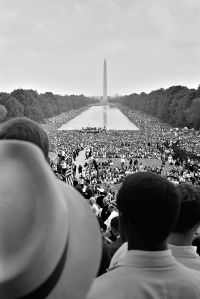
The crowd gathered on the Mall as seen from the Lincoln Memorial.
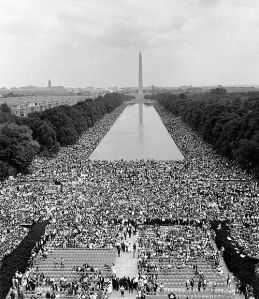
A participant in the March on Washington.
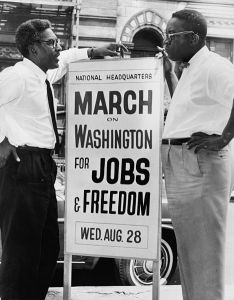
Bayard Rustin (left) and Cleveland Robinson (right), organizers of the March, on August 7, 1963.
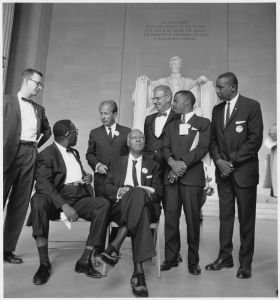
Civil Rights March on Washington, D.C. (Leaders of the march).
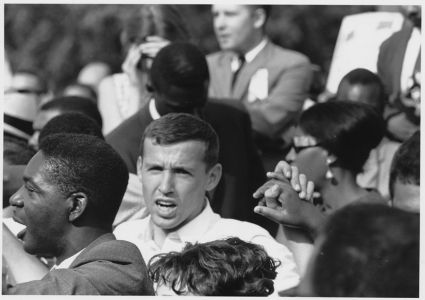
Nearly 250,000 people marched, including 60,000 white participants.
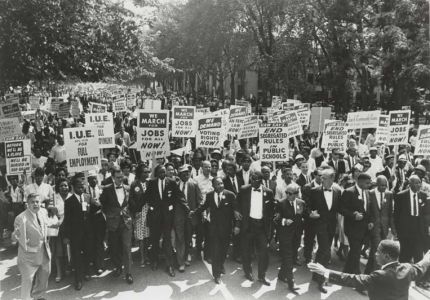
Leaders arrive late and link arms in front of marchers on Constitution Avenue.
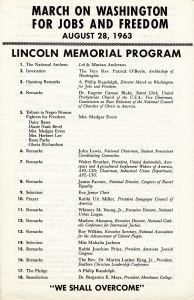
March on Washington for Jobs and Freedom program.
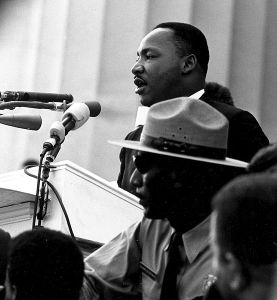
Martin Luther King, Jr. delivering his "I Have a Dream" speech.


_-_NARA_-_542056.jpg)
_-_NARA_-_542070.jpg)


After 1965: division of the black movement

The fight for civil rights in the United States has been characterised by a variety of philosophies and strategies. The Civil Rights Act of 1964 represented a major legislative victory against segregation and marked a significant advance in the fight for equal civil rights. However, it did not mean the end of the struggle for many activists. Martin Luther King Jr. and other advocates of integration and non-violence saw the legislation as an important step towards equal opportunity and full integration, but they recognised that the law alone could not eliminate socio-economic disparities or deep-rooted prejudices in society. They continued to campaign for deeper changes, including economic rights and the elimination of all forms of racial discrimination. On the other hand, there were those in the civil rights movement who were more sceptical about integration into white society, if not outright at odds with it. These individuals and groups, sometimes referred to as Black separatists or Black nationalists, advocated Black self-determination, economic autonomy and, in some cases, the creation of a separate nation for people of African descent. Figures such as Malcolm X and groups such as the Nation of Islam, and later the Black Panther Party, were associated with this philosophy. This period saw an intensification of debate about the best strategies for achieving real equality and social justice. The following years saw the emergence of more radical movements that moved away from the non-violent strategy advocated by Martin Luther King Jr, reflecting growing frustration with slow improvements in living conditions and persistent racism.
The rise of the Black Power movement in the 1960s represented a significant evolution in the struggle for civil rights in the United States, marking a shift towards more assertive and sometimes militant forms of expression and advocacy. This movement emphasised racial pride and self-determination, with figures such as Stokely Carmichael at the forefront and groups such as the Black Panther Party embodying this new phase with an approach that combined armed self-defence with social programmes to support black communities. However, this period also saw a slowdown in federal support for civil rights initiatives, despite legislative victories such as the Civil Rights Act and the Voting Rights Act. With the escalation of the Vietnam War, political priorities were redirected to international issues, shifting resources and attention away from civil rights issues. At the same time, there was a conservative backlash, with some segments of the white population perceiving advances in civil rights as a threat to their status. Moreover, after the passage of major legislation, there was a widespread perception that the legislative objectives had been achieved, despite the persistence of systemic inequalities. This legislative saturation, combined with a lack of ongoing commitment from some government officials and political opposition, contributed to a decline in federal support for the movement. The growth of the movement and the emergence of more radical groups also raised concerns within government, where issues of radicalism and violence sometimes hampered federal support. Thus, the late 1960s and early 1970s were characterised by a shift in the dynamics of the civil rights movement. From the struggle for integration and equality before the law, the focus broadened to include power, autonomy and responding to the systemic and structural inequalities that continued to affect black communities across the United States.

.jpg)
Distinguishing between the experiences of black Americans in different parts of the country is crucial to understanding the dynamics of the civil rights movement and the impact of the legislation that was passed during this period. The Voting Rights Act of 1965 marked a major advance by targeting the discriminatory practices that had historically prevented blacks in the South from exercising their right to vote. However, for the millions of blacks living in the urban ghettos of the North and West, the challenges were often different and less linked to official segregation laws than those in the South. In the North and West, discrimination was more rooted in systemic practices of economic racism, residential segregation and inequalities in education and employment. These problems could not be directly addressed by laws protecting voting rights. In the major cities of the North and West, ghettos were formed largely as a result of unofficial and official redlining policies, restrictive deed covenants, and employment discrimination that limited economic and social opportunities for blacks. These policies resulted in the creation of deprived urban environments that perpetuated poverty and social isolation. While the Civil Rights Act of 1964 and the Voting Rights Act of 1965 marked significant legal victories against institutionalized racism, these laws did not directly address systemic racism or deep-rooted economic inequalities. As a result, despite legislative progress in the South, many blacks in other regions continued to live in conditions of extreme poverty and marginalisation. The civil rights movement therefore gradually turned its attention to these issues of economic and social justice, leading to campaigns such as the Poor People's Campaign, which emphasised the need to broaden the struggle to include economic and housing issues. It also led to the emergence of other movements that sought to address conditions in the ghettos more directly and to strengthen the black community from within, including community economic development initiatives and black self-determination movements.
The assassinations of emblematic civil rights figures had a profound effect on the nation and the movement as a whole. The death of Malcolm X in February 1965, followed by those of Martin Luther King Jr. and Robert F. Kennedy in 1968, represented devastating losses for millions of Americans fighting for social justice and an end to racial discrimination. Malcolm X, known for his more militant outlook and calls for black self-determination, had begun to influence the more radical thinking of the civil rights movement, especially after his move away from the Nation of Islam and his trip to Mecca changed his vision of interracial collaboration and unity. His assassination therefore came as a shock to black communities and meant the loss of a voice that advocated both autonomy and a move towards more direct engagement in social change. The assassination of Martin Luther King Jr, the best-known face of the non-violent civil rights struggle, had an even deeper impact. He was seen as America's moralizer, using civil disobedience and powerful rhetoric to bring about peaceful change. His death left a huge void and prompted revolts in over 100 American cities, known as the Holy Week Uprising. Robert Kennedy, another civil rights activist and presidential candidate, was assassinated shortly after Martin Luther King Jr. His commitment to the cause of civil rights and his call for national unity raised hopes for a fairer America. With his death, many felt the loss of an opportunity to make that hope a reality. The assassinations, coupled with the endemic violence and riots that erupted in the ghettos of the North and California, projected the image of a nation in the grip of deep internal conflict. The riots were often triggered by incidents of police brutality, persistent inequality and frustrations built up over generations. These revolts have been met with intense repression, sometimes involving the National Guard and military forces. The combination of killings and riots contributed to a sense of urgency and national crisis. It not only exposed deep-rooted racial divisions but also underlined the considerable resistance to moving towards a truly egalitarian society. The chaos and instability of this period marked a turning point in American history, posing fundamental challenges to national consciousness and identity.
The explosive violence and unrest that shook the northern ghettos and other urban areas across the United States in the 1960s can be attributed in part to the great economic and social divide between these neighbourhoods and the more affluent suburban residential areas. Residents of urban ghettos often faced high unemployment, substandard housing, inferior education, and de facto segregation that persisted even after the legal abolition of de jure segregation. These conditions, combined with police brutality and systemic economic exclusion, created fertile ground for frustration and anger. The proposal for a solution similar to the Marshall Plan is a reference to the ambitious programme of financial aid put in place by the United States after the Second World War to help rebuild European countries devastated by war. Such a plan, when applied to American ghettos, suggests the need for a deep and sustained commitment in terms of investment in infrastructure, education, housing and economic opportunity to repair the damage caused by decades of neglect and discrimination. The idea would be to pursue a policy of internal reconstruction that tackles the roots of social and economic inequality in a holistic way. This would include not only substantial funding but also policy change to ensure that marginalised communities have access to the resources they need to thrive, including fair access to employment opportunities, quality education, affordable housing, adequate healthcare and political representation. This kind of radical intervention would have the potential to transform troubled communities and address some of the systemic issues that lead to violence and unrest. However, such an initiative would require significant political will and public support, as well as collaboration between local and federal governments, private businesses and the communities themselves.
The presidency of Lyndon B. Johnson's presidency was marked by two ambitious efforts that ultimately collided: on the one hand, his 'Great Society' and the War on Poverty, which sought to transform the American social and economic landscape, and on the other, his escalation of US military involvement in the Vietnam War. Johnson launched ambitious national programmes, which included major initiatives such as Medicare, Medicaid, education reforms and grants for urban development projects. These programmes aimed to eradicate poverty and hunger and improve education and healthcare for all Americans. However, the Vietnam War was beginning to consume an increasing proportion of American resources, both financial and human. Conscription for the Vietnam conflict affected all sectors of American society, but the burden fell disproportionately on young men from disadvantaged backgrounds, including many African-Americans. This exacerbated frustration in communities that benefited least from the Great Society's programmes, while paying a high price in a distant and increasingly unpopular conflict. Discontent was not limited to the black community. In 1968, young people around the world were rising up against what they perceived as injustices, social rigidities and authoritarian policies. In the United States, this took the form of anti-war demonstrations, uprisings in urban ghettos, and a culture of protest that permeated the music, art and literature of the time. The social and political chaos of 1968 helped to create a climate that favoured the election of Richard Nixon. Nixon campaigned on a promise to restore order and to support the "silent majority" of Americans who, he argued, wanted a return to stability without the social upheaval that had characterised the late 1960s. This promise of stability, combined with a strategy that sought to capitalise on racial divisions and the backlash against the civil rights movement, ultimately contributed to his electoral success.
The 1968 presidential election revealed the deep divisions that persisted in American society, particularly on the issue of civil rights and racial segregation. George Wallace, former Governor of Alabama, had become known for his unwavering support for segregation, symbolised by his infamous proclamation of "segregation now, segregation tomorrow, segregation forever". His bid for the presidency as a candidate of the American Independent Party attracted a significant base of voters who were resistant, even hostile, to the changes brought about by the civil rights movement. Wallace's campaign resonated particularly strongly in the Southern states, but he also attracted votes in other parts of the country, revealing a resistance to civil rights progress that went beyond the traditional geographical boundaries of the Deep South. By promoting overtly segregationist policies and playing on the fears and prejudices of his electorate, Wallace sought to capitalise on the racial and social tensions of the time. Although his candidacy was not successful in terms of electoral victory, it nevertheless shook up the American political landscape. The voices he gathered proved that segregationist and discriminatory attitudes remained deeply rooted among some Americans. Wallace's campaign highlighted the need for a continuing commitment to the fight for equal rights and social justice, emphasising that the passage of laws such as the Civil Rights Act and the Voting Rights Act was only one step in the long process of changing attitudes and social structures. Wallace's failure also demonstrated that, despite resistance, America was slowly moving towards greater acceptance of the principles of equality and justice for all. It encouraged civil rights activists to continue their hard work, knowing that every action, every march and every speech contributed to building a more inclusive and just nation.
Annexes
- Weiss, Jana (2017). "Remember, Celebrate, and Forget? The Martin Luther King Day and the Pitfalls of Civil Religion", Journal of American Studies
- Martin Luther King Jr. Day of Service official government site
- [King Holiday and Service Act of 1994] at THOMAS
- Remarks on Signing the King Holiday and Service Act of 1994, President William J. Clinton, The American Presidency Project, August 23, 1994
- I Have a Dream: Martin Luther King Jr. and the Future of Multicultural America, James Echols – 2004
- Alexandra Alvarez, "Martin Luther King's 'I Have a Dream': The Speech Event as Metaphor", Journal of Black Studies 18(3); doi:10.1177/002193478801800306.
- Hansen, D, D. (2003). The Dream: Martin Luther King Jr. and the Speech that Inspired a Nation. New York, NY: Harper Collins. p. 58.
- "Jones, Clarence Benjamin (1931– )". Martin Luther King Jr. and the Global Freedom Struggle (Stanford University).
- Horwitz, Morton J. (Winter 1993). "The Warren Court And The Pursuit Of Justice". Washington and Lee Law Review. 50.
- Powe, Jr., Lucas A. (2002). The Warren Court and American Politics. Harvard University Press.
- Swindler, William F. (1970). "The Warren Court: Completion of a Constitutional Revolution" (PDF). Vanderbilt Law Review. 23.
- Driver, Justin (October 2012). "The Constitutional Conservatism of the Warren Court". California Law Review. 100 (5): 1101–1167. JSTOR 23408735.
- Myrdal, Gunnar (1944). An American dilemma: The negro problem and modern democracy. New York: Harper & Bros.
- Inbody, Donald S. The Soldier Vote War, Politics, and the Ballot in America. Palgrave Macmillan US :Imprint: Palgrave Macmillan, 2016.
- Schønheyder, Caroline Therese. “U.S. Policy Debates Concerning the Absentee Voting Rights of Uniformed and Overseas Citizens, 1942-2011.” Thesis / Dissertation ETD, 2011.
- Coleman, Kevin. (2010). The Uniformed and Overseas Citizens Absentee Voting Act: Overview and Issues.
- US Policy Debates Concerning the Absentee Voting Rights, United States. Congress, U.S. Government Printing Office, 1944
- Krenn, Michael L. The African American Voice in U.S. Foreign Policy since World War II. Garland Pub., 1999.
- Maxwell, William J. F.B. Eyes: How J. Edgar Hoover's Ghostreaders Framed African American Literature. Princeton Univ. Press, 2017.
- Executive Order 9981 - On July 26, 1948, President Truman issued Executive Order 9981 establishing equality of treatment and opportunity in the Armed Services. This historic document can be viewed here.
- Jon E. Taylor, Freedom to Serve: Truman, Civil Rights, and Executive Order 9981 (Routledge, 2013)
- Patterson, James T. (2001). Brown v. Board of Education: A Civil Rights Milestone and Its Troubled Legacy. Oxford University Press. ISBN 978-0195156324.
- Abraham, Henry J. (1992). Justices and Presidents: A Political History of Appointments to the Supreme Court (3rd ed.). New York: Oxford University Press. ISBN 978-0-19-506557-2.
- Belknap, Michael (2005). The Supreme Court Under Earl Warren, 1953–1969. The University of South Carolina Press. ISBN 978-1-57003-563-0.
- Cray, Ed (1997). Chief Justice: A Biography of Earl Warren. ISBN 978-0-684-80852-9.
- Powe, Lucas A. (2000). The Warren Court and American Politics. Belknap Press. ISBN 978-0674006836.
- Schwartz, Bernard (1983). Super Chief: Earl Warren and His Supreme Court, A Judicial Biography. New York University Press. ISBN 9780814778265.
- Urofsky, Melvin I. (2001). The Warren Court: Justices, Rulings, and Legacy. ABC-CLIO. ISBN 9781576071601.
- See, e.g., Cumming v. Richmond County Board of Education, Berea College v. Kentucky, Gong Lum v. Rice, Missouri ex rel. Gaines v. Canada, and Sweatt v. Painter
- Aguiar, Marian; Gates, Henry Louis (1999). "Southern Christian Leadership Conference". Africana: the encyclopedia of the African and African American experience. New York: Basic Civitas Books. ISBN 0-465-00071-1.
- Cooksey, Elizabeth B. (December 23, 2004). "Southern Christian Leadership Conference (SCLC)". The new Georgia encyclopedia. Athens, GA: Georgia Humanities Council. OCLC 54400935. Retrieved February 12, 2008.
- Fairclough, Adam. To Redeem the Soul of America: The Southern Christian Leadership Conference and Martin Luther King, Jr. (University of Georgia Press, 2001)
- Garrow, David. Bearing the Cross: Martin Luther King, Jr., and the Southern Christian Leadership Conference (1986); Pulitzer Prize
- Meier, August; Rudwick, Elliott M. (1975). CORE: A Study in the Civil Rights Movement, 1942-1968. University of Illinois Press. ISBN 9780252005671.
- Frazier, Nishani (2017). Harambee City: Congress of Racial Equality in Cleveland and the Rise of Black Power Populism. University of Arkansas Press. ISBN 1682260186.<
- Congress of Racial Equality Official website
- Harambee City: Archival site incorporating documents, maps, audio/visual materials related to CORE's work in black power and black economic development.
- Catsam, Derek (2009). Freedom's Main Line: The Journey of Reconciliation and the Freedom Rides. University Press of Kentucky. ISBN 9780813173108.
- Niven, David (2003). The Politics of Injustice: The Kennedys, the Freedom Rides, and the Electoral Consequences of a Moral Compromise. University of Tennessee Press. ISBN 9781572332126.
- PEDAGOGÍA INTERNACIONAL: CUANDO LA INSTRUCCIÓN CÍVICA SE CONVIERTE EN UN PELIGRO PARA LA VIDA..., R. UEBERSCHLAG - The student, international student magazine.
- Whitby, Kenny J. The Color of Representation: Congressional Behavior and Black Interests. University of Michigan Press, 1997. JSTOR, www.jstor.org/stable/10.3998/mpub.14985.
- The Voter Education Project, King Research & Education Institute ~ Stanford University.
- Voter Education Project, Civil Rights Movement Veterans
- Tyson, Timothy B. (2017). The Blood of Emmett Till, Simon & Schuster. ISBN 978-1-4767-1484-4
- Anderson, Devery S. (2015). Emmett Till: The Murder That Shocked the World and Propelled the Civil Rights Movement. Jackson, MS: University Press of Mississippi, 2015.
- Houck, Davis; Grindy, Matthew (2008). Emmett Till and the Mississippi Press, University Press of Mississippi. ISBN 978-1-934110-15-7
- Whitaker, Hugh Stephen (1963). A Case Study in Southern Justice: The Emmett Till Case. M.A. thesis, Florida State University.
- The original 1955 Jet magazine with Emmett Till's murder story pp. 6–9, and Emmett Till's Legacy 50 Years Later" in Jet, 2005.
- Documents regarding the Emmett Till Case. Dwight D. Eisenhower Presidential Library
- Federal Bureau of Investigation. Prosecutive Report of Investigation Concerning (Emmett Till) Part 1 & Part 2 (PDF).
- Hogan, Wesley C. How Democracy travels: SNCC, Swarthmore students, and the growth of the student movement in the North, 1961–1964.
- Hogan, Wesley C. Many Minds, One Heart: SNCC's Dream for a New America, University of North Carolina Press. 2007.
- Carson, Clayborne (1981). In Struggle, SNCC and the Black Awakening of the 1960s. Harvard University Press.
- Student Nonviolent Coordinating Committee Founded ~ Civil Rights Movement Veterans.
- The Voter Education Project, King Research & Education Institute ~ Stanford University.
- Faubus, Orval Eugene. Down from the Hills. Little Rock: Democrat Printing & Lithographing, 1980. 510 pp. autobiography.
- Anderson, Karen. Little Rock: Race and Resistance at Central High School (2013)
- Baer, Frances Lisa. Resistance to Public School Desegregation: Little Rock, Arkansas, and Beyond (2008) 328 pp. ISBN 978-1-59332-260-1
- Kirk, John A. "Not Quite Black and White: School Desegregation in Arkansas, 1954-1966," Arkansas Historical Quarterly (2011) 70#3 pp 225–257 in JSTOR
- "Civil rights rider keeps fight alive" . Star-News. 30 June 1983. pp. 4A
- Civil Rights Act of 1964 (Pub.L. 88–352 , 78 Stat. 241 , enacted July 2, 1964)*Civil Rights Act Passes in the House ~ Civil Rights Movement Veterans
- "A Case History: The 1964 Civil Rights Act". The Dirksen Congressional Center.
- The Voting Rights Act of 1965: Background and Overview (PDF), Congressional Research Service
- Brown v. Board of Education 347 U.S. 493 (1954)
- Brown v. Board of Education 349 U.S. 294 (1955)
- Bolling v. Sharpe 347 U.S. 497 (1955)
Références
- ↑ Aline Helg - UNIGE
- ↑ Aline Helg - Academia.edu
- ↑ Aline Helg - Wikipedia
- ↑ Aline Helg - Afrocubaweb.com
- ↑ Aline Helg - Researchgate.net
- ↑ Aline Helg - Cairn.info
- ↑ Aline Helg - Google Scholar
- ↑ Stephen Lucas et Martin Medhurst, « "I Have a Dream" Speech Leads Top 100 Speeches of the Century », University of Wisconsin News, University of Wisconsin–Madison, 15 décembre 1999 (lire en ligne).
- ↑ A "Dream" Remembered, NewsHour, 28 août 2003.
- ↑ Goduti Jr., Philip A. (2012). Robert F. Kennedy and the Shaping of Civil Rights, 1960-1964. McFarland. ISBN 9781476600871.
- ↑ Goldzwig, Steven R.; Dionisopolous, George N. (1989). "John F. Kennedy's civil rights discourse: The evolution from "principled bystander" to public advocate". Communication Monographs. Speech Communication Association. 56 (3): 179–198. doi:10.1080/03637758909390259. ISSN 0363-7751.
- ↑ Loevy, Robert D. (1997). The Civil Rights Act of 1964: The Passage of the Law That Ended Racial Segregation (illustrated ed.). SUNY Press. ISBN 9780791433614.