大萧条与新政:1929 - 1940年
根据 Aline Helg 的演讲改编[1][2][3][4][5][6][7]
美洲独立前夕 ● 美国的独立 ● 美国宪法和 19 世纪早期社会 ● 海地革命及其对美洲的影响 ● 拉丁美洲国家的独立 ● 1850年前后的拉丁美洲:社会、经济、政策 ● 1850年前后的美国南北部:移民与奴隶制 ● 美国内战和重建:1861-1877 年 ● 美国(重建):1877 - 1900年 ● 拉丁美洲的秩序与进步:1875 - 1910年 ● 墨西哥革命:1910 - 1940年 ● 20世纪20年代的美国社会 ● 大萧条与新政:1929 - 1940年 ● 从大棒政策到睦邻政策 ● 政变与拉丁美洲的民粹主义 ● 美国与第二次世界大战 ● 第二次世界大战期间的拉丁美洲 ● 美国战后社会:冷战与富裕社会 ● 拉丁美洲冷战与古巴革命 ● 美国的民权运动
20 世纪 20 年代,欣欣向荣,充满无忧无虑的乐观主义,常被称为 "咆哮的二十年代"。这一时期的美国欣欣向荣,富足和成功似乎已成为常态。然而,随着 1929 年 10 月股市崩盘,这个富裕和欣喜的时代戛然而止,为严峻的大萧条拉开了序幕。这场美国历史上最具破坏性的经济灾难,将一个曾经繁荣昌盛的国家变成了一个因大量失业、普遍贫困和金融不稳定而陷入困境的国家。
大萧条不仅震撼了经济,还践踏了美国人民的灵魂和精神。数百万人不仅失去了工作,还失去了对繁荣未来的信心。企业和银行纷纷破产,留下的是一片荒凉和无助。作为经济支柱的农民被剥夺了土地,更加深了人们的绝望感。
危机在美国人的心中种下了怀疑和不确定性,他们曾经对自己繁荣昌盛的国家充满乐观和信心。对经济体系和政府的极度不信任油然而生,彻底改变了国民的心理。然而,在这绝望的深渊中,富兰克林-D-罗斯福新政的创新政策犹如一束光亮出现了。大胆的改革和政府对经济的更多参与开始了一个愈合的过程,为逐步复苏奠定了新的基础。
大萧条不仅重构了美国政治,推动了共和党向民主党的权力转移,还促使人们重新深刻审视公民与国家之间的关系。民主党曾经与南方和天主教移民联系在一起,如今却成为受危机打击最严重的工人阶级和中产阶级的拥护者。美国的政治格局被重新定义,随之而来的是一个复兴和社会转型的时代。
这场巨大的动荡催生了百花齐放的社会运动、对文化价值观的重新评估以及对民族身份的重新定义。大萧条在美国历史上留下了不可磨灭的伤痕,它沉痛地提醒人们,在不可预测的经济力量面前,人类是脆弱的。然而,大萧条也展现了美国的韧性和创新能力,彰显了美国在最具破坏性的考验中重塑自我的不容置疑的能力。
1929 年股市崩盘的原因
1929 年的股市崩盘并不仅仅是欧洲经济不稳定或欧洲国家无力偿还一战后向美国银行贷款的结果。相反,它是经济、金融和政治因素综合作用的结果,每一个因素都造成了毁灭性的崩溃。20 世纪 20 年代,股市投机盛行。不切实际的乐观情绪导致许多投资者将巨额资金投入股市,而且往往是赊账。这导致股价人为膨胀,形成了脆弱的金融泡沫。保证金购买或过度使用信贷购买股票使情况变得更糟。当信心崩溃时,许多投资者发现自己无力偿还贷款,从而加剧了危机。缺乏强有力的金融监管纵容了高风险和不道德的行为,使股市和银行变得不稳定。此外,恐慌和匆忙抛售加剧了市场崩溃。史无前例的股票抛售量导致股价暴跌。除了股市的动态变化,美国经济还存在深层次的问题。财富不平等、工农业生产过剩和消费下降都导致经济基础脆弱。银行在股市投入巨资或借钱给投资者购买股票,在股票价值暴跌时受到重创。银行的倒闭加剧了信心危机,进一步减少了获得信贷的机会。欧洲的不稳定和欧洲国家无力偿还债务也在危机中发挥了作用。世界经济的相互联系将一场国家危机变成了一场国际灾难。这些因素交织在一起,创造了一个大规模经济崩溃不可避免的环境。国际经济不稳定加剧了无管制投机、宽松信贷、潜在经济不稳定和恐慌性抛售等有毒因素的混合。这凸显了对股票市场和银行系统加强监管和监督的迫切需要,导致在随后的几年里进行了实质性改革,以防止此类灾难再次发生。
导致 1929 年股市崩盘的国际和国内因素之间的这种对立是关于大萧条起源的争论的核心。国际经济紧张局势,尤其是欧洲债务,不容忽视。然而,仔细观察会发现,美国的基本经济动态也发挥了关键作用。在 "咆哮的二十年代",以巨大的技术进步和工业扩张为特征的第二次工业革命灌输了一种经济不可战胜和明显繁荣的意识。在这一时期,新兴产业不断涌现,生产率不断提高,金融市场普遍欣欣向荣。然而,这种经济繁荣掩盖了脆弱的金融环境,过度的投机行为和危险的债务积累破坏了这一环境。20 世纪 20 年代的繁荣并不像看上去那么稳固。它的部分原因是容易获得信贷和无节制的股市投机。许多投资者被热情和乐观蒙蔽了双眼,没有意识到投机资本充斥的市场所蕴含的风险。亢奋掩盖了潜在的经济脆弱性,助长了不可持续的乐观情绪。当经济现实与投机行为背道而驰时,市场急剧下跌。投资者开始意识到潜在的不稳定性和金融不安全性。随后的股市崩盘不可避免,这不是因为外部压力,而是因为美国经济尚未解决的内部缺陷。在这种情况下,欧洲债务和国际不稳定仅仅是加剧危机的因素,而不是危机的根源。美国繁荣的基础并不稳定,由于不谨慎的金融行为和缺乏适当的监管而被掏空。随之而来的大萧条不仅是一次残酷的市场调整,也是对一个长期沉浸在经济自满情绪中的国家的一次粗暴唤醒。大萧条表明,必须在创新、增长和金融审慎之间取得平衡,这为美国建立新的经济秩序奠定了基础。
这种由债务推动的投资狂热和无节制的乐观情绪是导致 1929 年股市崩盘的关键因素。当时的市场动态以集体亢奋为特征,对经济持续上升的盲目自信让谨慎退居其次。市场可能无限上扬的想法在许多投资者心中根深蒂固。他们的投资策略往往缺乏谨慎,在很大程度上以保证金购买股票为主。这种投机方式虽然在短期内有利可图,但本质上是脆弱的,使经济极易受到市场波动的影响。股价达到了极高的水平,而助推股价的不是坚实的经济基础,而是肆无忌惮的投机行为。股票的实际价值与认知价值之间的错位造成了不可持续的金融泡沫。每一个泡沫,无论大小,迟早都会破灭。1929 年的泡沫也不例外。当现实再次降临,投资者信心崩溃,股市陷入一片混乱。投资者,包括那些用保证金买入并已深陷债务泥潭的投资者,急于抛售,引发了股价迅速而无情的螺旋式下跌。大量投资者匆忙抛售股票加剧了危机,将一场或许不可避免的市场调整变成了一场规模惊人的经济灾难。其后果远远超出了华尔街,渗透到美国和全球经济的每一个角落。这场金融灾难不是单一因素的产物,而是无管制投机、宽松信贷和自满情绪等有毒因素综合作用的结果,一场完美风暴引发了现代经济史上最黑暗的时期之一。这次股灾的教训是显而易见的:如果没有审慎的监管和适当的监督,任由市场自生自灭,就很容易陷入过激行为,给每个人带来毁灭性的后果。
20 世纪 20 年代汽车和家用电器行业的迅速崛起是工业快速发展这把双刃剑的典型例子。尽管这些创新标志着一个表面繁荣的时代,但它们也为即将到来的经济危机埋下了种子。工业生产达到了历史最高水平,但与之相对应的需求却没有增长。生产能力超负荷运转的美国经济机器开始吱吱作响,产生的过剩商品远远超出了消费者的购买能力。工厂生产速度超过消费速度,生产过剩的幽灵成为令人担忧的现实。蓬勃发展的汽车和家用电器产业成了自身成功的牺牲品。国内市场已经饱和;每个买得起新车或家电的美国家庭都已经拥有了一辆。供需失衡引发了连锁反应,消费下降导致生产减少、滞销库存增加、公司利润下降。在本已动荡不安的金融环境中,经济放缓是一个令人担忧的征兆。股票市场长期以来一直是繁荣的源泉,但现在进行调整的时机已经成熟。股票估值过高,是投机而非公司内在价值的产物。商业信心的动摇引发了多米诺骨牌效应。投资者因紧张和不确定而撤出资金,使市场陷入螺旋式下跌。因此,1929 年的股市崩盘并非孤立事件,而是一系列相互关联因素的结果。工业生产过剩、市场饱和、股票估值过高以及商业信心丧失等因素交织在一起,形成了一个岌岌可危的经济环境。当经济崩溃来临时,它不仅仅是一次金融修正,更是对 20 世纪 20 年代繁荣所赖以建立的基础的一次残酷的重新评估。审慎和监管成为经济讨论的关键词,开创了一个时代,在这个时代,快速增长将因认识到其潜在的局限性和过度增长的危险而有所收敛。
消费信贷的兴起是 20 世纪 20 年代美国经济的一个显著特征,这是一个快速但不计后果的扩张时代。人们被眼前的繁荣所诱惑,纷纷举债享受超出自身能力的生活水平。便捷的信贷不仅刺激了消费,还催生了一种负债文化。然而,这种便捷的信贷渠道掩盖了国家经济基础的深刻裂痕。消费支出虽然很高,但却被债务人为地夸大了。个人和家庭被表面上的充裕和容易获得信贷所诱惑,积累了大量债务。这种态势造成的经济虽然表面上繁荣,但本质上是脆弱的,其稳定性取决于消费者管理和偿还债务的能力。当 "咆哮的二十年代 "的乐观情绪让位于经济衰退的现实时,这种扩张性信贷体系的脆弱性就显现出来了。消费者本已负债累累,现在又面临着不确定的经济前景,他们纷纷削减开支。由于无力偿还债务,违约和消费衰退的恶性循环开始出现,加剧了经济放缓。这种突然的逆转暴露了以债务和投机为基础的经济的不足。信心的崩溃和信贷的收缩引发了一场不仅席卷美国,而且席卷全球经济的危机。个人、公司甚至国家都发现自己陷入了债务和违约的漩涡,迎来了一个衰退和重新调整的时代。这种情况凸显了谨慎、深思熟虑的信贷和债务管理的必要性。事实证明,宽松信贷和过度消费助长的经济亢奋是不可持续的。在大萧条的废墟上,一种新的经济和金融方法开始出现,这种方法认识到了无管制的繁荣所固有的危险,并在增长和金融稳定之间寻求一种更可持续的平衡。
20 世纪 20 年代盛行的低利率制度为 1929 年的股市崩盘埋下了伏笔。在低利率的推动下,信贷渠道的增加鼓励了消费者和投资者举债。在廉价资金唾手可得的环境下,谨慎理财往往被过度热情和对经济上升轨道的信心所取代。廉价货币不仅刺激了消费,还鼓励了股票市场的激烈投机。投资者凭借容易获得的信贷,涌入估值已经过高的市场,推动股价远远超出其内在价值。这种态势造成了一种过热的金融环境,实际价值与投机行为出现了危险的错位。纠正的方式是提高利率。虽然利率上调对于冷却过热的经济是必要的,但对投资者和借款人来说却是一个冲击。面对更高的借贷成本和日益沉重的债务负担,许多人被迫在股市上清仓。这种争相离场的行为导致了大规模抛售,引发了股价的快速和无节制下跌。利率倒挂揭示了建立在廉价信贷和投机活动基础上的经济的脆弱性。1929 年的股市崩盘和随后发生的大萧条,戏剧性地揭示了过度依赖债务的无节制经济增长的局限性和危险性。教训是惨痛的,但也是必要的。在危机发生后的几年里,人们更加关注货币政策和利率的审慎管理,认识到它们在稳定经济和防止投机过度可能导致经济灾难方面的核心作用。1929 年的灾难促使人们对经济管理的基本原则和做法进行了深刻的重新评估,强调了在增长的必要性与金融稳定和安全的必要性之间保持平衡的必要性。
缺乏强有力的监管是加剧 1929 年股市崩盘严重性的关键弱点。当时,股票市场在很大程度上是一个不受监管的领域,是一种金融 "狂野西部",政府的监督和投资者保护措施微乎其微,甚至根本不存在。这助长了肆无忌惮的投机、市场操纵和内幕交易。股市运作缺乏透明度和道德规范,造成了市场的高度动荡和不确定性。投资者缺乏可靠和准确的信息,往往被蒙在鼓里,被迫在一个信息不对称和操纵司空见惯的市场中游刃有余。任何健康的金融体系都离不开信任,但信任却被削弱,取而代之的是不确定性和投机。在这种情况下,欺诈和内幕交易激增,加剧了普通投资者的风险,因为他们往往没有能力了解或减轻市场固有的危险。监管保护措施的缺失加剧了他们的脆弱性,使得许多投资者只能任由反复无常且经常被操纵的市场摆布。崩盘发生时,这些结构性和监管方面的弱点被残酷地暴露出来。面对股市价值的急剧下跌,投资者在监管和保护基础设施不完善的情况下已无计可施。1929 年的灾难为政府和监管机构敲响了警钟。此后,以引入更严格的监督机制和保护投资者为特征的监管改革时代到来了。美国 1933 年《证券法》和 1934 年《证券交易法》等立法为建立一个更加透明、公平和稳定的股票市场奠定了基础。股市崩盘的惨痛教训揭示了监管和监督在维护金融市场诚信和稳定方面的极端重要性。它引发了人们对金融市场认识和管理方式的深刻变革,标志着监管和投资者保护成为金融稳定核心支柱时代的开始。
1929 年股市崩盘前夕,经济不平等是美国经济结构中一个潜在的、往往被忽视的薄弱环节。富人与工人阶级之间日益扩大的差距不仅仅是一个社会公正的问题,也是经济极度脆弱的一个因素。在 20 世纪 20 年代的繁荣时期,盛行着一种前所未有的繁荣和增长的说法。然而,这种繁荣并不是平均分配的。虽然财富和奢华表面上展现在社会上层,但相当一部分美国人的经济状况却岌岌可危。工人阶级虽然是工业生产和增长的基础,但他们只是财富的边缘受益者。财富分配上的这种失衡在经济内部造成了紧张和裂痕。消费是经济增长的重要动力,但由于大多数工人的实际工资不足而受到影响。他们充分参与消费经济的能力受到了限制,这就造成了生产过剩和债务日益增加的态势。在这种情况下,消费者的信心十分脆弱。工薪阶层家庭面临着不断上涨的生活费用和停滞不前的工资,很容易受到经济冲击的影响。当经济衰退的迹象出现时,他们吸收和克服冲击的能力有限。他们放弃消费加剧了经济放缓,使温和的衰退变成了严重的萧条。这种财富不平等现象的暴露对经济和社会政策产生了深远的影响。财富分配的差距不仅仅是社会不公平,而且是经济缺陷,可能会放大繁荣和萧条的周期。认识到经济公正、工资稳定和工人保护的重要性,成为大萧条后几年政治和经济应对措施的核心,塑造了一个改革和复苏的时代。
财富集中在少数精英手中不仅是导致 1929 年经济崩溃的一个因素,也加剧了随后大萧条的严重性。国家的大部分财富掌握在一小部分人手中,这种差距削弱了整个社会的经济复原能力。在一个以消费为主要增长动力的经济体中,大众购买商品和服务的能力至关重要。工人和中产阶级的实际工资停滞不前,降低了他们的购买力,导致需求萎缩。需求减少反过来又影响了生产。面对销售额的下降,企业纷纷减产裁员,形成了失业和消费下降的恶性循环。工薪阶层和中产阶级没有足够的经济来源,无法推动经济复苏。企业的投资和扩张能力也因市场需求萎缩而受阻。最富有阶层积累的利润和红利不足以刺激经济,因为这些利润和红利往往没有以消费或生产性投资的形式重新投入经济。这凸显了一个重要的认识:财富的公平分配不仅是一个社会公正问题,也是经济发展的当务之急。经济要想健康发展并具有韧性,就必须广泛分享增长带来的好处,以确保强劲的需求并支持生产和就业。应对大萧条的措施,特别是新政政策,反映了这一认识。为提高工人的购买力、规范金融市场和投资公共基础设施以创造就业机会,政府采取了各种举措。这标志着向更具包容性的经济繁荣愿景过渡,财富和机会的分配被视为经济稳定和增长的核心支柱。
大萧条极大地调整了美国的经济和社会政策。经济灾难暴露了深层次的结构性缺陷和不平等,而这些问题在很大程度上以前都被忽视或低估了。为稳定经济、保护最弱势公民和减少不平等现象,国家进行积极干预的必要性变得十分明显。富兰克林-罗斯福新政的出现标志着美国人对政府作用看法的转折点。虽然大萧条之前的主流意识形态倾向于自由放任和尽量减少政府干预,但危机使这种做法受到质疑。显然,仅靠市场不足以保证稳定、繁荣和公平。新政采取救济、恢复和改革三管齐下的战略,从多方面应对危机。救济意味着为数百万面临贫困、失业和饥饿的美国人提供直接和即时的援助。这不仅是一项人道主义措施,也是一项振兴消费需求和刺激经济的战略。复苏的重点是振兴经济的关键部门。通过大规模的公共工程项目和其他举措,政府努力创造就业机会,提高购买力,启动螺旋式上升的增长和信心。花在基础设施建设或工资上的每一美元都会转嫁到经济中,促进消费和投资。然而,改革也许是新政最持久的方面。新政旨在从结构上改变经济,防止导致大萧条的错误重演。这包括加强对金融部门的监管、保证银行存款以及减少经济不平等的政策。因此,大萧条和新政的应对措施重新定义了美国的社会和经济契约。它们强调了在市场自由与政府干预、经济增长与公平、个人繁荣与集体福祉之间取得平衡的必要性。这一转变塑造了未来几十年美国政治和经济的轨迹。
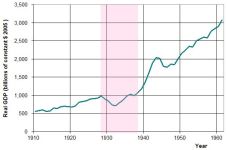
1910 年至 1960 年美国年度实际国内生产总值,其中突出显示了大萧条时期(1929-1939 年)。
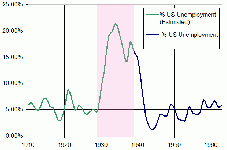
1910 年至 1960 年美国的失业率,其中突出显示了大萧条时期(1929-1939 年)。

道琼斯工业指数,1928-1930 年。
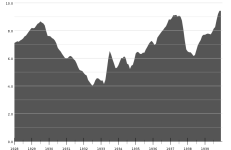
美国工业生产(1928-39 年)。

美国农产品价格(1928-1935 年)。
- GDP depression.png
以 2000 年定值美元计算的人均国内生产总值(人均收入)所反映的美国经济萧条的总体演变情况,以及这一时期的一些重要事件。[8]


.JPG)
产出增长与工资停滞之间的不匹配是加剧大萧条严重性的关键因素之一。经济的繁荣不仅取决于创新和生产,还取决于强劲和可持续的需求,这就要求收入的均衡分配。如果在 20 世纪 20 年代能够特别关注工人的公平报酬,并确保将生产率的提高转化为更高的工资,那么国家本可以更好地抵御经济衰退。工人和家庭本来会有更多的财力来维持消费,从而缓解经济紧缩的影响。换句话说,一个广泛共享繁荣的经济体更有韧性。它比财富集中在少数人手中的经济更能承受经济冲击。在体面的工资和公平的收入分配的推动下,消费需求能够在困难时期维持企业和就业。前提是,每个工人不仅是生产者,也是消费者。如果工人工资高,他们就会消费更多,从而刺激需求,而需求又反过来支持生产和就业。这是一个生产与消费和谐共存的经济生态系统。1929 年的经济崩溃和随后的大萧条为这种平衡的重要性提供了宝贵的经验教训。尽管经济不平等和薪酬公平的挑战仍然是当代的一个问题,但随后的改革和政策一直在努力恢复和维持这种平衡,这也重申了从经济史上那段动荡时期吸取的经验教训的现实意义。
价格调整可以成为平衡供需的有效机制,尤其是在消费者购买力有限的情况下。从理论上讲,降低价格可以刺激消费,从而改善企业的流动性并支持经济。在 20 世纪 20 年代,生产增加和工资停滞不前共同造成了供不应求的失衡。生产的商品超过了市场的消化能力,这主要是因为消费者的购买力受到工资水平不足的限制。通过降低价格,企业本可以使其产品更容易获得,从而刺激需求,减少未售出库存的积累。然而,应该指出的是,这一战略也有其挑战性。降价会侵蚀企业的利润空间,可能使企业陷入困境,尤其是在企业已经因其他经济因素而处于弱势的情况下。此外,普遍降价或通货紧缩可能会对经济产生不利影响,如鼓励消费者推迟购买,以期待更低的价格,从而加剧经济放缓。因此,尽管降价在短期内可能是增加需求的可行策略,但必须谨慎从事,并结合更广泛的经济战略。将这一方法与提高消费者购买力的举措相结合,例如通过提高工资或实行优惠的税收政策,创造一个生产与消费动态平衡的环境,可能会更有益处。
当时的环境特点是过度乐观,对市场的永久增长抱有不可动摇的信念,不愿对自由市场机制进行干预。当时的共和党政府根植于自由放任原则,不愿干预经济事务。当时的主流思想是,市场会自我调节,政府干预弊大于利。这种思想虽然在经济繁荣时期有效,但事实证明不足以预防或缓解迫在眉睫的危机。同样,许多工商业领袖也受困于短期愿景,只关注眼前利益的最大化,而非长期的可持续发展。经济繁荣带来的欣喜往往掩盖了正在积累的警示信号和潜在失衡。过度自信、监管不力和缺乏纠正措施,这些因素结合在一起,为一场毁灭性危机的爆发创造了温床。1929 年的经济崩溃并非孤立事件,而是多年来经济和金融失衡累积的结果。从这一悲惨时期汲取的教训是,人们认识到需要审慎监管,需要有长远眼光,需要为经济不稳定做好准备。从大萧条中产生的政策和制度,包括加强监管和政府在经济中发挥更积极的作用,反映了人们对经济体系复杂性的认识,以及平衡增长、稳定和公平的必要性。
与繁荣的股票市场和迅速扩张的工业相比,农业部门虽然不那么耀眼,但却是经济和社会的基本支柱。第一次世界大战导致对农产品的需求急剧增加,促进了生产和价格。然而,战争结束后,全球需求萎缩,但产量却居高不下,导致供过于求,价格下跌。农民们发现自己的财务状况越来越岌岌可危,其中许多人的利润已经微薄。农业机械化也发挥了作用,它提高了产量,但也减少了对劳动力的需求,导致农村人口外流。农民和农村工人迁移到城市寻找更好的机会,推动了快速城市化,但也导致了城市劳动力市场的饱和。这些农村动态是大萧条的前兆和放大器。当股市崩盘、城市经济萎缩时,本已衰弱的农业部门无法起到平衡作用。农村贫困和困境加剧,扩大了经济危机的范围和深度。农业部门的复苏和农村社区的稳定成为复苏工作的基本要素。农业立法稳定价格、努力平衡生产与需求以及投资农村基础设施等新政举措,是振兴经济和建立一个更有韧性、更平衡的体系的总体战略的重要组成部分。
农业衰退的后果并不局限于农村地区,而是影响到了整个经济,产生了多米诺骨牌效应。农业部门的萎缩不仅减少了农民的收入,也减少了依赖农村地区的企业的收入。农业材料和设备供应商、零售商,甚至向农民提供贷款的银行都受到了影响。农村需求的萎缩减少了各行各业的收入和就业,使经济困境远远超出了农场和农业社区的范围。农产品价格下跌加剧了农民的负债,导致拖欠贷款和没收土地,影响了农村和城市金融机构的稳定。本已受到其他因素削弱的银行承受了更大的压力。这种连带效应凸显了经济的综合性和相互依赖性。一个部门的问题会影响到其他部门,造成螺旋式下滑,很难停止和扭转。在大萧条的背景下,农业部门的衰退既是更广泛的经济崩溃的症状,也是其催化剂。应对危机的政治和经济措施必须考虑到这种复杂性和相互依赖性。稳定和振兴农业部门的干预措施是恢复国家经济健康的整体努力的组成部分。提高农产品价格、支持农民收入和改善农村稳定的努力与恢复信心、刺激需求和实现总体经济复苏有着内在联系。
农村人口的困境是新政改革的主要催化剂。在大萧条期间,农民是受打击最严重的群体之一。生产过剩、农作物价格下跌、债务增加以及恶劣的气候条件(如沙尘暴期间出现的气候条件)共同导致了农村地区的经济和社会灾难。富兰克林-罗斯福总统发起的 "新政 "出台了一系列计划和政策,旨在缓解农业部门的困境。实施了《农业调整法》等措施,通过控制生产来提高农产品价格。政府希望通过向农民支付减产费用来提高价格,增加农民收入。政府还采取了其他措施,如制定《紧急农场抵押法》,为面临取消赎回权威胁的农民提供贷款。这有助于稳定农业部门,使农民能够保留土地并继续生产。此外,公共工程项目的实施不仅创造了就业机会,还有助于改善农村基础设施,将农村地区与城市市场连接起来,改善农产品的市场准入。这些政府干预措施在当时是史无前例的,标志着联邦政府在经济中的角色发生了根本变化。新政不仅带来了即时的救济,还为结构性改革奠定了基础,以防止今后再次发生此类经济灾难。它强调了平衡农业和工业部门的重要性,并加强了国家作为经济调节器和稳定器的作用。
由于当时的共和党政府无法有效应对农业危机,因此对国家的人口和经济动态产生了显著影响。自由放任的经济政策在很大程度上忽视了农村地区日益严重的困境。生产过剩和随之而来的农产品价格下跌使农民陷入了财政不稳定的境地。没有足够的支持,又面临债务和破产,许多农民被迫离开自己的土地。这种情况不仅加剧了农村地区的经济困境,还助长了向城市的移民。城市地区虽然在经济机会方面大有可为,但却被大量涌入的寻求就业和经济保障的工人所淹没。这种快速移民使城市资源紧张,加剧了提供住房、服务和就业方面的挑战。已经受到经济萎缩影响的城市劳动力市场趋于饱和,导致失业率和贫困率上升。在此背景下,大萧条揭示并加剧了美国经济和政治的潜在结构性弱点。大萧条突出表明,政府必须采取更有力的行动,对经济的各个领域给予均衡的关注。以 "新政 "为形式的应对措施标志着一个转折点,这不仅体现在具体政策上,也体现在对政府在经济中的作用的认识上。政府需要进行干预,以稳定经济、规范市场和支持处于困境中的公民,这已成为美国经济政策中公认的一部分,并影响了未来几十年的政治和经济格局。
快速城市化的趋势和农业部门的衰弱同时带来了一系列复杂的挑战,加剧了当时的经济问题。随着农村人口的减少,这些地区对商品和服务的需求也在减少。依赖农民和农村工人需求的当地企业受到影响,导致经济螺旋式下滑。更重要的是,大量农村劳动力涌入城市的同时,股市崩盘和随之而来的经济萎缩加剧了对本已稀缺的工作岗位的竞争。城市基础设施、社会服务和住房市场都没有做好应对人口如此快速增长的准备。这给城市资源带来了额外的压力,加剧了贫困和失业问题。农业部门的衰退也对工业和金融服务产生了影响。依赖农业需求的企业,无论是农业机械、化学品还是金融服务,也都受到了影响。农民的负债和拖欠款不断增加,影响了银行和金融机构的健康。农产品需求减少、负债、农村企业破产、城市人口不断增加但却没有足够的工作岗位等一系列因素加剧了整体经济形势。所有这些因素都导致了大萧条的深度和持续时间。罗斯福新政试图通过一系列计划和改革来解决这些相互关联的问题,这些计划和改革旨在稳定经济,为受影响最严重的人群提供直接救济,并改革经济和金融体系,以防止未来再次发生此类灾难。当时经济和社会挑战的复杂性和相互依赖性凸显了政府采取多方面协调行动的必要性。
农业部门的问题因生产过剩、价格下降和负债累累而加剧,在很大程度上被忽视。这种不作为,再加上 1929 年的股市崩盘,凸显了当时采用的自由放任经济方法的不足之处。农业部门是美国经济的重要组成部分,其恶化所造成的影响远远超出了农村地区。农民的经济实力本来就很薄弱,他们无力应对大萧条造成的经济动荡。国内需求减少、出口市场萎缩以及无法获得信贷加剧了危机。罗斯福政府的上台和新政的实施标志着政府政策的彻底转变。联邦政府首次采取重大措施干预经济,标志着与自由放任理念的背离。新政推出了《农业调整法》等措施,通过减少生产过剩来提高农产品价格。政府还提供低息贷款和补贴,帮助农民保留土地和继续经营。此外,还启动了公共工程项目,以创造就业机会和刺激经济活动。因此,虽然最初面对农业和金融危机无所作为,加剧了大萧条的影响,但随后的新政干预措施帮助减轻了一些最严重的苦难,稳定了经济,并为持久复苏和改革奠定了基础。这些举措还重新定义了联邦政府在管理经济和保护公民福利方面的作用,这一遗产至今仍在影响着美国的政策。
1929 年的经济崩溃及其后果

20 世纪 20 年代通常被称为 "咆哮的二十年代",其特点是表面繁荣和经济快速增长。然而,这种增长在很大程度上是不可持续的,因为它是建立在信贷大规模扩张和无节制投机的基础上的。宽松的信贷和低利率鼓励了一种超出消费者和投资者实际能力的消费和投资文化。人们被鼓励超前消费,对持续增长的过度自信助长了危险的投机泡沫。股市成为投机热的中心。数以百万计的美国人,从最富有的到最贫穷的,都把积蓄投入股市,希望迅速获利。股价将无限期上涨的信念如同海市蜃楼,吸引着各行各业的人们。然而,潜在的经济现实并不支持市场的亢奋情绪。当信心开始削弱、泡沫破灭时,市场的迅速逆转引发了恐慌。投资者纷纷清仓,但由于买家寥寥无几,股价大幅下跌。这次股市崩盘产生了多米诺骨牌效应,引发了严重的经济萎缩。消费者和投资者的信心严重动摇,导致支出和投资减少。银行也受到危机和随之而来的恐慌的影响,限制信贷,进一步加剧了经济衰退。随后发生的大萧条是对美国经济结构和监管进行深刻重新评估的时刻。它凸显了无节制投机和过度依赖信贷的危险,强调了在消费、投资和可持续经济增长之间实现更健康平衡的必要性。它还为政府加强监管以降低可能导致此类危机的风险和过度行为铺平了道路。
股市狂热和信贷扩张掩盖了美国经济深层次的结构性弱点。尤其是生产过剩,这不仅是工业部门的主要问题,因为工业部门的生产超过了需求,而且也是农业部门的主要问题。本已在低价和收入下降中挣扎的农民受到沉重打击,加剧了农村衰退和经济苦难。财富分配不均也是一个关键因素。一小部分精英享受着日益增长的繁荣,而大多数美国人的生活水平却没有显著提高。这种动态减少了总需求,因为大部分人口无力购买大量生产的商品。当股市投机泡沫破灭时,这些潜在的弱点就显现出来了。恐慌情绪迅速蔓延,投资者和消费者对经济稳定失去了信心,国家进入了经济萎缩、失业率上升和破产的下行通道。政府的应对措施和 "新政 "的出台凸显了政府进行更有力干预以纠正市场失衡和脆弱性的必要性。所实施的方案不仅要提供即时救济,还要启动结构改革,为未来的经济增长奠定更加坚实和公平的基础。这一时期标志着美国经济政策的概念和应用发生了重大转变。
1929 年的股市崩盘并不是一个孤立的事件,而是一系列结构性和系统性问题在美国经济中根深蒂固的最明显和最直接的表现。在容易获得信贷和低利率的鼓励下,肆无忌惮的投机行为创造了一种环境,在这种环境中,深思熟虑和审慎的投资往往被忽视,而倾向于快速获利。这种对短期利润的关注不仅助长了股市泡沫,还使资本偏离了本可支持可持续经济增长的生产性投资。此外,由于缺乏适当的监管和政府监督,市场缺乏有效的保障措施来防止投机过度和高风险的金融行为。由于政府没有积极干预,间接导致了不可持续的经济泡沫的形成。当股市泡沫破裂时,经济的潜在脆弱性暴露无遗。银行和金融机构受到重创,随着信贷紧缩,企业和消费者发现自己陷入了流动性紧缩的困境。信心崩溃,消费和投资也随之崩溃。大萧条要求对经济政策进行深刻的重新思考,并转向加大政府干预力度,以稳定经济、保护消费者和投资者,并为未来更加平衡和可持续的增长奠定基础。在当代关于经济监管、投机泡沫管理以及政府在促进公平和可持续增长中的作用的辩论中,那个时代的教训仍在产生共鸣。

这次股灾不仅仅是一次暂时的经济调整,而是一次灾难性的崩溃,对全球经济产生了深远而持久的影响。
股票价值的急剧下降令许多投资者措手不及。咆哮的二十年代 "市场欣欣向荣,财富似乎无止境地增长,但很快就变成了绝望和恐慌。大小投资者的投资组合价值暴跌,不仅侵蚀了他们的个人资产,也削弱了他们对金融体系的信心。恐慌迅速蔓延到华尔街之外。本已因不良贷款和投机性投资而衰弱的银行,又受到了恐慌性撤资浪潮的冲击。一些银行无法应对突如其来的流动性需求,被迫关门歇业。这加深了危机,使不信任和不确定性蔓延到整个经济体系。市场价值的迅速损失,加上恐慌和投资者撤资,标志着大萧条的开始。其影响远远超出了股票市场,波及全国各地的企业、工人和消费者,最终波及全世界。金融崩溃导致经济萎缩、大量失业、企业破产以及普遍的贫困和苦难。股市崩盘促使人们对金融体系及其监管机制进行彻底的重新评估。它严酷地揭示了不受监管的投机市场所固有的危险,并引发了重大改革,以加强金融体系的透明度、问责制和稳定性,从而防止今后再次发生此类灾难。
银行和信贷公司的倒闭是毁灭性的。尤其是银行系统,它是现代经济的支柱,促进了经济增长所需的信贷和投资。它的失败加剧了经济问题。银行的倒闭意味着许多人和企业失去了储蓄和获得信贷的机会。在这个世界上,从日常的个人财务管理到企业的经营和扩张,信贷都是必不可少的,银行的倒闭造成了深远的影响。企业被迫缩小经营规模或关闭,导致失业率迅速上升。不确定性和恐惧导致消费支出急剧萎缩。人们担心自己的经济前景,避免不必要的消费,造成需求、产出和就业减少的恶性循环。这种自我实现式衰退的特点是需求减少,而需求减少又导致生产减少,失业率上升。这场危机还凸显了货币和金融体系的脆弱性以及信心对经济稳定的重要性。事实证明,恢复信心是一个漫长而艰难的过程,需要深入改革和政府的大力干预,以稳定经济、改革金融和银行体系,并采取保障措施防止未来发生危机。这场经济灾难开创了一个转型时代,带来了新的、创新的经济政策,重新定义了政府、经济和公民之间的关系,并重新关注监管、社会保护和经济公平。
经济崩溃是大萧条历史上的一个决定性时刻。它不是一场短暂的危机,而是一个深刻而持久的经济困难时代的前奏,几乎影响到日常生活的方方面面。大萧条的广度和深度都是前所未有的。股市崩盘暴露并加剧了美国经济结构中已有的裂痕。失业率达到前所未有的水平,企业以惊人的速度倒闭,绝望和悲观的气氛笼罩着整个国家。从工业到农业,各行各业都受到了影响,人们排队等待食物的画面成为时代的显著标志。股市崩盘和随后的大萧条也导致了对经济和金融政策的深刻重新审视。自由放任和放手不管的做法暴露了其局限性和失败。为此,人们开始加强监管、政府监督,并采取措施提高透明度和金融稳定性。例如,富兰克林-罗斯福的新政不仅是应对直接经济危机的一系列措施,也是政府与经济互动方式的一场革命。新政引入的政策和制度至今仍影响着美国的经济政策。

一些惊人的数据显示,大萧条对美国经济造成了量化的灾难性影响。1929 年至 1932 年间,美国国民生产总值(GNP)急剧下降,降幅超过 40%。工业生产下降了 50%,加剧了这一巨大的经济衰退,而这一行业在美国曾一度蓬勃发展。与此同时,作为美国经济支柱的农业部门也未能幸免。农业大幅萎缩,产量的下降与工业的下降如出一辙。这些关键部门的同时衰退造成了经济活动的螺旋式下滑。失业率作为经济健康状况的一个明显指标,飙升得令人震惊。1929 年,约有 150 万美国人失业。然而,到 1932 年,这一数字跃升至 1200 万,标志着一场前所未有的就业危机改变了经济和社会面貌。大规模失业导致数百万家庭收入大幅减少。收入减少的直接后果是无家可归者人数增加、饥饿现象更加普遍以及贫困加剧。人们获取食物、住房和医疗保健等基本需求的能力受到严重影响,凸显了经济危机的严重性。
农村地区也未能幸免于经济困境,农产品价格的急剧下降使农民陷入了经济衰退的漩涡。为了量化这一点,让我们设想一下农产品价格下跌 50%的情况。这意味着农民的收入以及他们的购买力将受到严重影响。价格下跌的多米诺骨牌效应将是显而易见的。由于农民收入减少,被迫放弃土地,农村人口大幅减少。试想一下,农村人口减少 30%,反映了向城市中心迁移的严重程度。农村人口向城市的流动导致了农业生产的萎缩。如果对这种下降进行量化,我们可以设想农业生产减少 40%,由于持续供过于求,加剧了价格下跌。农村经济正处于螺旋式下滑之中。价格下降和人口减少导致产量下降。这种有毒的组合不仅加剧了农村地区的贫困和困境,还导致城市剩余劳动力饱和,加剧了本已很高的失业率。
大萧条的特点是经济状况灾难性地恶化,给人类带来了无法估量的痛苦。如果我们用数字来描述这场危机,我们可能会认为失业率飙升至令人震惊的 25%,这意味着每四个处于工作年龄的美国人中就有一个没有工作。粮食不安全问题十分严重。可能多达三分之一的美国人口受到影响,在没有稳定收入的情况下面临营养不良和饥饿。贫困率达到了前所未有的高度,数百万人(可能多达总人口的 40%)生活在贫困线以下。在此背景下,新政应运而生,以解燃眉之急。通过各种计划创造了数百万个工作岗位--举例来说,"平民保护团 "雇用了约 250 万单身青年从事保护和自然资源开发工作。然而,尽管做出了这些巨大努力,经济衰退仍在持续。差不多过了十年,直到 20 世纪 40 年代中期,美国经济才开始出现强劲复苏的迹象,失业率恢复到一个比较容易控制的数字,贫困率和粮食不安全率开始下降。这一时期凸显了经济和人道主义破坏的规模,以及政府需要进行协调和有意义的干预,以促进复苏并确保公民在危机时期的福祉。
消费者支出估计下降了 30%,表明经济下滑,消费者信心和购买力崩溃。失业率达到了令人吃惊的 25%的峰值,凸显了人们找不到工作、因而无法赚取收入的程度。收入减少造成了恶性循环,消费减少导致对商品和服务的需求减少。用数字来说明,工业生产下降 40%,说明需求急剧下降。经济困境渗入每个家庭,平均收入可能下降 50%,使数百万美国人难以获得基本需求。事实上,多达三分之一的美国人无法满足食品和住房等基本需求。这场危机造成了巨大的人员损失。食品银行和避难所不堪重负,可能有 20% 的人口在为家人的一日三餐而挣扎。无家可归者的人数成倍增加,全国各地出现了数以千计的 "帐篷城"。这些令人震惊的数据描绘了大萧条时期美国的惨淡景象,凸显了经济和人类的深重困境,需要政府进行大规模的果断干预,以扭转经济和社会恶化的趋势。
大萧条摧毁了美国中产阶级的经济和社会基础。试想一下,50% 的中产阶级家庭的经济保障崩溃了,他们不仅失去了工作,还失去了积蓄。房屋的损失令人震惊;一度每天有近 1 000 处房屋被取消赎回权,导致家庭无家可归,陷入绝境。财产作为经济安全的支柱,对数百万人来说已不复存在,无家可归者估计增加了 25%。人们对赫伯特-胡佛总统领导下的政府的信心降到了历史最低点。对危机的反应迟缓而不充分,使得约 60% 的美国人感到被忽视,在日益严重的贫困和不确定性中得不到支持或救济。曾经富裕的中产阶级家庭的生活水平急剧下降。实际工资可能下降了 40%,可自由支配的开支成为奢侈品。每四个美国人中就有一个失业,经济苦难渗透到日常生活的方方面面。这些数字从一个具体的角度说明了大萧条对美国中产阶级造成的破坏程度,并强调了许多人对政府的无力感,因为政府被认为是无效的,对人民的深重苦难麻木不仁。
胡佛村 "的出现标志着大萧条的低谷,凸显了美国所遭受的人类和经济苦难的规模。毫不夸张地说,全美各城市涌现出成千上万个这样的临时定居点,为失去一切的家庭提供住所。这些社区背后的数字讲述了一个绝望的故事。每个 "胡佛村 "都可能有数百甚至数千名居民。在纽约市,中央公园出现了一个特别大的 "胡佛村",数百人住在临时搭建的避难所里。这些社区的生活岌岌可危。由于几乎没有适当的卫生设施,疾病很容易传播。营养不良率很高,可能多达 75% 的居民缺乏足够的食物,这些营地的预期寿命大大缩短。胡佛村 "的出现是政府未能有效应对危机的明显标志。90%以上的居民失业,失去了一切生活来源,他们的困境成为国家经济和社会恶化的有力象征。这些数字让人们看到了大萧条时期人类危机的严重性,凸显了失业、贫困和政府未能应对普通美国人日益恶化的生活条件所造成的破坏性影响。
胡佛村的居民代表了受大萧条打击最严重的人群。例如,60%的人可能是移民或非裔美国人,这反映出经济危机加剧了歧视和不平等。在这些临时社区,有色人种和移民的失业率比全国平均水平高出约 50%。获得支持和工作机会的途径有限,加剧了他们的经济脆弱性。每个胡佛村都有自己的自助系统。近 80% 的居民依靠慈善、食物和衣物捐赠或偶尔工作来维持生计。他们必须自给自足,对社区服务和慈善机构的依赖程度极高。心理影响也是深远的。对许多人来说,胡佛村的生活代表着生活水平的急剧下降,可能有 70% 的居民以前生活在中产阶级的条件下。羞耻和屈辱无处不在,每个家庭和个人都在不堪重负的环境中努力维持尊严。这些数字描绘了一幅胡佛别墅区生活的动人画卷,凸显了大萧条时期数百万处于社会边缘的美国人所经历的不平等和苦难。这是黑暗的一章,生活条件恶化和社会边缘化成为深刻的经济和人道主义危机的明显症状。
大萧条加剧了美国现有的种族不平等,对非洲裔美国人社区的影响尤为严重。例如,当全国失业率达到惊人的高度时,非裔美国人的失业率却高出约 50%。这一令人痛心的统计数字凸显了这样一个现实:非裔美国人往往最先被解雇,最后才被雇用。随着失业率的上升,出现了逆向移民现象。约 130 万非裔美国人(占当时城市非裔美国人的很大比例)发现自己被迫返回南方,往往面临着佃农或农民的生活。这又回到了不稳定的生活和工作条件,加剧了贫困和歧视。非裔美国人的工资在大萧条之前就已经很低,现在更是进一步下降。非裔美国人的平均工资可能比白人工人低 30%,加剧了经济和社会挑战。非裔美国人的生活条件也每况愈下。在大量非裔美国人居住的胡佛村,生活条件岌岌可危。由于缺乏饮用水和卫生设施等基本服务,这些居住区多达 90% 的有色人种居民受到了影响。这些数字不仅揭示了大萧条对非裔美国人造成的毁灭性经济影响,还揭示了这场危机如何加剧了种族和社会不平等,使许多非裔美国人陷入极度贫困和岌岌可危的境地,并凸显了当时的系统性歧视。
政府的歧视性政策加剧了大萧条对墨西哥移民的影响。1929 年至 1936 年间,在 "墨西哥遣返 "行动中,大量墨西哥裔人被迫离开美国。据精确估计,高达 60% 的受影响者实际上是在美国出生和长大的美国公民。困难的经济环境导致仇外心理加剧。大萧条时期,全国失业率高达 25%,"释放 "工作岗位的压力助长了反移民情绪。对于墨西哥裔美国人来说,这种情绪往往转化为大规模驱逐,10% 到 15%的墨西哥裔美国人被迫离开美国。遣返 "的条件往往十分残酷。火车和公共汽车被用来将墨西哥裔人运回墨西哥,其中约 50%是在美国出生的儿童。他们发现自己来到了一个几乎不熟悉的国家,往往没有资源安顿下来,开始新的生活。遣返政策非但没有解决失业问题,反而加剧了人类的苦难。墨西哥裔美国人,包括墨西哥裔美国公民,被污名化和边缘化,社区四分五裂。美国历史上的这一篇章凸显了仇外心理和歧视的危险,尤其是在经济危机时期。
大萧条并不局限于美国边境,它也深深影响了墨西哥,加剧了被遣返者所面临的挑战。在包括美国公民在内的数十万墨西哥裔人被遣返回墨西哥的同时,墨西哥也面临着自身的经济危机。失业率居高不下,大量人员回国给本已脆弱的经济带来了更大的压力。据估计,墨西哥的经济在大萧条时期萎缩了近 17%,没有能力应对突然涌入的工人。劳动力市场的吸纳能力有限;劳动力需求远远超过供给,导致失业率和贫困率上升。许多返回者是美国公民,他们发现自己身处一个陌生的国家,没有资源或支持网络。约 60% 的被驱逐者从未在墨西哥生活过。他们面临着融入社会的挑战,包括语言和文化障碍,以及不友好的经济环境。这种大规模的流离失所造成了持久的后果。家庭离散,社区纽带断裂,集体创伤逐渐形成。这一事件见证了移民政策,尤其是在全球经济危机背景下实施的移民政策所造成的深刻而持久的影响。然而,受影响者的复原力也证明了人类在特殊情况下的适应和重建能力。
大萧条加剧了美国现有的种族和经济不平等。尽管这场危机影响到各阶层人口,但非裔美国人和墨西哥移民等边缘化群体受到的影响尤为严重,加剧了他们日常的艰辛和挣扎。非裔美国人本来就面临着系统性的种族隔离和歧视,在大萧条期间,他们的处境更加恶化。非裔美国人的失业率约为白人的两倍。许多救济措施和就业计划要么是有色人种无法获得的,要么是种族隔离的,提供的工资和工作条件也很差。非裔美国工人往往最先被解雇,最后才被雇用。在农业发达的南方,许多黑人农民已经作为佃农受到剥削,由于农产品价格下跌,他们被赶出了自己的土地,加剧了贫困和粮食不安全。墨西哥移民也遭受了更严重的偏见。大规模驱逐和强制遣返使家庭和社区支离破碎,许多人在美国和墨西哥都岌岌可危。仇外情绪加剧了这些行动,而在经济危机时期,仇外情绪往往被放大。在此期间,争取获得资源和援助是一个共同的主题。现有的种族偏见限制了边缘化群体获得政府救济计划和经济机会,加剧了不平等和贫困。大萧条凸显了美国社会在公平和正义方面存在的深刻裂痕,这些裂痕在随后的几十年中仍在继续得到解决和争论。
1932 年大选和富兰克林-罗斯福的崛起
赫伯特-胡佛(Herbert Hoover)是 1929 年至 1933 年期间的美国总统,他在处理大萧条问题上经常受到批评。他的意识形态信仰是 "粗犷的个人主义 "和自由放任的经济学,这使他采取了不闻不问的态度,这与公众对政府行动日益增长的期望形成了鲜明对比。胡佛认为,经济复苏的主要责任在于个人、企业和当地社区。他坚信美国经济有能力在没有政府直接干预的情况下自然复苏。胡佛鼓励将私人倡议和慈善作为缓解公众困境的主要手段。他期望企业避免裁员并维持工资水平,期望富人为慈善事业慷慨解囊,帮助弱势群体。然而,这些期望在当时黯淡的经济现实中被证明是不现实的,其特点是就业迅速萎缩、破产和广泛的社会困境。面对天文数字的失业率、住房损失和贫困,美国人民期待着更有力、更直接的应对措施。人们认为胡佛无所作为,这在民众中造成了绝望和被遗弃的感觉,使胡佛村(无家可归者居住的棚户区)成为胡佛总统任期失败的明显标志,无处不在。直到任期快结束时,胡佛才开始认识到,至少在一定程度上,需要采取更直接的联邦行动来应对经济危机。然而,到那时,公众对他带领国家度过大萧条的能力的信心已经大打折扣。富兰克林-罗斯福在 1932 年总统大选中取得压倒性胜利,这反映出公众渴望改变方向和政府采取有力行动扭转国家局势。
1932 年,美国每个角落都能感受到大萧条带来的经济和社会困境。胡佛总统和共和党的袖手旁观显然失败了,这让许多美国人感到失望和绝望,更加强烈地呼吁政府采取果断行动。失业率达到了创纪录的水平,贫困和无家可归现象猖獗,普通民众正在为生存而挣扎。富兰克林-罗斯福以他的人格魅力和感同身受的方法吸引了全国人民的注意力。他提出的 "新政 "是对抗大萧条的大胆而必要的补救措施。他承诺利用联邦政府的权力减轻公民的痛苦,刺激经济复苏,并引入结构性改革以防止危机再次发生。这种彻底背离自由放任正统观念的做法正是许多选民所期待的。罗斯福承诺采取迅速、直接和有力的行动,这给这个被绝望和不信任所困扰的国家带来了信心和希望。他的建议旨在创造就业机会、支持农民、稳定工业和改革金融体系。因此,罗斯福在 1932 年的当选不仅象征着对胡佛保守做法的摒弃,也是公众对政府积极干预的明确授权。它标志着一个国家在经济中发挥关键作用的转型时代的开始,这一趋势将持续数十年。罗斯福在选举中获胜,标志着政府开始转型,不再袖手旁观,而是采取大胆措施,在危机时刻保护和支持公民。
与此相反,民主党推出了富兰克林-罗斯福(Franklin D. Roosevelt),他精力充沛、信心十足,提出了大胆的 "新政 "建议,承诺进行彻底变革,并采取有力行动应对经济大萧条。罗斯福宣称,经济和社会的恶化需要联邦政府进行直接和实质性的干预,以创造就业机会、支持农业、稳定工业和改革金融体系。两位候选人之间的对比十分明显。胡佛虽然值得尊敬,但他的政策在危机面前显得无能为力,许多人认为他冷漠,对民众的痛苦反应迟钝。他所传达的经济正在好转的信息似乎与数百万美国人失业、无家可归、生活贫困的现实脱节。相比之下,罗斯福则传达了一种充满活力、富有同情心的愿景。他承诺利用政府权力为受影响的公民提供直接和即时的救济,并进行结构性改革以防止危机再次发生,这在处于困境中的民众中引起了深刻共鸣。最终,1932 年的大选清楚地反映了美国人民对变革的渴望。胡佛和共和党在惨败中被扫地出门,而罗斯福和他大胆的新政计划则受到了希望和绝望的夹击。选举结果标志着政府在经济和社会福利方面开始了一场深刻的变革,开创了一个政府积极行动的时代,而这一时代将在未来数十年中定义美国政治。
富兰克林-罗斯福(Franklin D. Roosevelt,以下简称 "罗斯福")体现了美国政治和治理的变革与复兴浪潮。在大萧条时期,美国的经济和社会陷入一片荒芜,罗斯福接过这个国家的领导权后,为美国公民注入了希望,重塑了信心。他的新政计划以三个 "R "为核心,以一系列大胆的政策和项目为特征: 救济(救济穷人和失业者)、恢复(恢复经济)和改革(防止再次出现大萧条的改革)。罗斯福一跃成为受欢迎的偶像和领导者,这主要归功于他与美国人民直接沟通的能力。他的 "炉边谈话",即定期发表广播讲话,解释其政府的政策和意图,在恢复公众信心和阐明其国家复兴愿景方面发挥了至关重要的作用。有趣的是,罗斯福并不是第一位入主白宫的罗斯福。罗斯福家族的另一位杰出成员西奥多-罗斯福也曾担任过白宫的最高职位。西奥多是一位进步人士,他发起了许多旨在控制商业、保护消费者和保护自然的改革。罗斯福担任总统似乎是西奥多革新和进步传统的自然延伸。两人有着共同的特质,包括对公共服务的承诺、挑战既定规范的意愿以及创造一个更加公正和公平的社会的热情。虽然是远房表亲,但他们有着共同的复兴愿景,这不仅象征着他们的家族血统,也表明了他们对美国国家的变革性影响。今天,他们的遗产与进步和变革时期有着内在的联系,使罗斯福家族成为美国政治史上一股充满活力的力量。
富兰克林-罗斯福在特权和富裕的环境中长大,拥有纽约一个富裕且人脉广泛的家庭的优势。他在格罗顿和哈佛大学的成长经历不仅体现在学业上的优异成绩,还体现在他的人际关系网络上,这为他日后的政治崛起奠定了基础。在格罗顿和哈佛,罗斯福形成了鲜明的个性,具有人格魅力和领导才能。虽然学业严谨、知识机会丰富,但罗斯福在这些年里培养的社会文化和人际关系对他的影响尤为深远。进入哥伦比亚大学法学院时,罗斯福已经是一个前途无量的年轻人。虽然他没有完成学业,但他的事业并没有受到阻碍。他与埃莉诺-罗斯福的婚姻是一个重要的转折点,埃莉诺-罗斯福是一位充满信念和激情的女性。埃莉诺不仅是西奥多-罗斯福担任总统期间的标志性人物,她自身也成为一股强大的力量,致力于人道主义和社会事业。富兰克林-罗斯福是其成长经历和环境的产物。从格罗顿到哈佛,再到更远的地方,每一步都有助于塑造一位具有雄心壮志、洞察力和人际网络的领导人,以应对他所处时代的挑战。他与埃莉诺的婚姻不仅巩固了他的社会和政治地位,还为他带来了活力和社会责任感,这将成为他总统任期的核心。他们携手登上政治舞台,准备在未来动荡的几十年里影响美国的历史进程。
富兰克林-罗斯福的政治生涯给人留下了深刻的印象。他作为纽约州参议员的第一步是他热衷于公益和普遍利益的跳板。他对工人和消费者权利的坚定信念不仅决定了他在参议院的任期,也为他后来担任总统时提出的改革倡议铺平了道路。在伍德罗-威尔逊手下担任海军部长助理期间,罗斯福磨练了自己的治理和外交意识。这拓宽了他的视野,让他接触到国家和国际政治的复杂性和挑战。然而,就在 1921 年,罗斯福面临了他一生中最艰难的挑战之一。小儿麻痹症改变了一切,不仅改变了他的身体状况,也改变了他的人生观。小儿麻痹症非但没有使他退缩,反而激发了他的决心和韧性,这也成为他领导才能的基石。他个人与疾病的斗争增强了他对不幸者和弱势群体的同情,拓宽了他对社会和经济正义的视野。作为总统,罗斯福克服个人逆境的能力在危机时刻转化为果敢的领导力。在经济大萧条期间,他将来之不易的同情心和对进步的坚定承诺结合起来,制定了新政,一系列创新的政策和计划,旨在让这个被经济绝望所困扰的国家重获希望、尊严和繁荣。第二次世界大战爆发后,罗斯福再次以坚定不移的决心挺身而出。他在战争中的领导不仅是战略和外交的产物,也是个人坚韧不拔精神的体现。富兰克林-罗斯福是一个在逆境中成长起来的人,他成为美国坚韧不拔精神的象征。他在经济大萧条和第二次世界大战期间发挥的领导作用是他一生的见证,在他的一生中,个人的挑战被转化为大胆的公共参与,给国家和世界留下了不可磨灭的印记。
1920 年大选的失败并不是富兰克林-罗斯福的终点,而是一个新的起点。这次失败非但没有使他消沉,反而重新点燃了他对公共服务的热情和承诺。他回到纽约并不是退缩,而是一个重新聚焦、重建和准备迎接未来挑战的机会。小儿麻痹症是一种使人衰弱的疾病,可能会终结许多公众人物的职业生涯,但对罗斯福来说,它却成了转型的催化剂。他以坚定不移的决心,不仅重建了自己的身体,还完善并拓展了自己的政治视野。从与小儿麻痹症的对抗中,罗斯福对他人的挣扎有了更深的感知,这种同理心影响并丰富了他的政治方法。1928 年,美国政治即将经历一场变革。现任纽约州州长的罗斯福站在了这场变革的最前沿。大萧条不仅是一场经济危机,也是一场深刻的人道主义和社会危机。旧的方法和观念已不再足够。我们需要一种大胆、富有同情心和创新精神的新型领导力。罗斯福响应了这一号召。他为失业者设立的委员会,他支持退休金和工会权利的立场,都不是象征性的姿态,而是具体的行动。这些行动表明了罗斯福对时代挑战的深刻理解和采取行动的意愿。罗斯福担任州长期间,不仅推行了进步政策,还采取了新的政治方针,将人道、同情和创新作为核心。他是一位焕然一新的民主党人,一位准备超越传统规范和期望的变革型领导人。因此,他在 1932 年总统选举中获胜绝非偶然,而是个人和政治深刻转变的结果。新政及其一系列进步和人道主义政策,体现了经过多年斗争、挑战和转变而形成的愿景。因此,罗斯福,一个在逆境中伤痕累累的人,以坚定的信念和大胆的远见登上了总统宝座。他在大萧条时期的领导不仅是政治的产物,也体现了深厚的人性、广泛的同情心以及在个人逆境中锻造的坚韧不拔的精神。

富兰克林-罗斯福在 1932 年总统大选中获胜,象征着美国民族对变革的深切渴望。当时,美国正处于大萧条时期,经济灾难的规模和强度前所未有。数百万美国人失业,企业倒闭,空气中弥漫着绝望的气息。即将卸任的赫伯特-胡佛总统尽管尽了最大努力,但仍被普遍认为无法有效应对这场危机。在这种经济和社会混乱的背景下,罗斯福以希望的灯塔自居。他在纽约州州长任上的成功经验使他成为一位不仅了解危机的严重性,而且准备好并能够采取大胆行动应对危机的领导人。新政是罗斯福竞选活动的核心,它不仅仅是一套政策和方案,更是一个正在恢复、重建和前进的美国的新愿景。罗斯福擅长传播这一愿景。他以鼓舞人心的言辞和无可否认的魅力,成功地打动了美国人的心。他不仅谈到了政策和计划,还谈到了困扰国家的绝望、恐惧和不确定性。他提出的希望不是抽象的概念,而是具体的行动计划,体现在新政中。罗斯福当选总统,这不仅仅是一次政治胜利。它为国家指明了新的方向。这是对紧缩政策和经济保守主义的否定,是对创新、进步和政府干预的拥护,以保护和提升那些最弱势的群体。这不仅仅是领导层的变化,更是国家应对最紧迫挑战的方法的转变。在罗斯福担任总统期间,美国见证了一系列前所未有的改革和计划、大胆的立法和果断的行动,这些不仅抗击了经济大萧条,还塑造了美国未来几十年的发展。罗斯福的任期将是一个复兴和重建的时代,在这个时代,希望不再是一句空话,而是一个活生生的现实,是一股改变国家的力量。
富兰克林-罗斯福于 1932 年就任总统,标志着美国政府解决经济和社会问题方式的转折点。大萧条的危机要求采取迅速有效的行动,罗斯福新政是对前所未有的挑战的大胆回应。新政下推出的每项计划都有其具体特点和特定目标,以应对经济危机的各个方面。平民保护团(CCC)就是这种创新方法的一个例子。这是一项公共工程计划,让数百万失业青年从事自然资源保护和开发项目。这一举措为饱受贫困和失业之苦的家庭带来了即时救济,同时也为改善和保护国家公共空间进行了投资。与此同时,联邦紧急救济管理局(FERA)在向各州提供直接紧急援助以满足失业者及其家庭的需求方面发挥了核心作用。在饥饿、寒冷和疾病肆虐之时,联邦紧急救济管理局的快速反应对于防止更严重的人道主义灾难至关重要。在经济复苏方面,成立了国家复苏管理局(NRA),通过制定公平竞争法规和劳工标准来促进经济复苏。尽管国家复兴管理局饱受争议,最终被裁定违宪,但它体现了改革和规范因不稳定而肆虐的经济的雄心勃勃的尝试。最后,《社会保障法》是新政最持久的贡献之一。通过建立老年人和残疾人保险以及失业保险制度,罗斯福和他的政府为社会安全网奠定了基础,该安全网继续保护美国人免受贫困和经济不安全的影响。罗斯福及其新政对萧条美国的影响不可低估。在一个绝望和痛苦的时代,罗斯福的活力、决心和实际行动恢复了公众宝贵的信心,并为一个陷入困境的国家注入了新的希望。新政的每一项举措都体现了重建美国的承诺,不仅是恢复,而且是加强和平衡。在具体行动和雄心勃勃的改革的支持下,这种乐观主义和可能性的意识引导美国度过了最黑暗的时期,走向了更加光明的未来。
富兰克林-罗斯福在 1932 年竞选总统期间发表了充满希望和乐观主义的演讲。当美国陷入大萧条的深渊时,罗斯福为美国人民提出了大胆的 "新政"。他设想了一系列政府计划和政策,旨在为失业者提供救济,刺激经济增长,并推行必要的金融改革。罗斯福还承诺解决华尔街大亨和大企业等有权有势的利益集团的问题,他将经济危机归咎于这些利益集团。他在选举中大获全胜,击败了现任总统赫伯特-胡佛,这要归功于他与普通美国人沟通的能力。罗斯福传达了一种明显的希望和乐观情绪,将一个绝望的国家团结在他改革和振兴美国的愿景周围。在担任总统期间,他将民众的支持转化为行动,使他承诺的新政的许多内容得以实现。这一时期的政治历史还揭示了一个有趣的国际平行现象。1934 年至 1940 年担任墨西哥总统的拉萨罗-卡德纳斯与罗斯福有许多相似之处。与美国总统一样,卡德纳斯也致力于实施进步政策。他执政的特点是将关键产业国有化并扩大土地改革计划。这些措施旨在重新分配财富和权力,平衡墨西哥社会根深蒂固的不平等。两位领导人的魅力和沟通技巧在他们各自的成功中发挥了关键作用。罗斯福和卡德纳斯具有独特的能力,能够吸引公众、激发信心并动员大量民众支持其进步举措。在危机和转型时期,他们不仅在政策上脱颖而出,而且在联系、沟通和领导能力上也令人信服。
富兰克林-罗斯福在 1932 年的非凡胜利标志着美国政治格局的重大调整。自南北战争以来,民主党不仅首次入主白宫,还赢得了国会参众两院的控制权。这一政治优势为罗斯福塑造和部署他大胆的改革愿景(体现在新政中)提供了非同寻常的空间。新政不仅仅是一项计划,而是一系列广泛的倡议和政策,是对大萧条多层面危机的多方面回应。罗斯福所设想的美国,政府不是简单地观察经济起伏,而是在稳定和振兴经济方面发挥积极主动和决定性的作用。每个新政机构和计划都有自己的专门职责,旨在应对危机的不同方面。联邦紧急救济管理局的职责是满足心急如焚的美国人的即时需求,为受大萧条打击最严重的人提供直接援助。国家复苏管理局正在为更加平衡和可持续的经济奠定基础,努力平衡企业、工人和消费者的利益,以建立一个惠及所有人的体系。同时,农业调整管理局针对农业部门面临的具体挑战,努力纠正长期生产过剩,稳定物价,确保农民获得合理的劳动报酬。除了这些直接的经济措施,新政还建立了社会保障等标志性的社会计划,为今后保护几代美国人的社会安全网奠定了基础。平民保护团不仅为成千上万的美国青年提供了就业机会,还帮助保护和改善了国家的自然资源。新政的方方面面都反映了罗斯福的坚定信念,即面对如此巨大的危机,一个充满活力、尽职尽责的政府不仅是有益的,而且是绝对必要的。通过重新定义联邦政府在美国经济和社会生活中的作用,新政不仅仅是应对了当时的危机--它为一个崭新的、更公平的、更有韧性的美国奠定了基础,为迎接 20 世纪及以后的挑战做好了准备。
1932 年富兰克林-D-罗斯福当选美国总统,标志着美国政治史上的一个重要转折点。这段动荡的时期以经济大萧条的肆虐为标志,为美国政治的重大调整提供了背景。罗斯福成功地团结了民主党内的不同派别,克服了阻碍党内团结的地区分歧。事实证明,这次团结并不仅仅是一次政治行动,它拉开了民主党统治时代的序幕,这个时代将持续 20 年,直到 1952 年德怀特-艾森豪威尔(Dwight D. Eisenhower)就任总统才宣告结束。凭借民主党的力量和在国会的多数席位,罗斯福有了一个强有力的平台来推出他雄心勃勃的新政。新政是对大萧条造成的各种经济和社会弊端的全面、多层面的回应。平民保护团和联邦紧急救济署等计划的设立是为了向受大萧条影响的数百万美国人提供即时就业和援助。这些举措不仅旨在提供临时救济,还为持久的经济复苏奠定了基础。国家复兴管理局也是这种双重方法的象征,旨在通过一系列改革和法规来重新平衡和振兴经济。它体现了罗斯福的信念,即要走出大萧条,国家不仅需要刺激经济增长,还需要调整和改革现有的经济结构,以建立一个更加平衡和可持续的体系。这是一个复兴的时代,不仅是经济复兴,也是政治复兴。罗斯福没有简单地管理危机,而是重新定义了政府在美国人经济和社会生活中的角色。这场充满新政精神的变革在罗斯福任期结束后仍在继续塑造着美国的政治和社会格局。这是一位领导者的遗产,他在绝望和分裂的时代敢于设想一个未来,在这个未来中,政府可以成为保护和繁荣所有公民的积极力量。
罗斯福的智囊团在新政的构思和实施过程中发挥了至关重要的作用。这批高素质的专家和顾问在制定创新政策以应对大萧条带来的多方面挑战方面发挥了重要作用。新政 "包括一系列计划和倡议,是刺激美国经济、直接救济受大萧条影响的数百万人以及改革国家金融和经济机构的整体努力。联邦紧急救济管理局(FERA)是这一计划的支柱,它向失业者和就业不足者提供直接和即时的援助,减轻了大规模失业的破坏性影响。与此同时,农业调整管理局(AAA)致力于恢复美国农业的经济活力,通过控制收获量和稳定农民收入来解决生产过剩和价格下跌的问题。与此同时,国家复兴管理局(NRA)成立,通过调节价格和工资以及促进公平竞争来稳定经济。平民保护团(CCC)也对这一多方利益相关者的方法进行了补充,该计划不仅为成千上万的年轻人提供了就业机会,还为大型保护和发展项目做出了贡献。为了应对大萧条暴露出的银行系统的脆弱性,美国成立了联邦存款保险公司(FDIC),为银行存款提供保险,恢复人们对银行系统的信心。这一创新标志着美国金融安全发展的一个关键阶段。罗斯福通过 "智囊团 "实施了一系列多样化的政策,不仅解决了大萧条的直接症状,还为建立更加稳定和公平的经济奠定了基础。新政反映了一个团队的智慧和政治创新,他们决心将一个经济绝望的时期转变为一个改革和复兴的时代。
富兰克林-罗斯福的 "新政 "成为政府大胆干预、解决经济危机的代名词。标志着大萧条的全球经济崩溃导致数百万美国人失业,几乎没有任何资源来满足他们的基本需求。在这种绝望和不确定的背景下,"新政 "作为一条生命线出现了,它是一套政治和社会举措,旨在恢复受影响者的尊严、工作和希望。国家复兴管理局(NRA)是新政的重要支柱之一。它的成立旨在规范行业、促进公平的工资和工时以及刺激创造就业机会。国家复兴管理局在规范商业行为、鼓励雇主、工人和政府在经济复苏中合作方面迈出了重要一步。与《国家经济改革法》同时成立的还有农业调整管理局(AAA),以应对农民面临的危机。飞涨的商品价格摧毁了农村经济;农业调整管理局旨在通过减少农业生产、稳定价格和向农民提供财政援助来减轻农民的负担。工程进度管理局(WPA)是新政的另一个标志性计划,重点是创造就业机会。这些工程不是普通的工程,而是建设和加强国家基础设施、促进艺术和文化、对社会产生重大影响的项目。除了这些计划,新政还具有深远的社会意义。新政努力缓解失业者的困境,支持农村社区。改善住房、教育和医疗服务也被纳入了整体恢复战略。因此,新政不仅仅是对危机的反应,它代表了对政府如何与经济和社会互动的根本性反思。在一个绝望的时代,罗斯福和他的政府成功地灌输了一种希望的意识,并为一个更有韧性和包容性的国家奠定了基础。在那个时代,政府不再是一个遥远的旁观者,而是一个坚定的参与者,为应对当时的挑战提供了具体而切实的解决方案。
新政:1933 - 1935 年(计划与成就)
1933 年 3 月 4 日星期六,富兰克林-罗斯福就任美国第 32 任总统,这标志着美国应对当时重大经济危机的方式发生了决定性的转折。大萧条不仅对经济造成了破坏性影响,也打击了美国人民的士气。在这种背景下,罗斯福说出了他的名言: "我们唯一需要恐惧的是恐惧本身"。这句话号召人们在困难时期采取行动,坚韧不拔。罗斯福在新政政策中承诺迅速转变国家的经济政策,为数百万失业者提供即时救济,并对经济进行意义深远的结构改革。他设想联邦政府在经济监管方面发挥更大作用,这种做法与此前盛行的自由放任政策形成鲜明对比。这一行动呼吁不仅是一项振兴经济的战略。它也是恢复美国人信心的一种手段,使他们再次相信自己和国家有能力战胜这场毁灭性的危机。罗斯福明白,经济复苏不仅取决于经济政策,也取决于国民的心理。恢复信心将刺激消费、投资,并最终促进经济增长。
富兰克林-D-罗斯福的豪言壮语 "我们唯一需要恐惧的是恐惧本身",在大萧条的黑暗背景下成为一个反抗的时刻。这句话不仅象征着这位新任总统决心与当时的巨大挑战作斗争,也体现了一个国家在绝望和不确定性中充满希望和韧性的信息。罗斯福知道,恢复美国人民的信心与经济改革本身同样重要。从就任总统的第一天起,罗斯福就开始实施他雄心勃勃的新政,一系列计划和政策旨在为受经济危机影响的数百万人提供即时救济,刺激经济复苏,改革制度以避免灾难重演。联邦紧急救济署(Federal Emergency Relief Administration)应运而生,为有需要的人提供直接援助。平民保护团为年轻人提供了就业机会,同时为重要的保护项目做出了贡献。国家复兴管理局旨在刺激工业生产和增加就业。罗斯福新政以前所未有的速度和决心实施,标志着联邦政府在美国经济中作用的转折点。政府首次采取主动和直接的行动来缓解危机,开创了联邦负责经济管理和社会福利的新时代。虽然这些政策的实施伴随着批评和争议,但新政的净影响是深远的,它减轻了大萧条的破坏性影响,为美国经济更加稳健、更具韧性奠定了基础。
富兰克林-罗斯福是一位实用主义者,他关注的是满足处于困境中的国家的迫切需要,并在此背景下制定了新政。他的目标是修复和稳定美国的资本主义制度,而不是取而代之或对其进行彻底改造。他的政策侧重于修复导致经济崩溃的明显缺陷,同时保持美国市场经济的根本基础不变。他的行动以寻求平衡为指导。一方面,迫切需要国家直接干预,以弥补大萧条的破坏性影响--大规模失业、银行倒闭和普遍的苦难。另一方面,他认识到有必要维护资本主义的结构和原则,因为它们是美国繁荣的引擎。因此,他并没有像世界其他地方那样寻求废除私有财产或建立国家资本主义。这种做法使罗斯福的行动有别于墨西哥正在进行的更为激进的变革,墨西哥正在引入国家资本主义和更深入的改革。罗斯福希望避免社会或经济革命;相反,他寻求从内部改革制度,引入更严格的法规,并为最弱势的公民提供安全网。新政反映了这一理念:试图保护和振兴美国资本主义,提供紧急救济,并实施结构性改革,以避免未来再次发生此类经济灾难。罗斯福坚信,在维护资本主义基本原则的同时,政府在保护公民免受自由市场过度和失败的影响方面发挥着重要作用。他的政策融合了实用主义和改革主义,旨在现有经济体系的背景下恢复信心、稳定和繁荣。

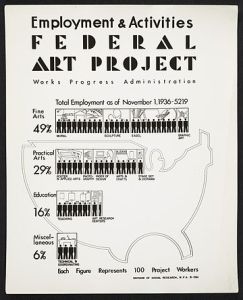
关于 WPA 联邦艺术项目的就业和活动的海报,1936 年。

WPA 雇用了 200 万至 300 万名非技术工人。
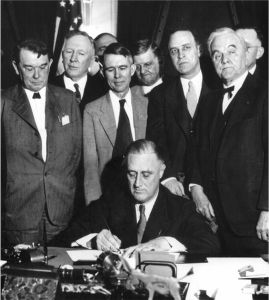
富兰克林-罗斯福总统签署《增值税法》。


.jpg)
富兰克林-D-罗斯福的总统任期是在美国经济史上最黑暗的时期之一的背景下开始的。数百万人失业,贫困肆虐,银行系统濒临崩溃,罗斯福政府的当务之急是稳定经济,为陷入困境的美国人提供直接救济。罗斯福将失业和经济不安全确定为需要立即关注的核心问题。公众对经济体系和金融机构的失望和不信任显而易见。为了解决这一问题,罗斯福不仅实施了为失业者提供直接就业和收入的计划,还努力恢复人们对经济体系的信心。罗斯福应对银行危机的计划体现了他的务实和果断。他暂时关闭了所有银行,只允许有偿付能力的银行重新开业,目的是制止银行业恐慌,恢复公众对银行系统的信心。这一 "银行假日 "是稳定金融体系的关键因素。罗斯福采取迅速果断的行动应对银行危机,这是他的政府与前任政府不同的早期例证。他不仅认识到政府干预纠正市场失灵的必要性,还看到了与美国公众进行有效沟通以恢复信心的重要性。罗斯福在这一时期的领导特点是愿意采取大胆而迅速的行动来满足美国人的迫切需要。他的务实、注重效率和激发信心的能力帮助国家度过了大萧条时期最困难的时期。他的新政政策和计划植根于对普通公民的经济和社会福祉的承诺,以及政府积极干预对稳定经济和恢复繁荣至关重要的信念。
国家复兴管理局(NRA)在美国历史上占有特殊的地位,它是联邦政府最早也是最雄心勃勃的努力之一,旨在协调和监管经济,以应对大萧条。NRA 在富兰克林-罗斯福总统新政的支持下成立,负责实施旨在提高工人工资、减少工作时间和消除不公平贸易行为的行业行为准则。全国劳资关系协会的守则虽然各不相同,但都有一个共同的目标,即通过提高工资来刺激消费需求,同时通过设定最低价格和限制过度生产来稳定行业。这些准则是与企业、劳工和政府合作制定的,旨在平衡所有利益相关者的利益。然而,《国家反垄断法》并非没有争议。批评者认为这是政府对经济事务的过度干预。大量的法规和守则、其复杂性以及与实施和遵守这些法规和守则相关的挑战经常受到批评。此外,尽管其初衷是促进公平竞争,但在实践中,一些准则却被批评为偏袒大公司而非小公司,从而削弱了竞争。1935 年,美国最高法院在 Schechter Poultry Corp. 法院裁定,《国家反垄断法》对不直接从事州际贸易的公司进行监管,超越了国会的宪法权力,因此宣布《国家反垄断法》违宪。尽管《全国劳资关系法案》存在时间不长且备受争议,但它为未来政府对经济的监管奠定了基础,并标志着联邦政府开始更直接、更广泛地参与经济事务。它为未来的劳资关系和福利立法开创了先例。
农业调整管理局(AAA)是罗斯福应对大萧条的核心举措。它旨在解决农业生产过剩和价格低廉的问题,这给美国农民带来了巨大的经济压力。通过 AAA,政府向农民支付减产费用,这一战略旨在提高农产品价格,从而增加农民收入。然而,AAA 的有效性和公平性引起了广泛争议。虽然政府帮助提高了价格,但其收益分配不均。大农户有财力减少产量,同时通过提高经营效率和技术来保持盈利,他们从补贴中获得的利益不成比例。他们还能灵活应对 AAA 法规,同时保持盈利。相反,小农户、佃农和佃农的处境则岌岌可危。对这些群体而言,减产意味着收入和生计的直接损失,他们不一定能从减产带来的价格上涨中获益。这种动态加剧了美国农业部门现有的不平等。因此,尽管 AAA 是对一个长期存在的经济问题的创新性回应,但它也揭示了平衡政府干预所固有的挑战。它鼓励了美国农业的整合和商业化,使农业部门从小型家庭农场转向农业综合企业。这些变化所带来的社会和经济影响持续了几十年,对美国农业和农村农业的影响一直持续到今天。
田纳西河流域管理局(TVA)体现了新政雄心勃勃和变革性的一面,表明联邦政府愿意直接干预经济以刺激地区发展。这一不朽的努力针对的是田纳西河谷,该地区当时正处于贫困之中,饱受环境和社会问题的蹂躏,缺乏基本的基础设施。田纳西河流域管理局(TVA)的成立不仅开启了解决贫困和不发达问题的协同努力,还彻底改变了该地区自然资源和人力资源的管理方式。在 TVA 的支持下修建的水坝和发电站不仅仅是发电那么简单,它们还象征着一场现代化运动,这场运动有望将该地区从经济和社会停滞不前的困境中拉出来。负担得起的电力供应带来了多方面的好处。它不仅促进了工业化进程,创造了就业机会,还提高了居民的生活质量,为以前无法享受到光明和电力的地区带来了福音。防洪是 TVA 的另一个关键目标,它保护了社区、农田和基础设施,减少了与毁灭性洪灾相关的经济和人道主义损失。因此,TVA 不仅仅是一个基础设施项目,更是一个社会和经济转型项目。它展示了政府协调干预重塑贫困地区的潜力,为可持续发展奠定了基础。然而,它也并非没有批评和争议,尤其是在社区迁移和环境影响方面。尽管如此,TVA 仍然是新政雄心壮志的典型案例,也是政府直接参与经济和社会发展努力所能产生深远影响的典型案例。
平民保护团(CCC)体现了罗斯福新政的独创性和人文关怀。在经济绝望、失业率飙升的时代,CCC 为成千上万的年轻人及其家庭带来了一线希望和新的尊严。乍一看,CCC 只是一项就业计划,但从其设计和实施过程中可以看出,它的深度和复杂性远不止提供工作这么简单。加入 CCC 的年轻人不仅仅是工作,他们还沉浸在一个重视服务、职业道德和责任的环境中。他们住在营地,分担责任,共同努力改善国家的公共土地。作为服务的回报,他们有吃、有住、有工资,这在困难时期为他们自己和家人提供了宝贵的经济来源。CCC 所做的工作产生了持久的影响,在国家公园和森林中留下了实实在在的遗产。但也许最重要的是,CCC 改变了参与其中的人们的生活。他们获得了技能、自信和成就感,对许多人来说,这些都是通往未来机遇和成功的跳板。CCC 体现了罗斯福对公共服务和集体行动力量的信念。在信心和希望缺失的时代,CCC 证明了通过辛勤工作、合作和开明的领导,个人和国家可以克服最严峻的挑战。该计划将经济需求与环境管理相结合,不仅为年轻人及其家庭提供了就业和支持,还为保护和改善国家的自然资源做出了贡献。更新的森林、美化的公园和建造的游乐场讲述了这样一个故事:即使在经济大萧条的动荡时期,远见卓识和积极进取也创造了美丽和实用的遗产,并延续至今。在整个 CCC 活动中,种植的每一棵树和修建的每一条小径都体现了开垦土地和弘扬民族精神的决心。因此,平民保护团不仅是危机时刻的应急方案,也是美国人坚韧不拔和创新能力的永恒见证。
联邦紧急救济管理局(FERA)以及后来的工程进度管理局(WPA)的出现,体现了罗斯福政府渡过大萧条动荡时期的坚定决心。联邦紧急救济署的任务是向赤贫者提供直接的紧急援助,它体现了缓解严峻的经济环境给人类带来的苦难的最初动力。FERA 是一种即时反应,是为一个正在流血的国家提供的创可贴,但它蕴含着更广阔愿景的种子,而这一愿景将随着 WPA 的诞生而逐渐成形。在 WPA 的保护伞下,紧急援助的雄心转变成了一项更强有力的战略,旨在通过生产性工作重振国家经济活力和恢复人民的尊严。WPA 不仅仅是一项工作计划,它还体现了一种信念,即即使在危机时期,人的潜能仍然是创新、创造力和复原力的不竭资源。WPA 的影响可以用修建的道路里程和建造的建筑物来衡量,但其遗产却超越了这些有形的衡量标准。它为艺术人才提供了舞台,培养了文化表现力,培育了公共精神。艺术领域的工作并不是事后才想到的,而是认识到经济复苏与文化复兴密不可分。尽管 FERA 和 WPA 是当时的产物,旨在应对特定的危机,但它们体现了普遍的经验教训。它们提醒人们,经济繁荣与人类福祉是密不可分的伙伴,在危机的熔炉中,人类的创新和坚持能力不仅能够生存,而且往往能够茁壮成长。FERA 奠定了基石,而 WPA 则建造了一座大厦,在这座大厦中,工作与人类尊严、基础设施与创新、经济与文化相辅相成。这一遗产仍在激励着人们,生动地提醒我们,危机的答案不仅在于经济补救,还在于大胆重申每个人的内在价值和不可估量的潜力。
工程进度管理局(WPA)是政府在经济危机时期如何以创新和富有成效的方式应对危机的光辉典范。在富兰克林-罗斯福的远见卓识下,WPA 不仅为绝望的工人提供了工作和工资,还巧妙地将经济需求与文化表达结合在一起,从本质上认识到一个国家的福祉既取决于其经济活力,也取决于其文化灵魂。由 WPA 修建的每一条道路和每一栋建筑,都是一个国家在历史上最黑暗时期顽强不屈的具体见证。但是,除了石头和灰浆之外,人们还深刻认识到艺术和文化的价值。艺术家往往被置于传统经济的边缘,但他们却被置于国家重建和振兴工作的中心。例如,得到 WPA 支持的摄影师的作品就是对美国文化遗产不可磨灭的贡献。他们捕捉到了普通美国人坚韧不拔的精神,为逆境展现了人性的一面,见证了即使在极度绝望的时候也能保持不屈不挠的尊严。这些图片不仅是了解当时挑战的宝贵资源,也是了解美国克服这些挑战的不屈不挠精神的宝贵资源。与墨西哥倡议的相似之处强调了一个普遍的主题:在危机时期,国家不仅有机会重建,而且有机会重塑自我。挑战不仅是经济上的,也是精神和文化上的。WPA 不仅与失业和经济停滞作斗争,而且还培育和维护了民族的文化精神,有力地肯定了每一个人,无论其职业或经济状况如何,都可以为国家结构做出宝贵的贡献。正是这种经济上的实用主义和文化上的远见卓识的融合,决定了 WPA 的永恒遗产。它提醒人们,即使在最黑暗的时代,也有机会肯定和颂扬人类精神的丰富性和多样性。在其构思和实施过程中,WPA 大胆地肯定了这样一种信念,即经济重建和文化复兴不是两个独立的过程,而是国家在不断追求实现其最大潜力过程中的亲密伙伴。
强化改革:1935 - 1936 年(社会保障、WPA 等)
1933 年至 1935 年期间实施的新政计划,其标志是国家救济局、增值税、CCC 和 WPA 等举措,受到墨西哥早期举措的影响,而这一点在标准的历史分析中往往被忽视。墨西哥拥有丰富的改革和社会倡议历史,其推出的计划与新政的关键组成部分惊人地相似,这表明在应对经济危机方面存在跨国思想和战略交流。然而,即使推出并实施了新政,美国的社会和经济结构仍然存在巨大差距。最初的举措虽然雄心勃勃,总体上也很有效,但却使整个人口群体,特别是边缘化群体和弱势群体,处于蒙昧状态。贫困、失业和不平等继续挑战着最初新政计划的框架。认识到这些持续存在的挑战和不足,1935 年至 1936 年间掀起了新一轮改革浪潮。罗斯福政府关注批评意见和对计划成效的评估,努力扩大和加强工作,以惠及那些仍未享受到新政福利的人。这是一个重新调整的时期,其特点是对政治和社会进行反思,并希望纠正计划初期阶段的错误和疏漏。然而,尽管进行了这些调整并加大了改革力度,失业的阴影仍然笼罩着整个国家。约 30% 的人口失业,经济危机持续不断,考验着新政的韧性和创造力。这提醒我们,经济危机具有内在的复杂性,需要采取多因素、适应性强的方法来驾驭不断变化的经济和社会动态。新政这一阶段的故事提醒我们,虽然取得了重大进展,但通往经济复苏和社会稳定的道路远非直线型。每一次成功都伴随着持续的挑战,每一次进步都面临着不平等和失业的持续现实。正是在这一背景下,我们必须评估新政的共鸣和影响--不是将其作为一个快速解决方案,而是作为一系列坚持不懈的适应性努力,以渡过美国历史上最动荡的时期之一。

罗斯福在 1935 年和 1936 年加强改革的背景是与失业和不平等有关的持续挑战。国家青年管理局(National Youth Administration)的成立和工程进度管理局(WPA)的扩大是对创造就业机会和支持受经济萧条影响的个人的直接回应。由于认识到危机的多层面影响,这些举措特别侧重于支持年轻人和创造性专业人员。虽然这些计划提供了重要帮助并创造了机会,但也并非没有局限性。尽管采取了这些干预措施,失业仍然是一个普遍存在的问题,凸显了危机的严重性,以及全面解决大萧条影响所固有的挑战。批评的声音越来越多,指出新政方案的利益分配不平等。组织严密的实体获得的利益不成比例,而社会中最脆弱的群体却感到被忽视了。这种不平等不仅是一个经济问题,也是一个政治挑战。政治共识的破裂是显而易见的。民主党的一些成员对现行政策不满,开始脱离党派,这标志着意识形态的分裂。针对政府政策的抗议活动反映出,在如何有效应对经济危机的问题上,不同意见和观点日益增多。这种不满情绪和意见分歧标志着政治和社会正处于一个充满活力的时刻。如何应对相互冲突的需求、不同的需要和多重期望,成为罗斯福执政时期政府治理的核心特征。经济效率、社会公平和政治凝聚力之间的紧张关系加剧,为延续至今的经济和社会政策辩论开创了先例。每项行动和举措都要从正义、包容和效率的角度进行审视,而在深陷危机之时,要实现这种平衡总是困难重重。
富兰克林-罗斯福发现自己处于一个微妙的境地。虽然他的新政计划给美国经济带来了一些缓解,他也成功地为经济复苏奠定了基础,但他面临着一个重大的困境。失业率居高不下,令人难以接受,而大选在即,必须加大力度创造就业机会,建立经济稳定。这是一个微妙的平衡术。罗斯福必须在推行能带来宏观经济稳定的政策与满足受大萧条影响最严重的人的迫切需要之间进行权衡。新政的第一阶段曾因偏袒特定群体而受到批评。大企业和地位稳固的农民是主要受益者,这加剧了不平等。在这种紧张的政治环境下,每项决策都受到严格审查。罗斯福意识到,日益加剧的不平等是不可持续的,但纠正这些不平等必须精心策划。边缘化群体和最需要帮助的人需要支持,但实施可能会疏远其他人群或经济合作伙伴的政策则是一个雷区。1935 年和 1936 年是重新调整的年代。新的改革是大胆的,旨在扩大经济安全网,将那些落在后面的人纳入其中。这是一个政治和经济重新调整的时期,面对大萧条的原始现实,不仅要加大力度稳定经济,还要确保更公平地分配机会和资源。政治和社会的不满情绪是显而易见的现实。民主党成员脱离了民主党,标志着之前的政治共识破裂。然而,罗斯福决心已定。他对新政的承诺是不可动摇的,尽管新政并不完美,也饱受批评。在一个仍在从现代史上最严重的经济危机中恢复的世界中,罗斯福的任务十分复杂,需要在经济需要、社会期望和政治现实之间取得平衡。他执政的这一篇章说明了危机时期治理的内在复杂性,每前进一步都充满了意想不到的挑战,灵活性和应变能力成为不可或缺的资产。
1935 年《社会保障法》体现了美国联邦政府对公民责任的重大转变。在该法案颁布之前,对弱势群体的保护和援助在很大程度上被忽视,导致许多家庭在需要时没有安全网。该法案由富兰克林-罗斯福总统签署成为法律,是一系列激进的新政改革之一,旨在重塑政府与社会的互动方式,尤其是在经济危机时期。第一项内容是退休计划,它为老年人的经济无保障问题提供了解决方案,大萧条加剧了这一问题。该方案由雇主和雇员共同出资,强调了团结和共同承担责任的原则。它为老年人提供了经济上的尊严,保证他们在多年辛勤工作后有一份稳定的收入。失业援助计划是第二块基石。它是对大萧条加剧的严重经济脆弱性的直接回应。由于数百万人失业,而且往往不是他们自己的过错,该计划承诺提供临时支持,强调了政府在不可预见的经济危机时期作为后盾的作用。第三部分涉及盲人、残疾人、老年人和贫困儿童的需求。它承认社会需求的多样性,并努力提供专业支持,以确保即使是经常被忽视的群体也能得到所需的关注和支持。社会保障法》的每一个组成部分都代表着政府朝着不仅管理公民,而且关爱公民的方向迈出了一步。它摒弃了自由放任的做法,转而采取一种更加家长式的方法,将公民,尤其是最弱势群体的保护和福利置于政治议程的中心。这种做法开创了一个先例,不仅影响了美国未来几十年的国内政策,也启发了世界各地的福利制度。
社会保障法》经常被视为富兰克林-罗斯福政府和新政最重要的立法成就之一。通过为老年人、失业者和残疾人建立金融安全网,该法深刻地改变了联邦政府在美国公民生活中的角色。在该法案颁布之前,许多老年人和弱势群体只能自食其力,依靠慈善机构或家人维持生计。社会保障改变了这一状况,引入了政府对公民经济福祉的直接责任。这有助于减少贫困和经济不安全,为数百万美国人提供了更大的经济稳定性。此外,该法案还为美国的现代福利制度奠定了基础,确立了至今仍为公共政策所借鉴的原则和做法。处于困境中的个人和家庭可以指望国家提供一定程度的支持,这加强了社会的凝聚力和稳定性。社会保障法》将团结和相互支持纳入了政府政策的根本结构,从而帮助定义了美国治理的新时代。这是朝着更加参与性的福利国家迈出的重要一步,这一点已成为美国政策的核心,也影响着世界各地的福利制度。此外,通过促进公民的福利和安全,它为一个更加平衡和公平的社会奠定了基础,减少了不平等现象,提高了许多美国人的生活质量。
社会保障计划的实施遇到了各种挑战和批评。小农、佃农、家庭佣工和工会被排除在外,凸显了该制度的重大缺陷。这些弱势群体是受大萧条打击最严重的群体之一,他们被排除在社会保障福利之外,加剧了他们岌岌可危的处境。特别是佃农和家庭佣工,由于非正规和非合同就业的结构而被排除在外,这引起了人们对公平性和包容性的担忧。工会已经在困难的经济环境中为工人争取权利,但在获取福利方面也面临挑战。对所提供的援助金额也提出了批评。虽然社会保障是政府在向有需要的人提供支持方面迈出的重要一步,但福利金额往往不足以满足基本需求,许多人仍然生活在贫困之中。然而,尽管存在这些批评和挑战,社会保障计划还是为美国的社会保障体系奠定了基础。多年来,该计划一直在修订和扩大,以纳入以前被排除在外的群体,并增加所提供的援助金额。这表明这些公共政策具有不断演变的性质,可以进行调整和改进,以更好地满足社会需求。这些最初的挑战也引发了关于政府在公民经济福祉中的作用的讨论,并有助于形成未来的福利和改革方案。最终,尽管《社会保障法》并不完美,但它标志着美国福利政策发展的一个重要里程碑。
1935 年通过的《全国劳资关系法》(NLRA)是美国劳资关系史上的一个重要里程碑。它通过使组建工会合法化和促进集体谈判,深刻地改变了劳资关系的面貌。在《全国劳资关系法》出台之前,工人往往面临艰苦的工作条件、低工资以及雇主对成立工会的巨大阻力。由雇主控制的 "内部 "工会经常被用来阻挠成立独立工会的努力。全国劳工关系法》不仅禁止这些做法,还建立了机制,确保工人组织工会和集体谈判的权利得到尊重。全国劳资关系委员会(NLRB)的成立对于落实这些权利至关重要。全国劳资关系委员会有权命令因工会活动而被解雇的工人复职,还可以认证工会为工人的合法代表。美国劳资关系法》的影响是深远的。它有助于平衡雇主和雇员之间的权力关系,使加入工会的工人数量大幅增加,工资和工作条件也得到改善。该法案有助于为雇主和工人之间的关系建立一个国家标准,将集体谈判权纳入美国联邦法律。然而,与其他重要立法一样,《全国劳资关系法》也面临着批评和挑战。一些雇主和行业团体抵制新法规,关于如何平衡工人权利和企业经济利益的争论也不绝于耳。尽管如此,《全国劳资关系法》仍然是新政时期最有影响力的立法之一,为美国现代劳资关系奠定了基础,并在随后的几十年里帮助建立了一个更加强大的中产阶级。
富兰克林-D-罗斯福的第二个任期:1936 - 1940 年(最高法院之争、经济挑战)
在 1936 年的总统选举中,富兰克林-罗斯福大获全胜,成功连任。在竞选期间,他在第一个任期内发起的激进而雄心勃勃的新政改革问题占据了中心位置。罗斯福受到对手阿尔夫-兰登和其他保守派的批评,认为他背离了美国政府的基本原则,并将社会主义元素引入美国政治。然而,这些攻击未能赢得绝大多数选民的支持。罗斯福新政的政策和计划广受群众欢迎,他们认为这些政策和计划是对大萧条时期严峻形势的必要缓解。罗斯福的妻子埃莉诺-罗斯福在他的连任竞选中发挥了至关重要的作用。她不仅是一位有影响力的第一夫人,还是民权、妇女和穷人权利的热心捍卫者。埃莉诺因其对社会最弱势群体的奉献和承诺而成为受人尊敬和钦佩的公众人物。罗斯福在 1936 年大选中获胜,是美国人民对他的政策的明确认可。这坚定了他推行和扩大新政举措的决心,尽管某些方面一直在反对。他在第二个任期内巩固了第一个任期内启动的改革,并进一步致力于确保普通美国公民的经济和社会福祉。因此,尽管罗斯福因被认为过于进步或干预而受到批评,但他的受欢迎程度和公众对新政政策的支持在选举结果中显而易见,这表明,对于大多数美国人来说,在 20 世纪最具破坏性的经济危机背景下,总统制定的路线不仅是必要的,而且是有益的。
富兰克林-罗斯福在 1936 年的胜利并不仅仅是现任总统的连任,而是象征着美国政治格局更深刻的转变。它反映了一个新的联盟,一个由团结在新政原则和方案周围的不同团体组成的异质但强大的联盟。它令人信服地展示了罗斯福团结广泛群体的能力,从城市工人阶级到中西部农民,从南方民主党人到新移民,再到众多种族群体和各行各业的工人。新政联盟不仅仅是一个临时性的选举联盟,而是塑造了民主党未来几代人的身份和方向。它体现了一种更加进步和包容的美国政治愿景,在这种愿景下,劳动人民、穷人和边缘化群体的利益得到了认可,并在国家决策中得到了考虑。罗斯福成功地编织了一张社会和经济网,不仅减轻了大萧条的破坏性影响,还为现代化的福利国家和规范的资本主义奠定了基础。他在全国几乎每一个州的胜利都反映了民众对干预和再分配政策的认可,虽然这些政策受到保守派的批评,但大多数选民普遍认为这些政策是必要和有益的。
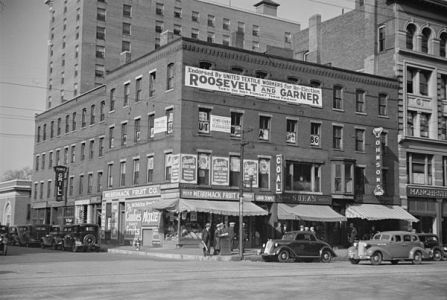
新罕布什尔州曼彻斯特的选举海报。
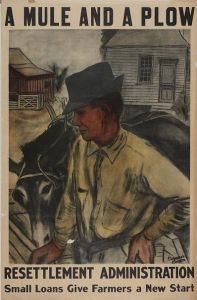
伯纳达-布赖森-沙恩(Bernarda Bryson Shahn)绘制的重新安置管理局海报。
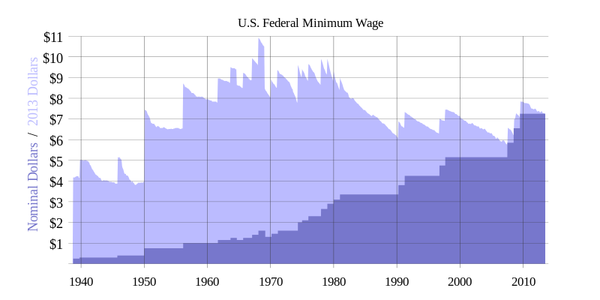
以实际和名义美元计算的联邦最低工资的历史。


富兰克林-罗斯福当选第三和第四个任期是美国历史上的一个反常现象。由于第二次世界大战的威胁迫在眉睫,他于 1940 年当选连任第三届。罗斯福是一位经验丰富的领导人,面对国际不确定性,美国选民选择让他继续执政,以确保领导的连续性。罗斯福在 1944 年选择第四个任期也是在战争背景下做出的。当时美国正处于全球冲突之中,在战时更换总统并不符合国家的最佳利益。罗斯福的稳定和经验再次受到青睐。然而,1945 年罗斯福逝世后,允许总统无限连任的做法显然需要重新审视。行政权长期掌握在一个人手中,有可能对美国民主构成威胁。因此,美国提出并通过了第22条修正案,将总统任期限制为两届。此举旨在确保定期更新领导层,使总统对选民负责,并防止权力过度集中。从那时起,所有美国总统的任期都限定为两届,这一原则加强了美国民主充满活力和顺应民意的性质,确保了权力的有序交接,并允许出现具有新思想和新观点的新领导人。
农业安全管理局(FSA)是罗斯福持续努力消除大萧条破坏性影响的重要一步。尽管初衷是好的,但资金不足、大规模贫困和绝望等挑战意味着该计划的影响比预期的要有限。在此期间,经济危机没有区别对待;它影响到美国社会的方方面面,但小农场主尤其脆弱。联邦农业局利用其有限的资源,试图为这一特殊群体提供解决方案,但面临的挑战是巨大的。在南方,该计划的影响甚至更加微弱。以种族歧视和不平等为特征的社会经济结构加剧了经济困难。佃农,无论是白人还是黑人,都发现自己的处境极不稳定,往往没有土地或生存手段。提供低息贷款和技术援助的努力对一些人来说是救命稻草,但对大多数人来说却遥不可及。当时复杂的现实情况--经济凋敝、社会变革和根深蒂固的不平等--使得成功实施《金融服务协定》计划成为一项艰巨的挑战。尽管如此,《粮食保障法》仍然证明了罗斯福政府即使面对看似无法逾越的障碍,也要努力实现救济和积极变革的承诺。它还为美国未来在农业政策和社会保障方面的思考和行动奠定了基础。
罗斯福试图在支持小农和有利于大农场的更广泛的经济要求之间取得微妙的平衡,而农业安全管理局(FSA)计划就是其中之一。虽然小农是一个重要目标,但经济效率和生产力同样是不容忽视的紧迫问题。通过向大土地所有者提供咨询和技术服务,金融服务管理局不仅注入了资金,还帮助改进了耕作方法,优化了生产力和可持续性。这种技术援助的目的不仅在于提高产量,还在于改善农场工人的工作条件,而这一群体往往被忽视和剥削。大地主从如何优化土地管理的建议中受益,从而提高了生产率。矛盾的是,通过帮助大农场,金融服务管理局也间接地通过提高生产率和耕作效率来帮助改善农场工人的生活。事实上,两难的核心问题是,对小农场主和大农场主的支持并不是相互排斥的。二者对于农业经济的蓬勃发展都至关重要。小农户需要支持才能生存,而大农场对经济效率和大规模粮食生产至关重要。因此,《联邦农业协定》表面上看矛盾重重,但其实反映了当时的复杂局面。它是一种平衡经济、社会和人类需要的努力,是在救济的迫切需要与生产力和可持续发展的长期目标之间的杂耍。在这种复杂的背景下,《公平劳动标准法》成功地产生了积极的影响,不仅直接支持了那些需要帮助的人,还引入了结构性变革,使整个农业社区及其他方面受益。
1938 年的《公平劳动标准法》(FLSA)标志着美国劳动立法迈出了关键的一步,为保护工人免受剥削确立了重要的保障措施。该法的起源主要是为了保护非工会工人,他们是当时的弱势群体,经常遭受不公平和不平等的工作条件。然而,它的适用范围超越了这一目标人群,也涵盖了工会工人,设定了一个普遍的最低标准,提升了全国各地工作条件的基础。然而,《公平劳动法》最初并非没有局限性。它的适用范围仅限于某些行业的工人,使得相当一部分劳动力,尤其是农业和家政服务业的工人,得不到必要的保护。这反映了当时的政治和社会妥协,某些群体的需求往往要与经济和政治现实相平衡。随着时间的推移,《公平劳动标准法案》不断演变,扩大到涵盖更多的劳动力,并提高了最低工资标准。这种适应性和演变对于确保法律在面对不断变化的挑战和劳动力动态时保持相关性和有效性至关重要。它已成为一份活的文件,根据美国社会不断变化的需求进行调整和修改。今天,《公平劳动法》仍然是美国劳动法的支柱。它证明了政府和社会保护工人免受剥削并确保公平分享经济收益的愿望。通过设定工资和工作条件的最低标准,该法创造了一个平衡的竞争环境,使工人能够为经济繁荣做出贡献,同时确保公平公正的工作条件。该法仍然是立法系统有能力适应和发展以满足人民不断变化的需求的一个生动范例。
新政的社会影响:评估政策和方案的遗产
The legacy of the New Deal is a subject of vast and intense debate. Initiated by President Franklin D. Roosevelt in the 1930s in response to the Great Depression, the New Deal introduced a series of programmes and reforms that not only changed the American economic landscape, but also influenced citizens' expectations of government. On the one hand, the New Deal has been hailed for introducing a significant social safety net, with the creation of Social Security being one of its most notable achievements. This key element provided much-needed relief for the elderly, disabled and unemployed, and has become a central element of the American welfare system. In addition, workers' rights expanded considerably under the New Deal, strengthening trade unions and bringing the Democratic Party closer to the working class. Millions of unemployed found jobs through public works programmes, and financial and banking reforms stabilised the financial system. However, the New Deal was not without its critics. Some argued that its measures were not sufficient and that the poor, particularly minorities, were often neglected. Government interventionism was a contentious issue, particularly among the business community, which perceived it as excessive. Although the New Deal introduced important structural reforms, it did not completely resolve the Great Depression, and it took the war effort of the Second World War to fully revitalise the US economy. Increased public spending also raised concerns about the national debt. The enduring legacy of the New Deal is its continuing influence on American politics and society. The debates that began at that time about the balance between government intervention and market freedom persist in contemporary political discourse. Overall, the New Deal is often seen as a bold response to an unprecedented economic and social crisis, although it is also associated with increased government intervention in the economy. Its structural and social reforms left a lasting imprint that continues to influence American politics, economics and society to this day.
The AFL was led by leaders who valued stability and cooperation with employers. In those days, the federation often avoided strikes and direct confrontation, preferring negotiation and arbitration. The AFL was also known to be exclusive, limiting itself mainly to skilled and white workers, often leaving out unskilled workers and minorities. This was due to the belief that a focus on skilled workers would result in more substantial gains for its members. However, the AFL's approach was not universally popular. Many workers, particularly unskilled workers and those in emerging industries, felt excluded and under-represented. The Great Depression exacerbated these tensions, as millions of workers lost their jobs or saw their wages and working conditions deteriorate. The emergence of the Congress of Industrial Organizations (CIO) in 1935 marked a turning point. Unlike the AFL, the CIO took a more radical and inclusive approach. It aimed to organise all workers within specific industries, regardless of their skill level. The CIO was also more willing to use strikes and other confrontational tactics to win concessions from employers. These two organisations played a central role in the expansion of workers' rights during the New Deal period. Their efforts, combined with progressive New Deal legislation such as the Wagner Act of 1935, which guaranteed the right of workers to organise and bargain collectively, led to a significant increase in the power and influence of trade unions in the United States. In the years that followed, the AFL and CIO continued to evolve, reflecting changes in the American economic and social landscape. They finally merged in 1955, forming the AFL-CIO, an organisation that continues to be a major force in the American labour movement today. The combination of trade union efforts and New Deal policies laid the foundations for the substantial improvements in wages, benefits and working conditions that characterised the post-war period in the United States.
At the time, the AFL's exclusive policy was a source of contention and division within the labour movement. Although the AFL succeeded in negotiating wage increases and improvements in working conditions for its members, its exclusion of unskilled workers and racial minorities left large numbers of workers without effective union representation. This has not only exacerbated existing inequalities, but has also limited the reach and impact of the trade union movement as a whole. Against this background of division and exclusion, other trade union organisations and workers' movements began to emerge to fill the vacuum left by the AFL. Groups of unskilled workers, minorities and other marginalised workers began to organise outside the AFL structure, forming their own unions and organisations to fight for higher wages, better working conditions and collective bargaining rights. The pressure exerted by these more inclusive and militant organisations eventually led to significant changes within the AFL and the trade union movement as a whole. The economic and social challenges of the Great Depression, combined with the growing activism of unskilled workers and minorities, made the AFL's policy of exclusion unsustainable. Legislative reforms introduced during the New Deal, notably the National Labor Relations Act (also known as the Wagner Act) of 1935, also strengthened workers' rights and made it easier to organise and bargain collectively. In the years that followed, the AFL and other unions were forced to adapt to these new realities. The inclusion of unskilled workers, minorities and other previously excluded groups not only broadened the base of the labour movement, but also led to an increase in the power and influence of unions in American politics and the economy. This period of increased inclusiveness and union activism laid the groundwork for significant improvements in workers' rights, wages and working conditions across the country.
The shift from craft unions, which were more exclusive and focused primarily on skilled workers, to organisations like the CIO and UAW, which were more inclusive and embraced a wider range of workers, marked a significant step in the evolution of the American labour movement. These new unions brought about a radical change in the way workers were organised and represented, creating opportunities for broader participation and fairer representation of diverse groups of workers. The National Industrial Recovery Act (NIRA) of 1933 was an essential element in facilitating this change. It encouraged collective bargaining and allowed workers to join unions without fear of reprisal from their employers. Although the US Supreme Court ultimately declared the Act unconstitutional in 1935, it nevertheless set an important precedent and paved the way for other pro-labour legislation, such as the National Labor Relations Act (NLRA), also known as the Wagner Act. The NLRA, passed in 1935, consolidated workers' rights to organize and bargain collectively. It also created the National Labor Relations Board (NLRB), a federal agency responsible for overseeing union elections and adjudicating unfair labour practice complaints. Under the NLRA, unions such as the CIO and UAW grew in importance and power, transforming the US labour landscape. The emergence of these new unions and the expansion of workers' rights also had profound implications for racial and class politics in the US. Organisations such as the CIO were more inclusive and accepted members regardless of race or skill level. This not only increased diversity within the labour movement but also played a role in the struggle for civil rights, social justice and equality. In this way, New Deal policies had a significant impact on the labour movement in the United States. They facilitated greater inclusion and representation of workers and contributed to the emergence of a new generation of trade unions that played a key role in defining rights and working conditions over the following decades.
The initiative of the Committee on Industrial Organization (CIO) within the AFL represents a significant development in the history of the labour movement in the United States. Prior to this initiative, the trade union landscape was largely dominated by craft unions that concentrated their efforts on skilled workers. Unskilled workers, particularly those in large industries, were often left behind, lacking adequate representation and unable to bargain collectively for better working conditions, fair wages and benefits. The formation of the IOC was a direct response to this shortcoming. By specifically targeting unskilled workers, it opened the door to broader representation and facilitated more meaningful inclusion in the trade union movement. The IOC's approach was radically different from that of traditional trade unions. Rather than focusing on specific trades, it aimed to unite all workers within particular industries, creating a more powerful and effective collective bargaining force. This not only changed the dynamics of the trade union movement, but also helped to transform industrial relations in the United States. With the ability to mobilise a larger number of workers and negotiate with employers in a more unified way, the CIO was able to achieve significant advances in wages, working conditions and workers' rights. However, the creation of the IOC was not without controversy. Its formation was followed by a period of tension and conflict with the AFL, resulting in the formal separation of the two organisations in 1938. The AFL continued to focus on skilled workers, while the CIO concentrated on unskilled workers, ushering in a new era of plurality and diversity in the American labour movement. The CIO's legacy lives on today. Its commitment to unskilled workers paved the way for significant advances in workers' rights and helped shape the landscape of labour and industrial relations in the United States in the twentieth century. This legacy still resonates in current discussions about economic justice, employment equity and workers' rights.
This substantial increase in the number of unionised workers was attributable to a number of factors, mainly linked to New Deal initiatives and the emergence of the CIO. The labor relations laws and other regulations imposed during this period not only legitimized unions, but also encouraged collective bargaining and expanded workers' rights, making organized labor a more powerful and present force in the lives of American workers. The rapid growth of unions was not without its challenges. Although the number of unionised workers increased dramatically, they remained a minority of the workforce as a whole. The diversity of workers, industries and regions presented unique challenges in terms of organisation, representation and bargaining. Unions had to fight not only employer resistance, but also internal divisions and disparities between skilled and unskilled workers, as well as regional and sectoral differences. Yet the late 1930s witnessed growing solidarity among workers, and the trade union movement grew in power and influence. Unions became key players in the national dialogue on workers' rights, economic equity and social justice. Although they represented only 28% of the workforce, their influence far exceeded that figure. They played a crucial role in setting labour standards, protecting workers' rights and improving working conditions across the country. The rise of the unions during this period also laid the foundations for the future evolution of the labour movement in the United States. It ushered in an era of expanded workers' rights, better representation and improved working conditions that continue to resonate in the contemporary labour landscape. Despite the challenges and controversies, the expansion of trade unionism during this period is widely regarded as a watershed in the history of workers' rights in the United States.
The success of the CIO marked an era of rapid change in American labour. However, this success was marred by persistent challenges. Employer resistance was often virulent; strikes and demonstrations were common, and workers frequently faced aggressive anti-union action. Companies used a variety of tactics to thwart union efforts, including disciplinary action, lockouts and exploiting internal divisions among workers. Within the trade union world itself, the CIO faced internal opposition from the AFL. The ideological and strategic differences between these two bodies often led to conflict. The AFL, with its focus on skilled workers and a more conservative approach to trade unionism, was often at odds with the CIO's more inclusive and progressive strategy. In addition, federal government policies regarding workers and unions were often fluid and sometimes contradictory. Although laws such as the NLRA provided a legal framework for collective bargaining and union organizing, the practical application of these laws was often hampered by competing political and economic interests. Shifting political decisions and the absence of consistent government support made navigating the complex political landscape particularly challenging for the IOC and other trade union organisations. Despite these challenges, the CIO has persisted in its efforts to organise unskilled workers and to extend workers' rights throughout the US economy. Its successes and challenges reflect the complexity of the struggle for workers' rights in the United States, a struggle that continues to shape the labour and employment landscape in the country today. Each victory and challenge faced by the IOC during this turbulent period highlights the complex dynamics of economic, political and social forces at play in the workers' rights movement.

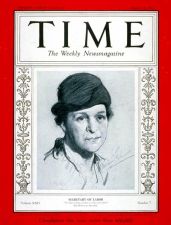
Labour Minister Perkins on the cover of Time (14 August 1933).


Women's participation in New Deal programmes was limited due to the social norms of the time and the design of the programmes. Although these initiatives were created to alleviate the devastating effects of the Great Depression and provide employment and support to millions in need, women were often overlooked or excluded from these opportunities. The CCC, for example, was primarily focused on providing jobs for young men. They were employed in public works projects such as park construction, tree planting and other conservation activities. Women were largely excluded from this programme due to prevailing gender norms that placed them in the role of caretakers of the home. The WPA, although more inclusive, also offered work opportunities that were largely segregated by gender. Men were often involved in construction and engineering projects, while women were relegated to projects considered 'feminine', such as sewing and food preparation. Although the WPA employed a large number of women, opportunities were often limited and wages were lower than for men. FERA, designed to provide direct aid to those in need, was also limited in its ability to help women. Many were ineligible for assistance because they had not worked outside the home prior to the Great Depression, and therefore could not prove that they were unemployed. In addition, the emphasis on the 'deserving family' meant that assistance was often granted on the basis of the employment status of the male head of household. These limitations reflect the attitudes and gender norms of the time. Women were often seen as secondary workers and their economic contribution was undervalued. The policies and programmes of the New Deal, while instrumental in helping to alleviate the effects of the Great Depression for many, were flawed and reflected the deep-rooted gender inequalities of that historic period. However, they also paved the way for a wider discussion of women workers' rights and laid the foundations for future reforms and developments in women's rights in the workplace.
Although the New Deal was a major response to the Great Depression, it reflected the gender norms of the time, often to the detriment of women. Initiatives such as the CCC and WPA were heavily focused on manual and outdoor work, traditionally male-dominated sectors. This focus created an imbalance, where men had access to greater opportunities to rebuild their lives economically, while women were often left behind. The CCC focused on environmental and construction projects, employing thousands of young men, but offering few opportunities for women. This reflected not only societal expectations about gender roles, but also a gap in public policy, where women's specific needs and skills were not fully recognised or utilised. Similarly, although the WPA employed women, they were often concentrated in lower paid sectors and were paid less than their male counterparts. This exacerbated existing gender inequalities and reinforced traditional stereotypes about 'appropriate' work for women and men. These dynamics reflect the complex challenges facing American society at the time. In attempting to remedy an unprecedented economic crisis, the government also navigated, sometimes clumsily, entrenched social and cultural realities. Women, despite being disadvantaged by these programmes, continued to play a vital role in the economy, albeit often in the shadows. These challenges and inequalities underline the complexity of the New Deal and serve as a reminder of the many layers of progress and struggle that characterise this crucial period in American history.
It demonstrates the profound inequality engendered by the policies and programmes implemented during this period. Support systems were heavily tilted in favour of men, based on the traditional perception that they were the primary breadwinners. This gender bias marginalised women, exacerbating their vulnerability during a period of acute economic crisis. Unemployed women often found themselves in a double bind. Not only were they excluded from many of the employment opportunities created by programmes such as the CCC and the WPA, but they were also under-represented among recipients of federal assistance. This situation was exacerbated by gender-based criteria for awarding assistance and deep-rooted gender stereotypes, which favoured men as the main providers. This reality, where 37% of the unemployed were women but only 19% of aid recipients were women, reveals institutionalised discrimination. It highlights the additional challenges women faced in accessing crucial resources and opportunities. Despite these obstacles, women have continued to play an essential role in society and the economy, although they are often undervalued or invisible. In retrospect, the gendered inequalities of the New Deal illustrate how economic and social emergencies can highlight and amplify existing injustices. They also serve as a reminder of the importance of integrating a gender perspective into policy-making, to ensure that all people, regardless of their sex, have access to the opportunities and support they need to thrive.
The socio-cultural context of the time greatly influenced the way New Deal policies were designed and implemented. Gender inequality was an inherent aspect of society, and this was reflected in the structure and scope of the programmes. Although the primary intention of the New Deal was not to exclude or marginalise women, underlying prejudices and social norms inevitably influenced the way policies were formulated and implemented. In response, women did not remain passive. They have shown remarkable resilience and determination, fighting for recognition of their rights and for equal opportunities. Women's groups and feminist organisations, often supported by progressive trade unions and other civil society organisations, undertook concerted efforts to denounce and remedy the manifest inequalities in the application of the New Deal programmes. These advocacy and activist efforts have helped to draw attention to gender disparities and to push for reforms. Although progressive, these changes were often not sufficient to overcome deeply rooted systemic barriers. However, they laid the foundations for future movements for women's rights and gender equality. Ultimately, although the New Deal brought much-needed relief to millions of people affected by the Great Depression, its legacy is also tainted by its shortcomings when it comes to gender equality. These historical lessons underline the crucial importance of adopting an intersectional approach to policymaking, ensuring that all voices and perspectives are considered to ensure that no one is left behind.
Eleanor Roosevelt played a key role not only as First Lady of the United States, but also as an influential campaigner and diplomat. She broke the traditional mould of the First Lady's role by becoming actively involved in politics, a space often reserved for men at the time. She was known for her strong convictions and commitment to social justice and human rights. During her husband's presidency, Eleanor highlighted pressing social issues, including the injustice and inequality suffered by women. She visited labour camps, hospitals and other institutions to understand first-hand the challenges faced by ordinary people. Her direct and empathetic approach not only humanised the Presidency, but also helped to raise public awareness of issues that were often overlooked. Eleanor Roosevelt was also a powerful voice within the Roosevelt administration. She advocated the inclusion of women in New Deal programmes and insisted that gender equality and social justice be integrated into government policies. She was a driving force in ensuring that women's issues were not relegated to the background, and encouraged their active participation in the political and social life of the country. Her passion for human rights did not stop at American borders. Following the presidency of Franklin D. Roosevelt, Eleanor played a key role in the creation of the United Nations Universal Declaration of Human Rights, a lasting testament to her commitment to dignity and equality for all. Eleanor Roosevelt's legacy is that of a woman of courage and conviction. She demonstrated that the role of First Lady could be a platform for social change and paved the way for more active participation by women in American and international politics. Her dedication to justice and equality continues to inspire generations of leaders and activists.
The growing involvement of women in politics during the New Deal era is testimony to the gradual evolution of social norms and the role of women in American society. At that time, women began to occupy positions of greater visibility and influence in government and other civil society organisations. Their participation helped shape policies and initiatives that better reflected the diversity of citizens' experiences and needs. With the support of Eleanor Roosevelt and other women's rights advocates, women gained a platform to express their ideas and demands. Their activism was remarkable in areas such as work, education, health and social welfare. Their active participation in policy-making began to reshape the traditional image of women, highlighting their ability and willingness to contribute meaningfully to complex public issues. This momentum was not limited to political circles. Women also played a growing role in professional and academic circles, breaking down barriers and challenging existing gender stereotypes. They have proved their competence and effectiveness in a variety of fields, helping to change public perceptions of what women can achieve. Although women still faced substantial inequalities, and the struggle for gender equality was far from over, the New Deal era marked an important turning point. Women moved from the traditionally confined role of the domestic sphere to a more active and visible participation in the public sphere. The foundations laid during this period served as a springboard for the feminist and gender equality movements that gained prominence in the decades that followed.
Frances Perkins is often credited with being a key figure in the development and implementation of New Deal policies, particularly in the areas of workers' rights and social security. She went down in history not only as the first woman to hold a position in the US presidential cabinet, but also as a pioneer of progressive social and economic reform. Her determination and commitment to workers' rights were rooted in her own experience and observations of the inequalities and injustices faced by working people. She played a crucial role in developing legislation to improve working conditions, guarantee fair wages and ensure workers' safety. Under Perkins' leadership, the Department of Labor helped implement innovative policies such as the Social Security Act, the National Labor Relations Act and the Fair Labor Standards Act. These laws not only strengthened workers' rights, but also laid the foundation for America's social safety net. Perkins was also aware of the specific challenges faced by women in the labour market. She advocated gender equality and worked to ensure that New Deal policies took into account the needs and contributions of working women. Her leadership and dedication to the social and economic cause made her an emblematic figure of the New Deal and an example of women's ability to influence and shape public policy. Frances Perkins' legacy lives on in the reforms she helped to implement and in the path she paved for future generations of women leaders.
Although the New Deal represented a major step forward in federal intervention to mitigate the devastating effects of the Great Depression, the benefits of these policies were not evenly distributed. African-Americans, in particular, were often left behind. Roosevelt needed the support of Southern politicians to push through his reforms, and they were often opposed to measures that would have promoted racial equality. As a result, much of the New Deal legislation did not apply to occupations where African-Americans were predominantly employed, such as agriculture and domestic service. The system of racial segregation, particularly in the American South, remained deeply entrenched. What's more, African-Americans were often the last to be hired and the first to be fired. They also received lower wages than white workers and were often victims of union discrimination. Institutional and personal racism continued to oppress African-Americans despite the implementation of New Deal programmes. However, despite these limitations, there were some improvements. Some African Americans benefited from jobs created by New Deal projects such as the Civilian Conservation Corps (CCC) and the Works Progress Administration (WPA). Eleanor Roosevelt, in particular, was an important ally, using her influence to advocate for the rights of African Americans. Initiatives such as the "Black Cabinet", a group of African-American advisers who worked in various New Deal agencies, also emerged, although their influence was limited. So while the New Deal marked a turning point in federal policy and set a precedent for increased government intervention in the economy, its benefits for African Americans and other racial minorities were limited. These shortcomings highlight the persistent challenges of racism and discrimination that these communities continued to face.
The socio-economic status of African Americans was largely determined by the institutionalised policies of discrimination and segregation that were prevalent at the time, particularly in the American South. Despite the progressive intentions of the New Deal, the social and economic benefits of these programmes were often limited for African Americans because of existing racial prejudices and power structures. Trade unions also played an ambiguous role. Although strengthened by New Deal legislation, notably the National Labor Relations Act (NLRA) of 1935, which encouraged collective bargaining and strengthened workers' rights, unions were often discriminatory in their membership practices. Many unions refused to accept African-American members, or relegated them to separate chapters with less power and resources. In addition, the New Deal, in its attempt to stabilise the economy, often collaborated with existing power structures, including those of the segregated South. Roosevelt himself was reluctant to challenge the racial power structure in the South for fear of losing the political support of influential Southern Democrats. This often led to compromises that maintained and, in some cases, reinforced existing racial inequalities. Yet there were some positive steps forward. Some New Deal agencies, such as the Works Progress Administration (WPA), employed both black and white workers. Eleanor Roosevelt, the First Lady, was also a passionate advocate of civil rights and often used her position to promote equality and challenge discrimination. Overall, although the New Deal offered some relief and opportunities for African Americans, it also revealed and, in some cases, perpetuated the deep racial inequalities that structured American society. The benefits and opportunities created by the New Deal were often limited by skin colour, illustrating the limits of progressive reform in a society characterised by racial discrimination and segregation.
The decentralisation of the implementation of New Deal programmes to the local level allowed prejudice and discriminatory practices to influence the distribution of resources and opportunities. In the South in particular, Jim Crow laws and a segregated social order were in force. The local authorities that oversaw New Deal programmes were often deeply rooted in this system and encouraged its perpetuation. Employment programmes, for example, were often segregated and offered unequal opportunities and benefits. Black workers were typically confined to lower-paid jobs and more precarious working conditions. Housing and community development projects funded by the New Deal also reflected segregation, with separate projects for white and black residents and significantly unequal levels of resources and quality. However, despite these challenges, the New Deal laid the foundations for increased awareness and mobilisation among African Americans. The inequalities exposed and exacerbated by the Great Depression and the policy responses that followed catalysed a civil rights movement and broader political mobilisation among black communities. Organisations such as the National Association for the Advancement of Colored People (NAACP) gained influence and support, and issues of social justice and racial equality became more central to the national discourse.
Eleanor Roosevelt stood out for her commitment to civil rights. She was a critical voice internally, actively advocating for the rights of African Americans at a time when discrimination and segregation were rampant. Despite the difficult political and social context and considerable resistance from many factions within government and society, she resolutely maintained her position. Her public support for the NAACP and other civil rights organisations was an important step, even if the concrete results were limited. Eleanor Roosevelt was particularly active in lynching advocacy, pushing for federal legislation to criminalise the horrific practice. Although her efforts did not result in concrete legislation due to resistance from Congress, her strong and persistent voice helped raise national awareness and put the issue of civil rights on the national agenda. One of the most emblematic moments of her commitment to civil rights was her high-profile departure from the Daughters of the American Revolution (DAR) when the organisation refused to allow the famous black singer Marian Anderson to perform at Constitution Hall in Washington, D.C. Eleanor Roosevelt expressed her disapproval of this decision by publicly renouncing her membership of the DAR, an action that sent a strong message to the nation and became a defining moment in the civil rights movement. Eleanor Roosevelt continued to be an ally of African Americans and other marginalised groups throughout her life. Her commitment to social justice, her courage in the face of controversy and her willingness to challenge traditional norms and expectations made her an iconic figure in the fight for equality and justice. Her efforts, though often met with obstacles, helped lay the foundations for civil rights advances in the years that followed.
African-Americans were largely excluded from the benefits of New Deal policies. The low-skilled, low-paid jobs in which the majority of African-Americans were employed at the time were not sufficiently protected by the labour laws of the period. These jobs were often precarious, with little or no job security, no insurance and low wages, making life extremely difficult for African Americans. Due to pervasive segregation and racial discrimination, African Americans were also denied access to the employment opportunities and benefits available to whites. Institutionalised racism and discriminatory practices in the North and South exacerbated economic and social inequalities. Although some New Deal programmes offered assistance to the disadvantaged, African-Americans often did not benefit because of racist and discriminatory practices. The socio-economic disadvantage of African-Americans was also exacerbated by their exclusion from trade unions, which deprived them of the protection and benefits that came with them. Many unions were segregationist and restricted membership to whites. This exclusion severely limited the ability of black workers to negotiate fair wages, decent working conditions and benefits. Against this difficult backdrop, African Americans continued to fight for their civil and economic rights. Figures such as Eleanor Roosevelt and other allies spoke out in favour of African-American rights, but the road to equality and justice was still long and fraught with obstacles. It was not until decades later, with the civil rights movement of the 1950s and 1960s, that African Americans made significant progress in the fight against segregation, discrimination and economic inequality.
The Agricultural Adjustment Act (AAA) is a glaring example of how a seemingly well-intentioned policy can have unintended and harmful consequences for certain populations. The AAA was designed to combat the agricultural crisis of the 1920s and 1930s by stabilising the prices of agricultural products. By paying farmers not to cultivate part of their land, the idea was to reduce supply, raise prices and, consequently, increase farm incomes. However, the reality for tenant farmers and farm workers, particularly in the South, was very different. Landowners received AAA payments, but they were not required to share these funds with their tenant farmers or farm workers. Instead, many of these landowners used the payments to mechanise their farms or to replace cotton with less labour-intensive crops. With less land to cultivate and greater mechanisation, many sharecroppers and farm workers, a significant proportion of whom were African-American, were rendered redundant. Faced with these changes, thousands of African-Americans were driven off their land and lost their source of income. Many black tenant farmers were forced off their land without compensation. This mass eviction contributed to the rural exodus of African-Americans from the South during the Great Migration, as they sought employment opportunities and a better life in the industrial cities of the North and West. This demonstrates how policies, even if designed to bring economic relief, can have complex and divergent impacts on different groups in society. In the case of the AAA, the benefits for large landowners contrasted with the severe consequences for African-American sharecroppers and farmworkers.
African-American workers often faced structural barriers that limited their access to New Deal programmes, due to the control exercised by state and local authorities. Institutionalized racism and discriminatory practices, particularly in Southern states where segregation and discrimination were deeply entrenched, often prevented African-Americans from fully accessing the benefits of these programmes. African-American workers were often relegated to lower-paid jobs and had limited access to more advanced employment and training opportunities. Legal and social barriers also contributed to lower wages and inferior working conditions for black workers, even within New Deal programmes. Some programmes, such as the Civilian Conservation Corps (CCC) and the Works Progress Administration (WPA), integrated African-American workers, but often in a segregated way and with limited opportunities compared to their white counterparts. Racial discrimination was common, and black workers were often assigned the hardest and lowest-paid jobs. Despite these challenges, the New Deal brought some benefits to black communities, including increased access to employment, housing and social services. In addition, the Roosevelt administration saw an increase in the number of blacks appointed to government positions, dubbed 'The Black Cabinet', which worked to address and alleviate some of the challenges African-Americans faced. Ultimately, although the New Deal had positive aspects, its benefits were unevenly distributed and African-Americans continued to face substantial discrimination and persistent economic and social inequalities. The need for deeper reforms and measures to specifically address racial inequalities became increasingly evident over time.
The New Deal programmes, despite their contributions to reducing unemployment and stimulating the US economy during the Great Depression, had a limited impact on reducing racial inequality and discrimination. Although these programmes offered jobs and economic support to millions of people, African-Americans were often left behind or discriminated against. Entrenched and institutionalised racial segregation, particularly in the American South, hindered African Americans' access to decent jobs, education and housing. Many New Deal programmes were implemented in such a way as to preserve existing social structures, including systems of segregation and discrimination. Jobs created by programmes such as the Civilian Conservation Corps (CCC) and the Works Progress Administration (WPA) were often segregated by race, with unequal pay and opportunities. African-Americans, and black women in particular, often found themselves in the lowest paid and most precarious jobs. Yet it is worth noting that the New Deal marked a turning point in the federal government's commitment to issues of economic and social welfare, and laid the foundations for the civil rights movements that gained momentum in the 1950s and 1960s. Although limited in scope and impact, the New Deal nevertheless represented a significant expansion of government intervention in the economy, paving the way for subsequent reforms and efforts to combat racial and economic inequality in the decades that followed.
The Great Depression had a devastating impact on Mexican and Mexican-American communities in the United States. During this period, a phenomenon known as "Mexican Repatriation" occurred, where hundreds of thousands of people of Mexican descent, including many US citizens, were sent back to Mexico. This mass deportation was partly a response to public pressure and the mistaken belief that deporting Mexican immigrants would improve job prospects for US citizens during a period of high unemployment. People of Mexican origin, whether born in the United States or in Mexico, have been particularly affected by discrimination, xenophobia and hostile public policies. Entire cities in the United States have organised raids to deport Mexicans and Mexican-Americans, and many have been deported without due process. Moreover, repatriation was not just an urban phenomenon but also affected rural areas where Mexican workers played a vital role in agriculture. Many agricultural workers of Mexican origin were expelled, exacerbating their economic and social precariousness. These actions were often justified by the misconception that Mexican workers were "stealing jobs" or were a burden on social support systems during the economic crisis. However, these deportations often ignored the significant economic and cultural contributions of Mexican communities in the United States. The effects of these mass deportations and expulsions reverberated through generations and helped shape the complex dynamics of immigration, citizenship and identity that persist today between the United States and Mexico. This period highlights the profound impact of economic crises on immigration policies and the lives of immigrants and their descendants.
The Mexican repatriation campaign of the 1930s is an often neglected chapter in American history. This largely forgotten operation saw the forced departure of large numbers of Mexicans and Mexican Americans, including many legal US citizens. Local and federal authorities, in an attempt to reduce welfare costs and open up jobs for 'non-Mexican' Americans during the Great Depression, launched mass raids and deportations. These actions were often hasty and unregulated, with little or no regard for the legal rights of the individuals affected. Families were torn apart, property lost and lives turned upside down. Although the authorities claimed that repatriation was voluntary, numerous testimonies and historical documents reveal the coercive and often violent nature of these deportations. The social and economic impact of these expulsions was profound. For those forced to leave the United States, returning to Mexico often meant no improvement in their situation. They found themselves in a country they knew little about, without the resources and support they needed to establish themselves and prosper. For the Mexican and Mexican-American communities that remained in the United States, the experience left deep scars, exacerbating mistrust of the authorities and further isolating these communities. The repatriation of Mexicans and Mexican-Americans in the 1930s sheds crucial light on the challenges and conflicts inherent in immigration policies, particularly in the context of economic crises. It also highlights the need for careful and respectful consideration of human and civil rights, even in the most difficult of times.
The discrimination and racism exacerbated during the Great Depression inflicted considerable harm on Mexican immigrants and Mexican Americans. Hostility and prejudice against these communities intensified, fuelled by economic misery and despair. In a context of fierce competition for limited resources and employment opportunities, Mexican immigrants often became scapegoats, accused of exacerbating the economic crisis. In the workplace, these workers often faced unfair working conditions and low wages, and were the first to be made redundant when job opportunities became scarce. Limited access to healthcare, education and other public services, exacerbated by discrimination and segregation, contributed to their precarious situation. Faced with such overwhelming adversity, many opted to return to Mexico, a choice often perceived as the lesser evil despite the persistent economic challenges on the other side of the border. However, this return was not always a smooth transition. Many who had spent a large part of their lives in the United States now found themselves in a country that had become foreign to them, facing challenges of adaptation and integration. This historical episode highlights the complexity of immigration issues and racial discrimination, particularly in the context of an economic crisis. It highlights the vulnerability of minority and immigrant groups, and reminds us of the importance of inclusive and humanitarian approaches in public and social policies, to ensure that the rights and dignity of every individual are respected and protected.
The Indian Reorganization Act (IRA) of 1934 marked a significant transition in American policy towards indigenous peoples. Prior to the IRA, Indian policy had been dominated by the Dawes Act of 1887, which aimed to assimilate indigenous peoples by distributing tribal lands to specific individuals. This strategy had disastrous consequences, resulting in the massive loss of tribal lands and the dissolution of indigenous community and cultural structures. The Wheeler-Howard Act represented a step change. It sought to reverse previous policies of forced assimilation and encourage the cultural and economic rebirth of indigenous peoples. It ended the allotment policy, restored tribal management of unallotted lands, and encouraged tribes to adopt constitutional governments. Under the Act, tribes were encouraged to adopt constitutions and create corporate tribal governments to strengthen their autonomy. Another crucial aspect of the IRA was the provision of funds for the purchase of land to restore some of the territory lost by tribes during the allotment era. It also promoted education, health and economic development on Indian reserves. However, although the Act marked a step forward in recognising the rights of indigenous peoples, it was not without its critics. Some tribes objected to its "one size fits all" approach, arguing that it did not take sufficient account of the diversity of indigenous cultures and governance. In addition, implementation of the IRA was hampered by bureaucratic problems and a lack of funds. Nevertheless, the Wheeler-Howard Act represents a turning point in US Indian policy, ushering in an era of reconstruction and renewal for many indigenous communities, although many challenges remain in fully restoring their lands, rights and cultures.
The Indian Reorganization Act (IRA) of 1934 was a transformational legal instrument that substantially altered US policy towards indigenous peoples. The reversal of previous destructive policies of assimilation and allotment was a significant step forward. Tribes were given the legal right to reorganize, to form tribal governments, and to manage and own their own lands. The provision of funds by the IRA for the restoration of tribal lands and resources opened up avenues for cultural and economic regeneration. Tribes have not only been recognised as autonomous entities but have also been given the support they need to rebuild and develop their communities. Access to a credit system for indigenous tribes and individuals has promoted economic autonomy and innovation, enabling indigenous peoples to seek development solutions tailored to their specific needs. However, it should be noted that although the IRA has helped to lay the foundations for a substantial improvement in the living conditions and rights of indigenous peoples, it has not eliminated all the challenges. The struggle for full recognition of the territorial, cultural and social rights of indigenous peoples in the United States continues to be a central issue. The IRA, however, remains a milestone, marking the beginning of greater recognition of the rights of indigenous peoples and a movement towards greater autonomy and self-determination.
The Indian Reorganisation Act of 1934 undoubtedly introduced a radical change in the way the federal government interacted with indigenous peoples. It initiated a movement towards the restoration of tribal sovereignty and ended the allotment policy that had drastically reduced tribal lands. However, its implementation was hampered by a number of challenges, one of which was the uneven application of the law. While some tribes enjoyed greater autonomy and sovereignty, others encountered considerable opposition, both from within and outside their communities. Internal resistance often stemmed from distrust of the federal government, rooted in historical experiences of dispossession and discrimination. Tribes were sceptical about the intentions and implications of the legislation, leading to internal divisions and inconsistent adoption of the reforms. In addition, the Bureau of Indian Affairs (BIA) did not always effectively support the implementation of the Act. Bureaucratic problems, lack of resources and, in some cases, a lack of political will to transfer power and control to tribal hands have undermined the Act's effectiveness. In addition, external interests, particularly those related to access to land and natural resources, have also played a role in obstructing the full realisation of indigenous peoples' rights. These interests, often backed by powerful political and economic entities, have sometimes hindered tribal efforts to regain and control their traditional lands and resources. Despite these challenges, it is important to recognise the significant impact of the Act on the revitalisation of tribal sovereignty, culture and economy. It marked the beginning of an era of greater recognition of the rights of indigenous peoples and laid the foundations for subsequent reforms and claims to territorial, cultural and political rights. The complexity and diversity of tribal experiences with the law reflect the multifaceted nature of the challenges and opportunities associated with the quest for self-determination and justice for indigenous peoples in the United States.
Summarise the impact of the New Deal on the country and its people
The final assessment of the New Deal is mixed. On the one hand, it is undeniable that the New Deal initiatives brought some relief in the midst of the Great Depression. Agencies and policies such as the Federal Emergency Relief Administration (FERA), the Civilian Conservation Corps (CCC), the National Recovery Administration (NRA), the Public Works Administration (PWA) and the Social Security Act were crucial in providing jobs, income and support to millions of Americans struggling to survive. However, there is a diverse set of critics who have attacked the New Deal from different angles. Economically, although the New Deal offered temporary respite, some argue that it failed to decisively end the Great Depression. For many, it was the war effort of the Second World War that catalysed the full economic recovery. Ideological controversies also emerged, with critics on the right condemning the expansion of government and economic intervention, and on the left wanting bolder measures to tackle poverty and inequality. In terms of implementation, the challenges were palpable. Organisations such as the NRA were criticised for being ineffective and even faced constitutional challenges, highlighting problems of management and legal legitimacy. Moreover, despite efforts to improve conditions for many Americans, questions of social justice were obviously present. The New Deal did not sufficiently address civil rights and equality issues for women and minorities, sometimes exacerbating existing inequalities and segregation. As such, the New Deal remains a period of significant historical importance, imbued with notable achievements and considerable challenges. It shaped the American political and economic landscape, and its resonances are still felt in contemporary debates about the role of government in the economy and society.
The New Deal encountered significant difficulties in achieving its objectives, particularly in reducing unemployment. Despite the introduction of ambitious and wide-ranging programmes designed to stimulate employment and economic growth, millions of Americans remained unemployed. The high rate of unemployment in 1939, representing 18% of the working population, is testimony to these persistent difficulties. The effectiveness of individual New Deal programmes was also a source of concern. While initiatives such as the CCC and PWA had a significant impact, others, such as the NRA, were marred by controversy and legal challenges. The Supreme Court's decision to declare the NRA unconstitutional was not only a blow to the Roosevelt administration but also highlighted inherent limitations in the design and implementation of New Deal policies. The challenges were not limited to employment and constitutional issues. The New Deal was also criticised for not sufficiently addressing deeper structural problems in the American economy and society. Issues of social justice, equality and civil rights are often cited as areas where the New Deal could, and should, have done more. These complexities contribute to a mixed record. While the New Deal laid the foundations for more robust government intervention in the economy and introduced important reforms and regulations, its shortcomings and failures have left an indelible mark on its legacy. Reflections on this period continue to inform the discourse on economic and social policy in the United States, illustrating the continuing tension between government intervention, market freedoms and the imperatives of social justice.
Although substantial steps were taken to mitigate the devastating effects of the Great Depression, pre-existing inequality and discrimination were to some extent exacerbated or neglected. Women, ethnic minorities and immigrants were often left behind, their specific needs and unique circumstances not sufficiently taken into account in policy formulation and implementation. Systemic discrimination and racism have continued, and in some cases worsened, due to a lack of attention and adequate responses from the authorities. This lack of inclusion and equity has left lasting scars and has contributed to the uneven landscape of opportunity and prosperity in the United States. On the economic front, despite the considerable efforts made under the New Deal, the full recovery of the US economy was achieved through industrial mobilisation and the massive spending associated with the Second World War. This dynamic overshadowed, to some extent, the achievements and limitations of the New Deal, highlighting the intrinsic challenges associated with reviving an economy in the grip of a deep and persistent depression.
The impact of the New Deal transcends mere economic indicators and extends into the social and political fabric of the nation. The initiatives adopted under the aegis of the New Deal not only sought to stabilise an economy in freefall, but also transformed the way in which the federal government was perceived and the nature of its involvement in the daily lives of Americans. Socially, the New Deal helped forge a new national identity. Faced with devastating economic hardship, citizens began to see the federal government not only as an entity capable of intervening in times of crisis, but also as one with a responsibility to do so. This shift in perception marked a turning point in the relationship between citizens and the state, setting a precedent for the expectation of proactive government intervention to alleviate economic and social hardship. Politically, the New Deal redefined the role of the federal government. Programs such as the Social Security Act, the Public Works Administration and the Federal Emergency Relief Administration expanded the government's mandate, establishing a more active role in areas such as social welfare, employment and infrastructure. This ushered in an era of active politics in which the government was intimately involved in the economy and society. The New Deal also gave rise to a series of regulations and reforms that would shape the country's political and economic structure for decades to come. The creation of the Securities and Exchange Commission (SEC) and the adoption of the Glass-Steagall Act are examples of lasting reforms initiated during this period. These measures not only responded to immediate crises but also introduced structural reforms designed to prevent future economic disasters.
One of the most striking consequences of the New Deal was the expansion of the federal government's role in the daily lives of its citizens. This period saw a profound transformation in the way government was perceived and its role in the economy and society. Before the New Deal, the predominant model was one of minimal government intervention. Markets were largely left to their own devices, and the idea that government should intervene actively in the economy or in social life was less accepted. The Great Depression, however, exposed the flaws in this model. Faced with an unprecedented economic crisis, it became clear that without significant government intervention, recovery would be slow at best and impossible at worst. The New Deal therefore introduced a series of programmes and policies that not only sought to provide immediate relief but also aimed to reform and regulate the economy to prevent future crises. This marked a radical change in the role of the federal government. Agencies such as the Works Progress Administration (WPA) and the Civilian Conservation Corps (CCC) played a direct role in job creation. The Social Security Act established a social security system that continues to be a fundamental part of the American social safety net. The creation of the Securities and Exchange Commission (SEC) introduced regulations into a previously unregulated stock market. This transformation was not without controversy. It opened up debates about the appropriate scope of government, debates that continue to animate American politics to this day. However, the legacy of the New Deal is undeniable. It set a precedent for more robust government intervention in times of crisis, established new standards for workers' rights and protections, and laid the foundation for the modern social safety net. By transforming expectations about the role of government in protecting the economic and social well-being of its citizens, the New Deal redefined the American state and its social contract with the people.
The political impact of the New Deal was profound and helped reshape the American political landscape for generations to come. Under the leadership of Franklin D. Roosevelt, the Democratic Party embodied an active governmental response to the Great Depression. The programmes and policies introduced not only offered tangible relief but also symbolised the party's commitment to supporting those citizens most vulnerable and affected by the economic crisis. This has led to a significant political realignment. The working class, minorities and other socially and economically disadvantaged groups turned to the Democratic Party, seeing it as a defender of their interests and a means of improving their living conditions. The "New Deal Coalition", a political alignment that brought together diverse groups to support the Democratic Party, grew out of this period and dominated American politics for decades. The popularity of the Democratic Party among workers and working class citizens was reinforced by policies that directly addressed their needs and concerns. The introduction of labour rights legislation, job creation and social security programmes established a close link between the Democratic Party and the working class. This realignment had lasting implications. The Democratic Party became associated with a larger and more active federal government, the social and economic protection of citizens and the advancement of workers' rights. This defined the party's identity for much of the 20th century and continues to influence its philosophy and policies. By consolidating its role as a workers' party and establishing a precedent for active government intervention, the New Deal not only responded to the immediate challenges of the Great Depression but also shaped the political and social future of the United States.
The legislation and agencies established under the New Deal had a profound and lasting impact, not only in responding to the emergencies of the Great Depression, but also in instituting structural reforms that continue to benefit American society. The Social Security Act, for example, was a revolutionary step in creating a social safety net for Americans. It introduced retirement benefits for the elderly, providing an essential source of income and financial security for those who could no longer work. This support system not only helped individuals but also helped reduce poverty among the elderly, having a wider positive social impact. The National Labor Relations Act, also known as the Wagner Act, was also a fundamental part of the New Deal. By protecting workers' rights to organise, form unions and bargain collectively, the Act helped to balance power between workers and employers. It set standards for working conditions and wages, improving workers' quality of life and strengthening the working class. The creation of the Federal Deposit Insurance Corporation (FDIC) is another example of the New Deal's lasting legacy. By guaranteeing bank deposits, the FDIC restored confidence in the US banking system after the catastrophic bank failures of the Great Depression. This not only stabilised the economy in the short term, but also created a sense of financial security among Americans that continues to be a pillar of the country's economic stability. Each of these programs and policies has helped shape an America where government plays an active role in protecting and promoting the well-being of its citizens. They helped set a precedent for government intervention in favour of social and economic justice, and their impacts are felt decades after their introduction.
The Second World War had a major impact on the US economy, marking a decisive turning point in the recovery from the Great Depression. The massive increase in industrial production to support the war effort not only boosted the economy, but also created millions of jobs, helping to solve the persistent problem of unemployment that had plagued the country throughout the 1930s. Factories and production facilities that had previously been dormant or underused were transformed into buzzing centres of activity, producing a variety of goods for the war effort, from munitions to military vehicles and aircraft. This increase in production also had a knock-on effect on other sectors of the economy, stimulating demand and production in related industries. The huge increase in government spending to finance the war effort injected vital energy into the economy. Funding the production of war material not only created jobs but also increased overall demand, stimulating economic growth and boosting household incomes. What's more, military service also absorbed a significant proportion of the workforce, helping to further reduce the unemployment rate. Mobilisation for war also had wider effects. It helped to catalyse innovation and technological development, and fostered a new era of cooperation between government, industry and the military. The war effort also contributed to the social and economic integration of previously marginalised groups, including minorities and women, opening up new opportunities for employment and participation in national economic life.
The Second World War had a dramatic effect on the American economy and labour market. The rapid and vast expansion of the defence industry created a huge need for labour, absorbing large numbers of workers and significantly reducing the unemployment rate. Millions of Americans were employed to produce goods and equipment for the war effort, transforming a stagnant economy into a thriving production machine. The huge injection of government spending was a major catalyst. As the production of war material increased, industries such as steel, shipbuilding and transport expanded significantly. This not only led to a boom in these specific sectors, but also generated an increase in economic activity throughout the country. Entire towns and communities have been revitalised, and the country's economic dynamic has been transformed. The massive mobilisation of resources and workers for the war also had positive secondary impacts on the country's social and economic structure. For example, it facilitated the integration of previously marginalised groups, such as women and ethnic minorities, into the workforce. Women, in particular, played a crucial role in the war effort, occupying positions previously reserved for men and demonstrating their ability to contribute effectively to roles in a variety of sectors of the economy. So, although the context of the war was tragic, the war effort nonetheless helped to stimulate a previously depressed economy, drastically reduce unemployment, and lay the foundations for post-war prosperity in the United States. It also marked a transition in which government played an active and decisive role in the economy, a legacy that persists in many ways today.
The impact of the Second World War on technological development and innovation was another key factor contributing to the restructuring of the US economy. The war necessitated the rapid development and adoption of advanced technologies to support the war effort, which in turn facilitated a transition to a diversified and innovative post-war economy. Massive investment in research and development during the war led to advances in areas such as aeronautics, communications, medicine and manufacturing. These innovations were not only crucial to the war effort, but also found civilian applications, stimulating economic growth and productivity in the post-war period. A classic example is the development of jet technology and advanced electronics, which paved the way for the expansion of the civil aviation industry and consumer electronics in the following decades. Similarly, advances in medicine and pharmacology improved public health and quality of life, contributing to a healthier and more productive workforce. The war also led to a considerable expansion and modernisation of America's industrial infrastructure. Factories and production facilities were modernised and expanded, facilitating increased production and diversification in the post-war period. As a result, the post-war US economy was characterised by rapid growth, continued innovation and increased prosperity. The foundations laid during the war, including technological advances, investment in infrastructure and the expansion of production capacity, helped to make the United States a global economic superpower in the second half of the 20th century. The impact of this transformation is still felt today, testifying to the scale and scope of the changes initiated during this crucial period.
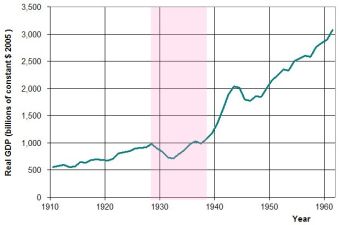
USA annual real GDP from 1910 to 1960, with the years of the Great Depression (1929–1939) highlighted.
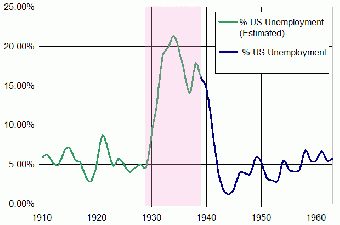
Unemployment rate in the US 1910–1960, with the years of the Great Depression (1929–1939) highlighted; accurate data begins in 1939.
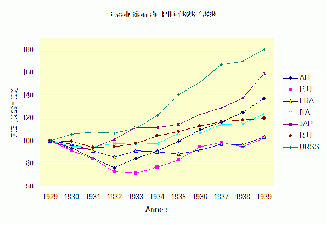
GDP growth in a number of countries between 1929 and 1939.

Annexes
- 1929-1939 : Une décennie de misère (La Grande Dépression au Canada)
- Textes sur la Grande crise des années 1930 Cliotexte.
- Souvenirs et réflexions sur l'âge de l'inflation de Jacques Rueff, économiste et ancien fonctionnaire du Trésor Français.
- Le Crach de 1929 et la grande Dépression - Comment éviter une répétition de la débâcle Keynésienne
- 1932 popular vote by counties
- How close was the 1932 election? — Michael Sheppard, Massachusetts Institute of Technology
- Foreign Affairs,. (2015). The Great Depression. Retrieved 29 October 2015, from https://www.foreignaffairs.com/articles/united-states/1932-07-01/great-depression
- When Did the Great Depression Receive Its Name? (And Who Named It?), 2-16-09, by Noah Mendel, History News Network though Hoover is widely credited with popularizing the term
- Klingaman, William K. (1989). 1929: The Year of the Great Crash. New York: Harper & Row. ISBN 0-06-016081-0.
- Harold Bierman, Jr. (April 1998). The Causes of the 1929 Stock Market Crash: A Speculative Orgy or a New Era?. Greenwood Publishing Group. pp. 19–29. ISBN 978-0-313-30629-7.
- "Market crash of 1929: Some facts of the economic downturn". Economic Times. Times Inernet. October 22, 2017. Retrieved February 16, 2019.
- "Hoovervilles and Homelessness". washington.edu.
- Carswell, Andrew T. (2012). "Hooverville". The Encyclopedia of Housing (Second ed.). SAGE. p. 302. ISBN 9781412989572.
- "Farm Security Administration/Office of War Information Black-and-White Negatives: About this Collection". Library of Congress. 1935
- Charles Kenneth Roberts, Farm Security Administration and Rural Rehabilitation in the South. Knoxville, TN: University of Tennessee Press, 2015
- James Ciment, Encyclopedia of the Great Depression and the New Deal (2001) Vol. 1 p. 6
- Indian Reorganization Act - Information & Video - Chickasaw.TV
- Texte de l’Indian Reorganization Act et de ses amendements
References
- ↑ Aline Helg - UNIGE
- ↑ Aline Helg - Academia.edu
- ↑ Aline Helg - Wikipedia
- ↑ Aline Helg - Afrocubaweb.com
- ↑ Aline Helg - Researchgate.net
- ↑ Aline Helg - Cairn.info
- ↑ Aline Helg - Google Scholar
- ↑ Per-capita GDP data from MeasuringWorth: What Was the U.S. GDP Then?